
The SIS is not the problem. The operating layer above it was never built.
American campuses own the best point solutions in the world: one system for the funnel, another for teaching, another for alerts, another for the catalogue. What nobody sells is the layer where curriculum, assessment, faculty work and clinical education share a single record, so that accreditation evidence is a by-product of the operation instead of a project. Creatrix starts with one workflow no current system owns, and extends from there.
How the American market got here
Four decades produced great instruments and no operating layer.
The best-of-breed market is not an accident of taste. It is the predictable result of four shifts, and each one made the academic record more fragmented than the year before.
The category map
Every category has a leader. None of them is the operating layer.
An honest reading of the American market: what each category of software owns, and precisely where its ownership ends.
Read one row at a time, this is a healthy market. Read together, it describes a single condition: most of these categories are reading an academic record that none of them own. That record, and the operation running on top of it, is the part nobody is selling.
Built to carry any framework
We do not ship one country’s rulebook. We ship the model underneath it.
Standards, criteria, thresholds, artefacts and review cycles are configuration rather than code. Select a piece of the model to see what it does.
Framework
Loading
Loading
How Creatrix answers it
Where American campuses lose time today
The academic workflows nobody's software actually owns.
Seven workflows that every institution runs and almost none of them run on one model. Select a workflow to see the pattern, and what changes when it sits on one record.
Of seven core academic workflows, three are still assembled by hand, three run on tools that own only part of the job, and one has no integrated system anywhere in the market.
Loading
Loading
Loading
On one record
Loading
What an operating layer has to prove
Three claims, and what each one actually requires.
These separate an institution reading reports from one running an operation. Each is easy to demonstrate in a proof session, and each depends on the record underneath rather than the dashboard above it.
Attainment is live, mid-term, not after the fact.
The windshield. The chair sees the problem while the cohort is still enrolled.Requires: assessments mapped to course and program outcomes, computed from real marks
The signal becomes an action.
Data to decision to next cohort. That is a quality culture rather than a compliance exercise.Requires: an owner, a due date and a recorded outcome inside the same system
The evidence is already there.
A live, dated, version-tracked file, not a narrative written the semester before the visit.Requires: artefacts tagged to the framework’s criteria as the work happens
Three ways institutions start
Win one problem first. The institution underneath is the same.
No American provost buys a category. They solve one urgent problem, and the second one is cheaper because it runs on the record the first one created. Choose where you would start.
For institutional effectiveness, assessment and accreditation offices
Map assessment to program outcomes once, and the criterion-tagged evidence for institutional and programmatic review is emitted from the work faculty already do, instead of being uploaded into a reporting shell each cycle.
The uncontested claim. The tools in this category report on evidence that somebody assembled by hand somewhere else.
For faculty affairs, deans and academic HR
Run recruitment, activity, annual review, promotion and tenure as one operation on one faculty record, so the dossier is assembled from real teaching, research and service rather than retyped into a reporting form.
Faculty activity reporting is solved. The faculty operation around it, the part that consumes a dean’s year, is not.
For medicine, nursing, pharmacy and allied health schools
Track rotations, competency milestones, structured clinical examinations and portfolios on one clinical record, and let competency evidence come from the clinical operation itself rather than a portfolio product plus a spreadsheet.
Nobody owns this workflow. Placement tools, portfolio products and spreadsheets divide it between them, and none of them holds the whole record.
Evidence by design
Today’s assessment spreadsheet becomes tomorrow’s reaffirmation evidence.
Assessment and accreditation is the one area where the whole category sells a reporting shell and the data underneath is still made by hand. Connecting the pipeline removes the most manual workflow on the American campus.
Daily academic work
Faculty grade against rubrics, evaluate clinical performance and record participation in the normal flow.
Outcomes attained
Course and program outcome attainment computes itself: thresholds, cohorts and per-question detail.
Evidence tagged
Attainment, improvement actions and artefacts tag to the configured criteria the moment the work happens.
Review ready
Your self-study assembles continuously, and readiness is visible long before the team arrives on campus.
Why it matters: accredited status is what federal aid eligibility rests on, which means the least automated workflow on campus is also the one carrying the most institutional risk.
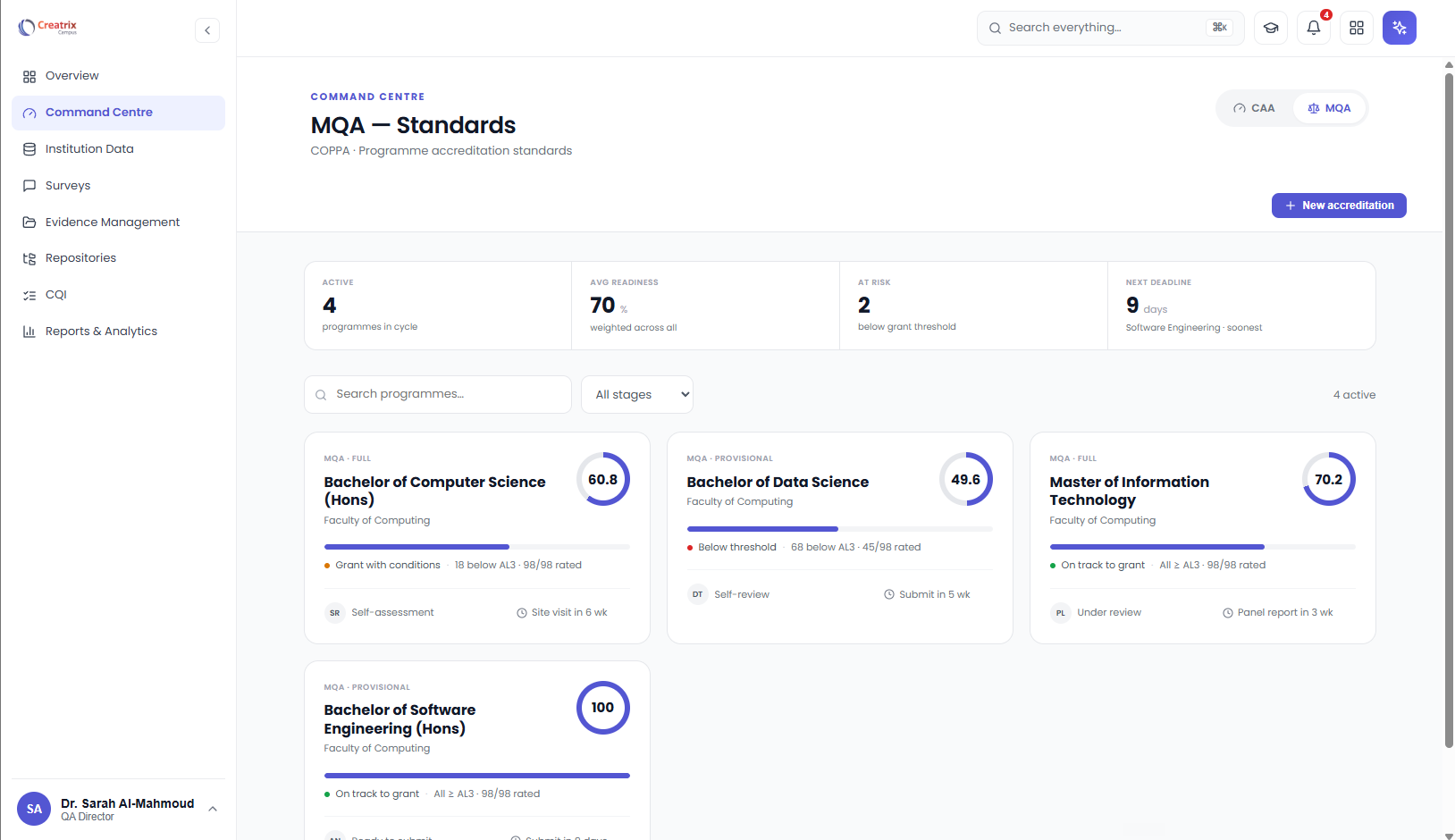 Accreditation command centre: programmes in cycle, readiness scored per programme, and a switch between frameworks. The framework shown here is one configuration of many.
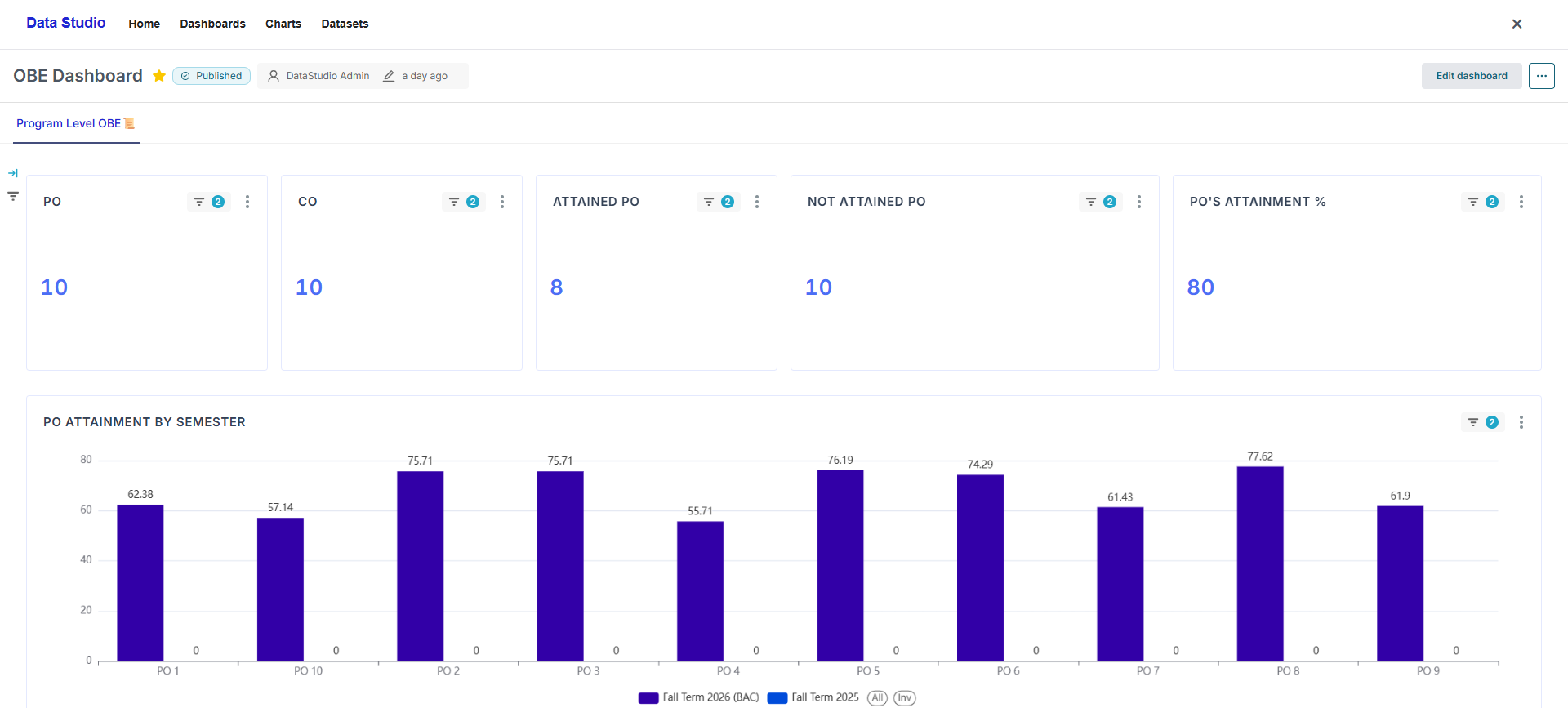 Program outcomes: attainment by term, attained versus not attained, and the course-to-program mapping matrix underneath it.
See it in the product
From outcome attainment to review-ready evidence, in one operation.
- Readiness before the visit: every programme in cycle scored against its configured criteria, with the gap list and the owner attached.
- Outcomes assessment computed from real grades: course to program mapping, thresholds and cohort views.
- Any framework: the same evidence set answers a second review without a second collection exercise.
Connect, don’t replace
Sits above the systems you already run.
An American campus already runs a student information system for records, an LMS for teaching, a CRM for the funnel and a dozen point tools around them. Creatrix replaces none of it. It is the academic operating layer above them, connected API first through Creatrix Connect.
Portfolios versus an operating system
Several vendors already sell you many products. That is not the same thing.
The strongest positions in the American market are not single products. They are families of products sold to one campus, usually assembled by acquisition and joined at the logo. Five patterns recur.
When a faculty member enters a grade, does your review evidence change?
On a portfolio the answer is no: something has to be exported, mapped and uploaded, usually by a person whose job that quietly becomes. On one record the answer is yes, because attainment, curriculum mapping and criterion tagging are the same object seen from three angles.
That is the whole difference between buying many products and running one operating system.
Creatrix is new to the United States, and we are not going to pretend otherwise or promise you a rulebook we have not implemented here. What we can say is how the system is built: accreditation standards, criteria and evidence types are configuration, so the framework your programs answer to is set up rather than developed.
Our references are universities in the UK, Ireland, Singapore, New Zealand, the Gulf, Malaysia and India, each running a different national framework on the same model. We would rather run an evaluation on two of your own programs than show you a domestic logo we have not earned yet.
United States FAQ
Questions American institutions ask.
Do we have to replace our student information system?
No. Creatrix is the academic operating layer above the student information system you already run. Records stay where they are and Creatrix connects API first through Creatrix Connect. Institutions that later choose to consolidate can, but nothing on this page depends on it.
Which accreditation frameworks does Creatrix support?
Standards, criteria, thresholds and evidence types are configuration rather than code. A framework is set up as a criteria model with its own artefacts and review cycle, which is how the same product serves very different national systems today. It also means one evidence set can answer an institutional review and a programmatic one without a second collection exercise.
Where does an American campus start?
With one academic workflow no current system owns: accreditation and outcomes assessment, the promotion and tenure operation, or clinical and competency-based education in the health sciences. Each runs on the same record, which is why the second costs materially less than the first.
How is this different from an assessment or accreditation reporting tool?
A reporting tool organises evidence that a person assembled somewhere else. In Creatrix the evidence is a by-product of daily academic work, because grading, curriculum mapping and clinical evaluation all happen on the record the reviewer eventually reads.
Is Creatrix FERPA aligned, and where is our data held?
Creatrix supports United States cloud residency with role based access, field level permissions and full audit history on views, edits and disclosures, and is certified to ISO/IEC 27001:2022 and ISO 27701:2019 with GDPR compliance.
Do you have United States customers today?
Not yet, and we will not imply otherwise. Creatrix runs at universities in the UK, Ireland, Singapore, New Zealand, the UAE, Kuwait, Malaysia and India, each under a different national framework on the same model. We would rather run an evaluation on two of your own programs than show you a domestic logo we have not earned yet.
GET STARTED
Pick the one problem worth winning first.
Bring two programs and your next accreditation cycle. We will run the evaluation on your own curriculum, your own assessment data and your own review calendar.
One workflow first · No rip and replace · Evaluated on your own programs