
Outcomes first. Accreditation follows.
The Commission for Academic Accreditation judges a UAE institution on what its students achieve, and on whether the institution can show it knows. Most campuses here can produce that evidence. The cost is a term of spreadsheet work per programme, repeated every cycle. Creatrix Campus is the Academic Operating System where outcome attainment, OBEF indicators and CAA evidence are one operation rather than three.
The spine
Everything CAA asks for at the end already exists at the start.
It exists in the marks your faculty enter. The only question is whether the chain from that mark to the standard it evidences is software, or a person with a workbook.
Outcomes are defined once
Programme and course outcomes live in the curriculum record, versioned, with the mapping between them held in one place.
Assessment measures them
Every rubric, question and mark carries the outcome it evidences, so attainment is computed rather than compiled afterwards.
Gaps become owned actions
An outcome or indicator below its band raises a corrective action with a name and a date against it. The action is itself evidence.
CAA and OBEF are answered
Attainment, actions and artefacts arrive tagged to the standard and the indicator they satisfy, with readiness visible per programme.
Why it matters here: a UAE institution is measured on learning outcomes and on weighted performance indicators at the same time. A chain that ends in a document store ends one step short of both.
Manual today
Six things UAE institutions still do by hand.
Each of these is done well by people who know their programmes. Each is also rebuilt from scratch every cycle, which is the part software should have taken over.
This is not a claim that institutions here lack discipline. There is plenty of it. It is spent assembling the record instead of running on it, and that is the cost an operating layer removes.
The UAE context
The frameworks your operation answers to.
Tap a framework to see what it asks for, and how Creatrix answers it as part of daily operations rather than as a separate compliance project.
Framework
CAA
Loading.
How Creatrix answers it
See it in the product
One mark entered. The CAA scorecard moves.
A single operation followed from a lecturer’s grade entry to the OBEF band a QA director reads before a CAA visit. Hover a marker to see what the screen is doing. The sequence loops, and you can take it over at any point.
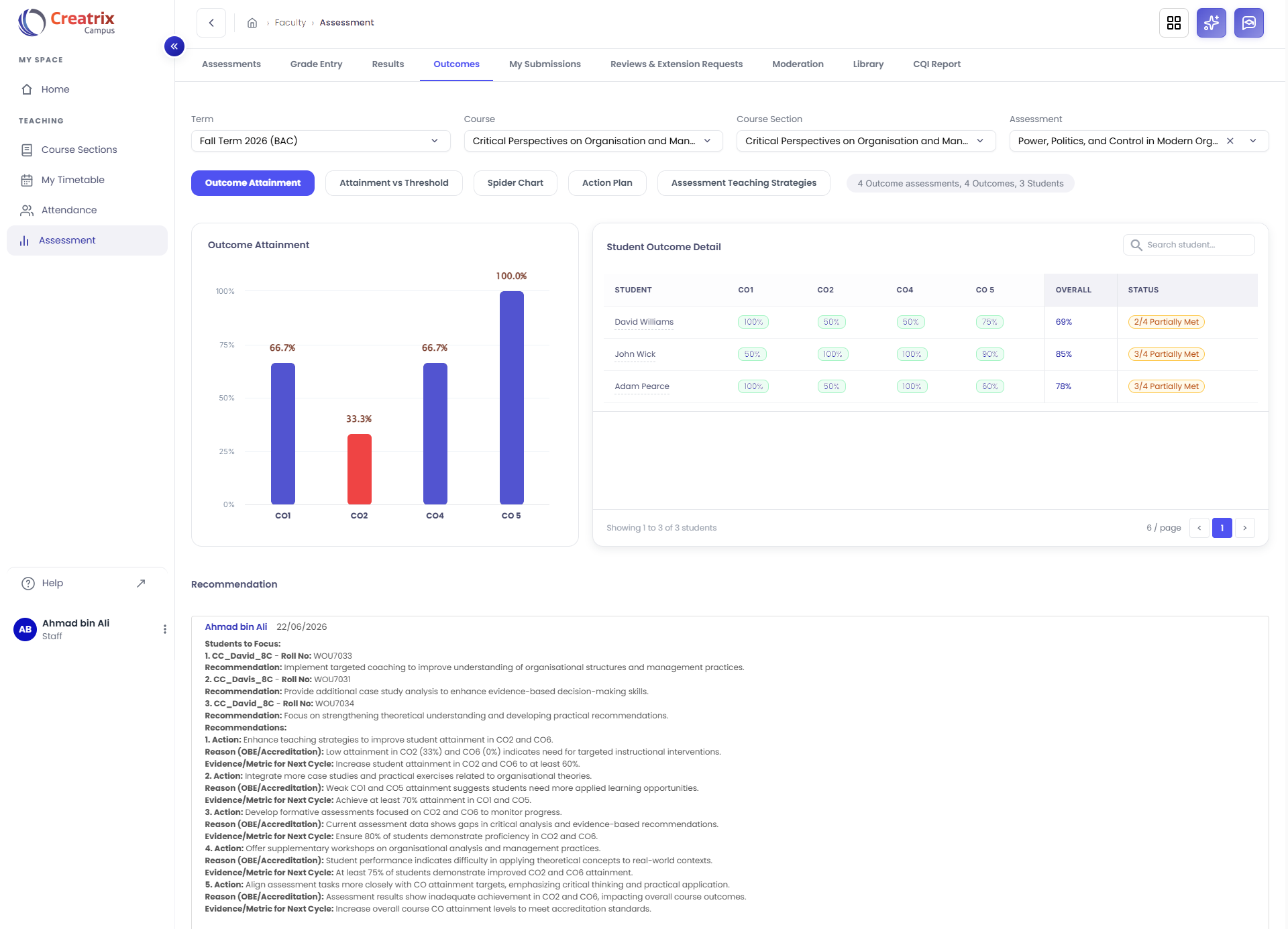 One outcome sits at 33 percent, below threshold, flagged the moment marks are entered.
Attainment per student, per outcome, so the conversation is about a person rather than an average.
The action is written against the outcome that missed, and becomes accreditation evidence on its own.
One outcome sits at 33 percent, below threshold, flagged the moment marks are entered.
Attainment per student, per outcome, so the conversation is about a person rather than an average.
The action is written against the outcome that missed, and becomes accreditation evidence on its own.
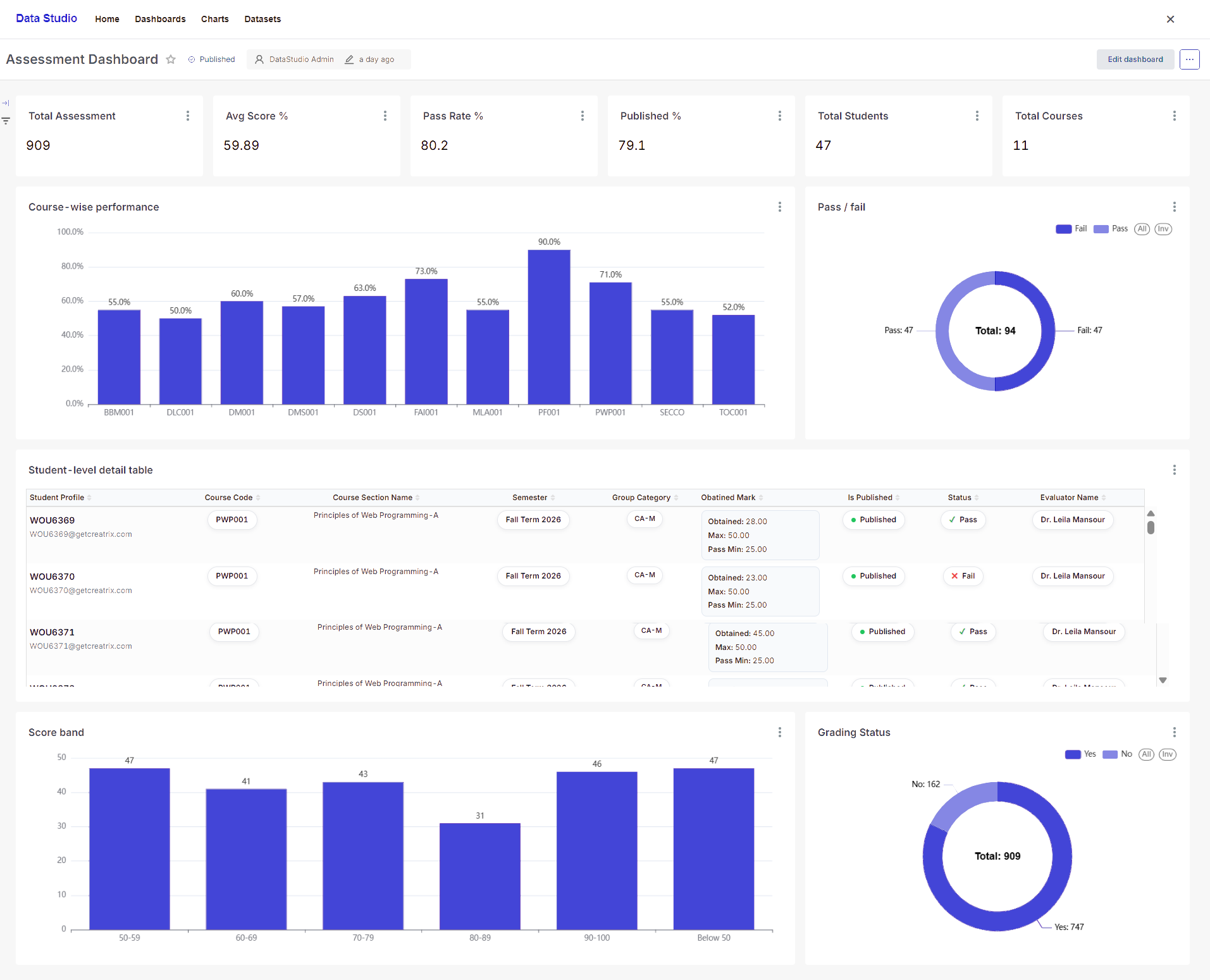 Pass rate, average score and publication state across every assessment in the term.
Performance course by course, so a weak cohort is visible before the term closes.
Student level marks with the evaluator named, so moderation has something to work from.
Pass rate, average score and publication state across every assessment in the term.
Performance course by course, so a weak cohort is visible before the term closes.
Student level marks with the evaluator named, so moderation has something to work from.
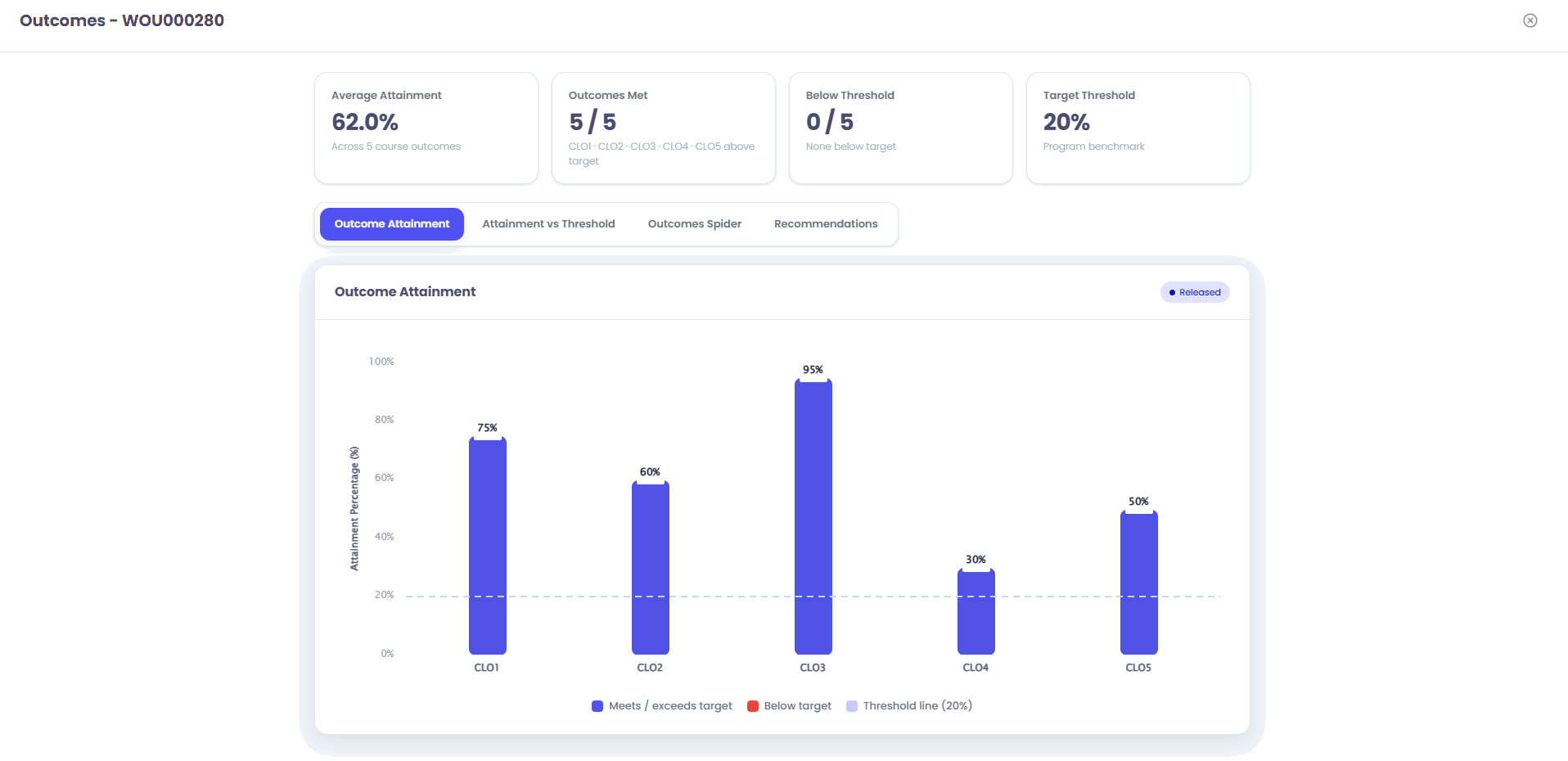 Five of five outcomes met, shown to the student rather than kept in a coordinator’s file.
Each outcome against the programme threshold, the same number the accreditation panel will read.
Five of five outcomes met, shown to the student rather than kept in a coordinator’s file.
Each outcome against the programme threshold, the same number the accreditation panel will read.
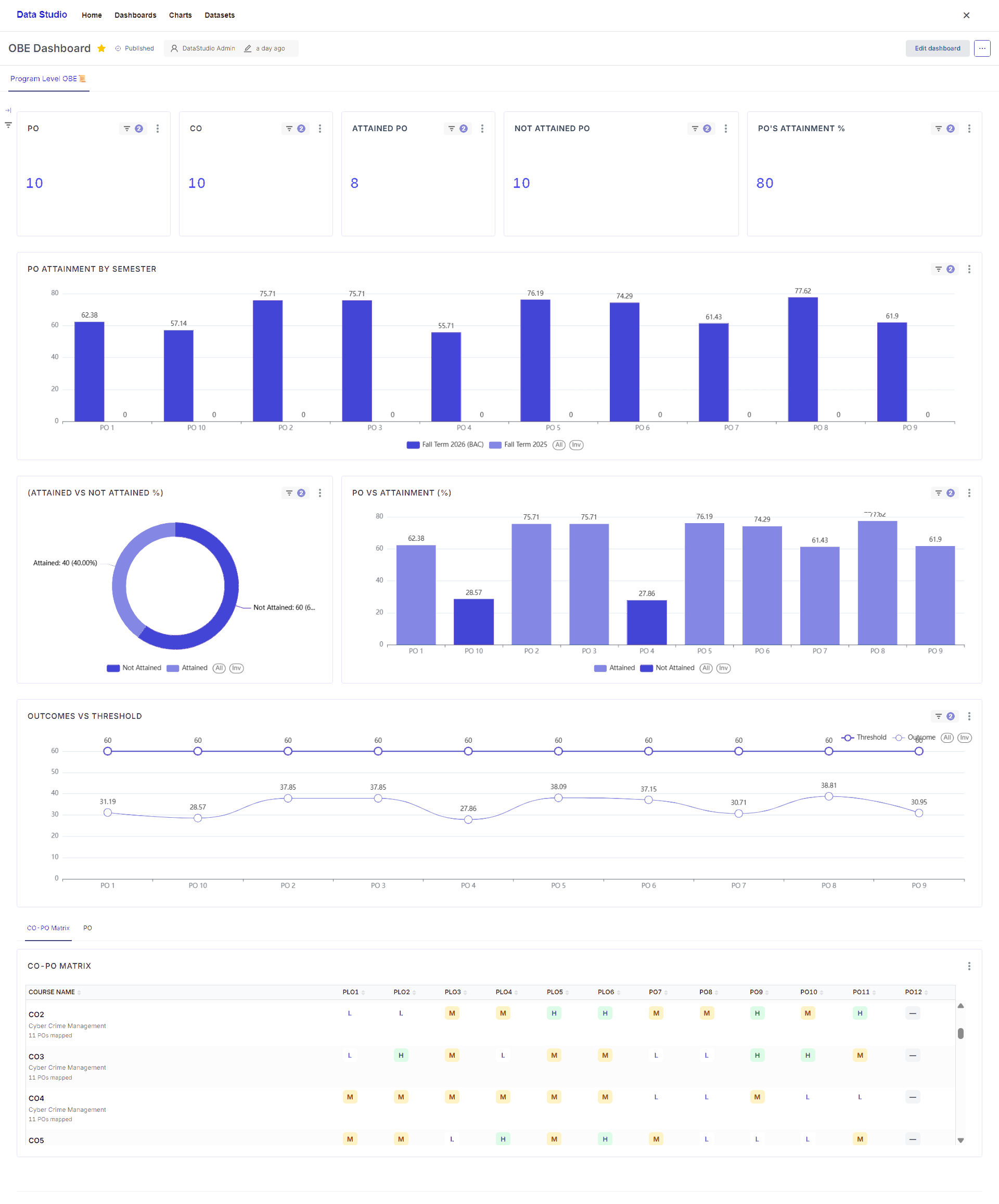 Programme outcome attainment by semester, computed from the marks rather than re-keyed from them.
Eight of ten programme outcomes attained, the number a programme committee argues over each cycle.
Every programme outcome against its threshold, generated from the curriculum rather than typed into a template.
Programme outcome attainment by semester, computed from the marks rather than re-keyed from them.
Eight of ten programme outcomes attained, the number a programme committee argues over each cycle.
Every programme outcome against its threshold, generated from the curriculum rather than typed into a template.
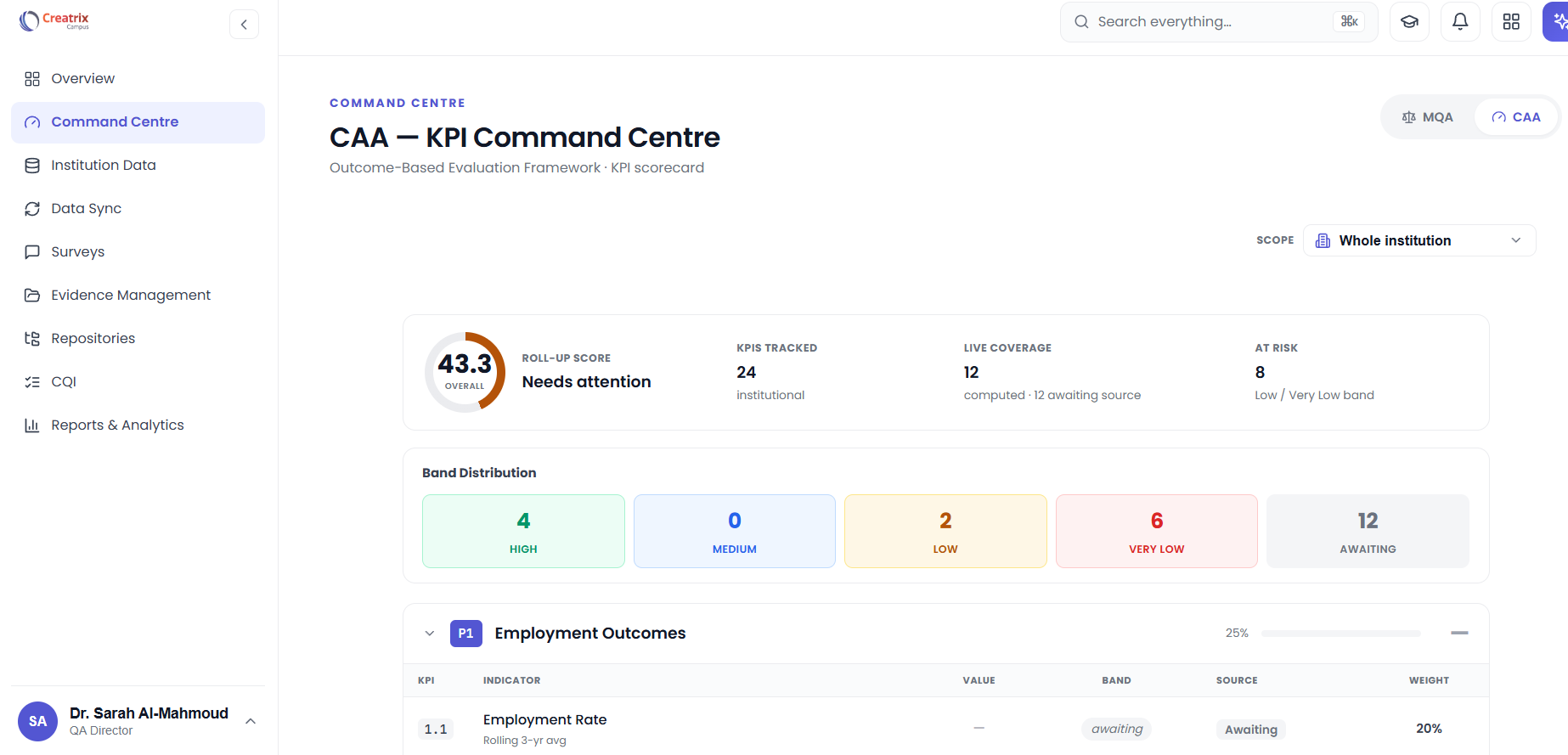 One weighted roll-up score for the institution, built from the indicators rather than asserted above them.
Coverage is stated honestly: twelve indicators computed, twelve still awaiting a source.
Every indicator lands in a band, so the argument is about which ones to fix, not about the numbers.
One weighted roll-up score for the institution, built from the indicators rather than asserted above them.
Coverage is stated honestly: twelve indicators computed, twelve still awaiting a source.
Every indicator lands in a band, so the argument is about which ones to fix, not about the numbers.
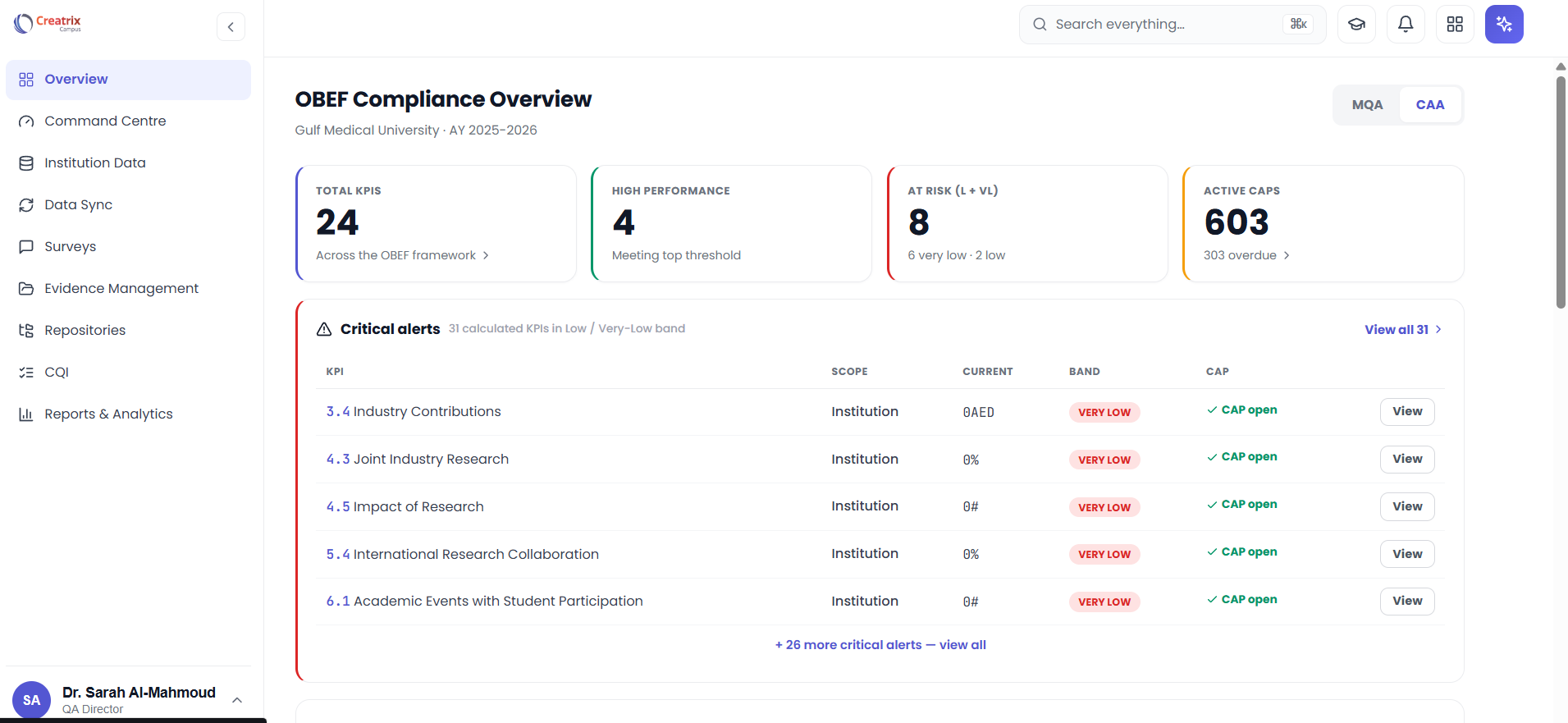 Same programmes, different framework. The rulebook is configuration, which is how one model carries CAA here and another accreditor elsewhere.
Corrective action plans counted and aged, including the overdue ones. Nothing quietly disappears.
Each indicator in a low band, with its scope, current value and an open action already attached.
Same programmes, different framework. The rulebook is configuration, which is how one model carries CAA here and another accreditor elsewhere.
Corrective action plans counted and aged, including the overdue ones. Nothing quietly disappears.
Each indicator in a low band, with its scope, current value and an open action already attached.
Faculty assessment outcomes: attainment per course outcome, with the action attached.01 / 06
Screens from the running product. The data shown is a demonstration tenant, not a customer’s.
Book a tailored proof sessionConnect, don't replace
Sits above the systems you already run.
A branch campus in the UAE runs a parent SIS in another country and answers to CAA locally. A national institution runs deep in-house systems it has no intention of retiring. Creatrix is the operating layer above both, connected API-first through Creatrix Connect, with no rip-and-replace.
Ask the institution, not the vendor.
UAE FAQ
Questions UAE institutions ask.
Is Creatrix Campus built for CAA requirements?
Yes. Programme and institutional standards are held as configuration, and the evidence a self-study cites is produced by the operations your faculty already run: outcome attainment computed from real marks, corrective actions with owners and dates, and artefacts tagged to the standard they support as the work happens.
What does Creatrix do with OBEF?
OBEF indicators are calculated from the academic record rather than collected from departments each cycle. Each one carries its value, its band, its weight and its source, and any indicator sitting in a low band raises a corrective action plan that is tracked to a recorded outcome.
We hold AACSB or ABET alongside CAA. Does that mean two evidence sets?
No. The framework is configuration over one evidence set, so the same attainment data, curriculum mapping and artefacts are read through a second accreditor’s criteria instead of rewritten into its template.
Do we have to replace our existing SIS?
No. Creatrix is the academic operating layer above what you already run: a parent SIS at a branch campus, an in-house student system, and Canvas or Moodle for delivery. It connects API-first through Creatrix Connect.
Where is our data stored?
Creatrix offers regional data residency options and is certified to ISO/IEC 27001:2022 and ISO 27701:2019, with GDPR compliance. Sovereign or on-premise hosting is available where a regulator or ministry requires it.
Do you have UAE customers?
Yes. Sharjah Education Academy runs on Creatrix, alongside universities in Kuwait, Malaysia, India and Singapore. Ask for a reference session with an institution operating under the same accreditor as you.
GET STARTED
Bring one programme, and we will map it.
Walk through your own outcomes, your OBEF indicators and your next CAA cycle with our team, on your programme rather than a demo one.
CAA · OBEF · AACSB · ABET · English & Arabic interface