
From Data to Decisions: Operationalizing AI in Institutional Effectiveness.
Institutions already have the data and the dashboards. Three higher education leaders discussed what it takes to turn that intelligence into decisions that actually change something.
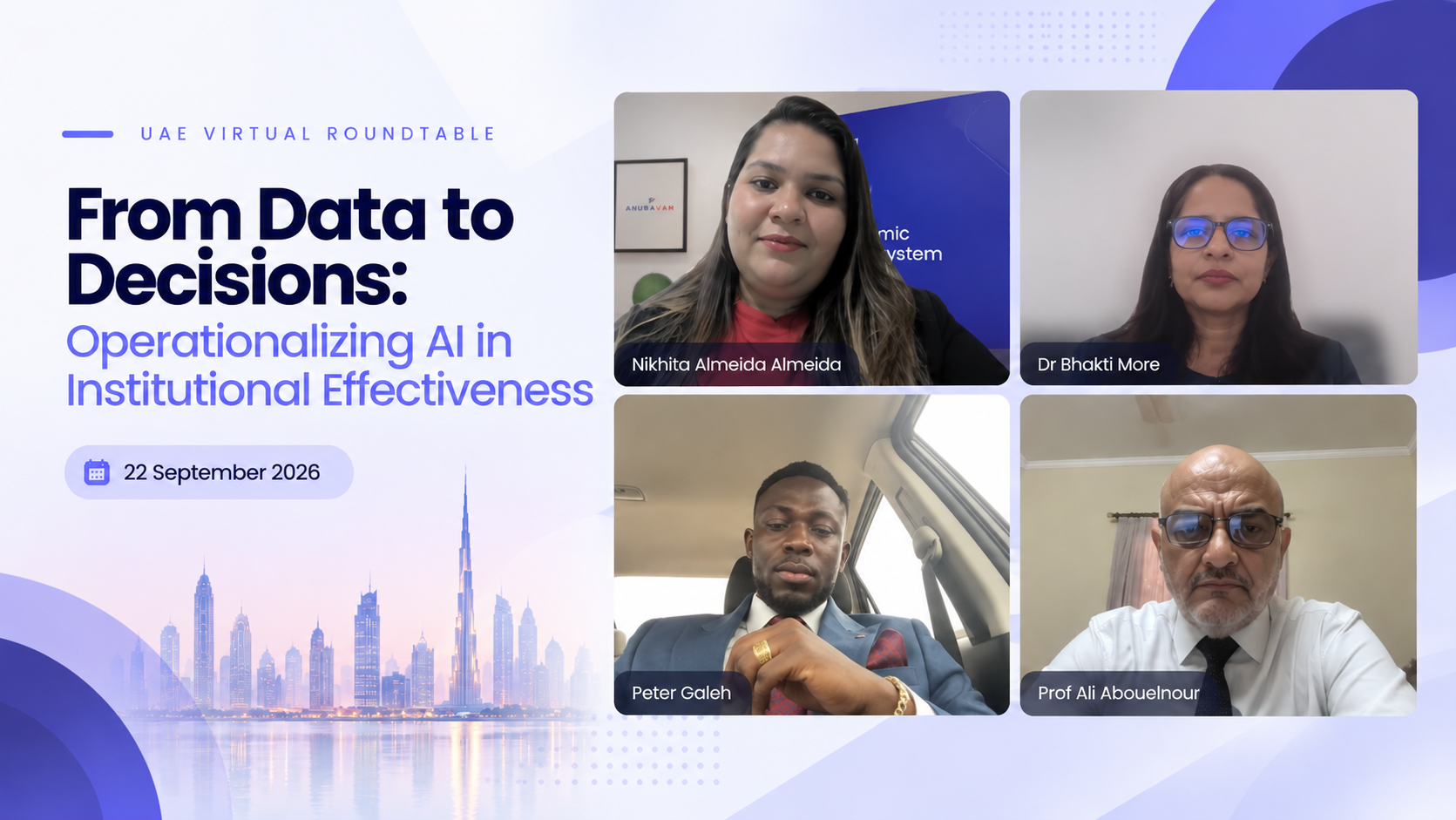
The panel in session, 22 September 2026.
AI changes an institution when it is tied to a KPI, governed by policy and trusted by the people who use it.
Universities have the data. They can build dashboards and have general AI assistants at hand. What most still find hardest is turning that data into insight someone acts on. This roundtable went one level into that gap: not whether AI belongs in higher education, but what it takes for institutional intelligence to change something.
Across the hour, the panel agreed that the technology is rarely the constraint. The constraints are a clearly defined problem, a KPI to measure against, a policy that keeps pace with use, and people who understand what the system does. What was said here feeds into the Creatrix UAE Higher Education Insights report.
On the panel
Three leaders who run the work, not just study it.
A small closed roundtable, run as an open conversation rather than a formal panel. Between them the speakers cover accreditation, university founding, ESG and new-institution building.
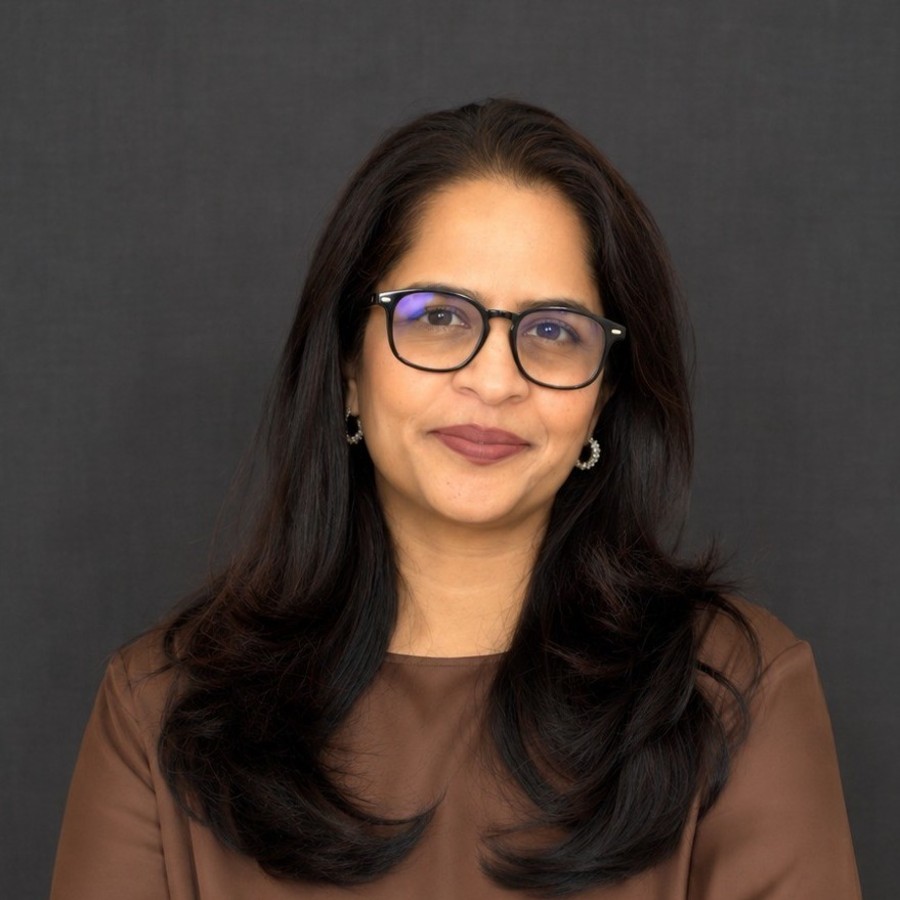
Dr. Bhakti More
Dean, School of Design and Architecture, and Head, Centre for ESGManipal Academy of Higher Education, DubaiOver three decades across academia and the design industry, focused on sustainability, ESG, climate action and the built environment. She has led MAHE Dubai's Race to Zero efforts and Team Tawazun for Solar Decathlon Middle East 2021. Her current research explores the role of AI in ESG.

Prof. Ali Abouelnour
Senior Strategic AdvisorHigher Education Transformation and University FoundingOver 28 years in academia, including 15 or more in senior leadership as Founding Chancellor, Vice Chancellor for Academic Affairs, Campus Director and Dean. He has secured licensure and accreditation for more than 50 programmes and led campus-wide digital transformation using AI and data analytics.

Mr. Peter Galeh
President and FounderCunningham Institute of Higher Education (CInHEd), AccraA Ghanaian educationist and entrepreneur whose experience spans higher education administration, international admissions, student recruitment, consultancy and institutional development. Under his leadership CInHEd has pursued collaborations across Europe, the Middle East and Africa.
Moderated byNikhita AlmeidaHead of Institutional Effectiveness, Creatrix Campus
What we worked through
Four questions, from where AI already works to where to begin.
Each question was put to the whole panel, and panellists were free to answer each other rather than the moderator.
Beyond pilots and dashboards
Where has AI become part of day-to-day work? Prof. Ali described at-risk alerts sent to academic advisors for early intervention. Dr. Bhakti described Nexora, a centre for Intelligent Systems Design where students work on live AI projects with industry mentors, and AI tools in career services for CVs and interview preparation.Prof. Ali Abouelnour, Dr. Bhakti More, Mr. Peter Galeh
Trust and resistance
How do you build trust while implementing AI, and where does resistance come from? The panel agreed that trust is a cultural outcome, earned through transparency, involvement and a clear strategy, and that resistance is mostly fear of the unknown.All panellists
Measuring impact
Not licences bought or logins counted, but what changed in decisions and outcomes. The answer was to tie AI to smart KPIs and compare them before and after it is introduced.Prof. Ali Abouelnour, Dr. Bhakti More
Where to start
One piece of advice for an institution beginning with AI. The three answers were about policy first, people first and problem first.All panellists
What we heard
The technology is ready. The institution around it usually is not.
Three findings came up again and again. The one number here was reported by a panellist from institutions he led; it is not a Creatrix figure.
An at-risk prediction model built at two institutions flagged students in academic or financial difficulty to their advisors. Retention rose from about 78% to 91 or 92%.
Source: reported by Prof. Ali AbouelnourFear of change, of being replaced, of ethics and privacy, alongside limited data literacy. Once people know what a system does, and see that it makes their work more efficient rather than monitoring them, trust grows.
Raised by all three panellistsAI arrived before the policies. Staff and students use it in every course without regulation, and models change faster than a policy can be written. Both panellists who addressed it argued for a framework-first approach.
Prof. Ali Abouelnour, Dr. Bhakti MoreIn their words
Three lines worth taking back to your leadership team.
To build trust, we need to understand what AI can do, where it can be used, and how it can improve processes. It should create workflows that are more transparent, clearer, and more data-driven. Once people understand its value, trust begins to grow.
Dr. Bhakti MoreManipal Academy of Higher Education, DubaiThe institutions that succeed with AI are not the ones that move fastest. They are the ones that establish the guardrails, define the outcomes, and align stakeholders before scaling. Strategy and policy are not barriers to innovation, they are the foundation that makes innovation real and sustainable.
Prof. Ali AbouelnourHigher Education Transformation and University FoundingIt’s not just about the technology. It’s not just about AI. It should be about identifying the problem. Once we identify the problem, we know what kind of system we need to build to solve it.
Mr. Peter GalehCunningham Institute of Higher Education (CInHEd)Measuring impact
Measure AI by what it changes, before and after, against a KPI you already own.
Start from the vision, mission and strategic goals, decide which smart KPIs AI is meant to move, and compare them before and after. These are the six metrics the panel proposed.
- 01Course and programme learning outcome attainmentAchievement of CLOs and PLOs before and after AI enters the classroom.
- 02Student satisfaction with the learning environmentStudents are the client, and programmes are being redesigned around how they learn.
- 03Employer and internship supervisor satisfactionHow the workplace rates graduates and interns, before and after.
- 04Stakeholder satisfaction with AI-delivered servicesAcademic and administrative services that AI now runs or supports.
- 05Operational time and costWhat AI removes from processing time and spend.
- 06Sustainability and campus resource allocationThe long-term effect, including ESG reporting, where data management is the hardest part.
Proposed by Prof. Ali Abouelnour, with the sustainability and ESG reporting dimension developed by Dr. Bhakti More.
Where to start
One piece of advice each, for an institution just beginning.
Without a robust strategy and clear governance, AI use becomes fragmented and inconsistent. Establish guidelines, define outcomes and align stakeholders first.
Prof. Ali AbouelnourPartner with industry, and measure impact beyond process efficiency: what the university gives back to its community through AI.
Dr. Bhakti MoreLook department by department for the real problem, then choose or build the system that solves it, with the support of the staff who do that work.
Mr. Peter GalehCommon questions
About this roundtable.
What was the Data to Decisions roundtable about?
It was a Creatrix Leaders Connect roundtable held online on 22 September 2026. The panel discussed what it takes to turn institutional data and AI-generated insight into decisions that change something inside a university: embedding AI in workflows, building trust, measuring impact and where to start.
Who spoke at the roundtable?
The panel was Dr. Bhakti More of Manipal Academy of Higher Education, Dubai, Prof. Ali Abouelnour, a senior strategic advisor in higher education transformation and university founding, and Mr. Peter Galeh of the Cunningham Institute of Higher Education in Accra, Ghana. It was moderated by Nikhita Almeida, Head of Institutional Effectiveness at Creatrix Campus.
How should a university measure the impact of AI adoption?
Measure it against smart KPIs, before and after AI is introduced, not by counting licences. The panel named course and programme learning outcome attainment, student satisfaction, employer and internship supervisor satisfaction, stakeholder satisfaction with AI-delivered services, operational time and cost, and long-term sustainability and use of campus resources.
What is the biggest barrier to AI adoption in universities?
People, not technology. The panel described fear of the unknown, fear of being replaced, limited data literacy and doubts about ethics and privacy. Their answer was transparency about what each system does, involving staff in choosing tools, building capacity through training and acting visibly on feedback.
Where will the findings from this roundtable be published?
What was said at this roundtable, and at earlier sessions in the series, feeds into the Creatrix UAE Higher Education Insights report.
Creatrix Leaders Connect
Bring the question your institution is working through.
The series continues. Suggest a topic or join a future session, and we will bring the right people to the table.