Request a QA Walkthrough

Compliance Dashboard
MQA Ready
92%Audit Ready
24Documents
8Standards Met
3Pending
MQACOPPASETARAMyRA
ISO 9001 evidence uploaded2m
MQA compliance verified15m
COPPA review in progress1h

Accreditation should be generated by how you operate, not assembled the month before the visit.

If your teams chase evidence close to deadlines, the gap is usually not effort. It is structure, ownership, and visibility (struktur, pemilikan dan keterlihatan).

Accreditation becomes a special project

Work spikes, stress rises, and governance turns reactive when readiness lives in a rush window.

Evidence ownership is unclear

Without named accountability, QA teams end up chasing bukti, version history, and approvals across too many places.

Leadership visibility arrives too late

Status updates are manual, delayed, and hard to trust when they are built from scattered files.

Knowledge stays with individuals

When staff leave or change roles, institutional memory and audit history become fragmented.

The Command Centre

Every programme's MQA readiness, on one screen.

Weighted readiness, at-risk programmes and the next deadline, live, with a per-programme score, stage and evidence status you can act on today.
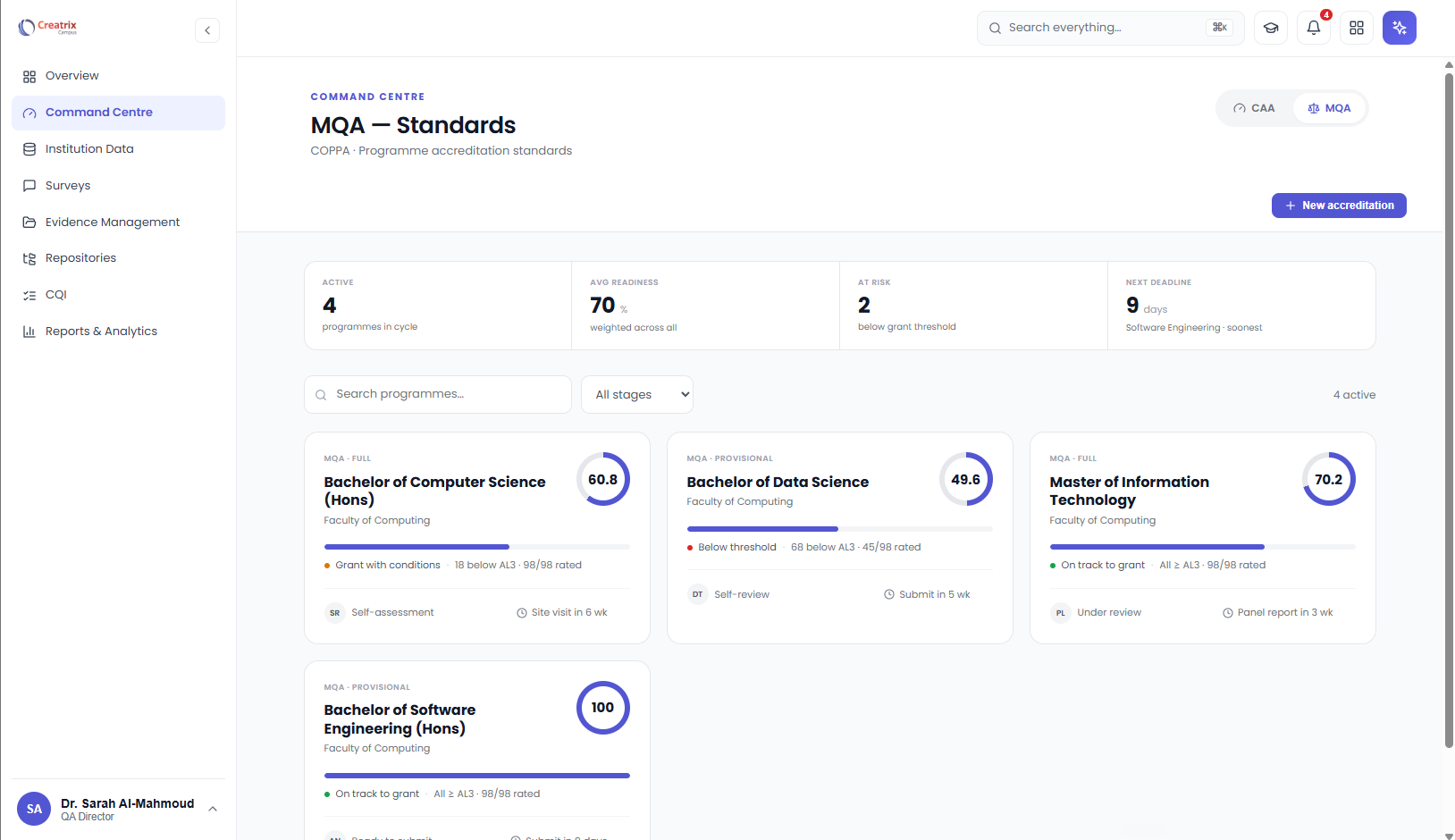
app.creatrixcampus.com / command-centre
Accreditation dashboard showing faculty contributors, submitted evidence, criteria progress and programme status
Weighted readiness scoringPer-programme stage & deadlineAt-risk alertsCAA / MQA toggle

Most Malaysian universities do not have a QA effort problem. They have an evidence flow problem.

Fragmented evidence systems increase risk across compliance, reporting, and confidence during reviews.

Simple realityWhen readiness is manual, quality becomes episodic. When readiness is structured, quality becomes continuous.
01

Evidence lives across drives, emails, and WhatsApp groups

Files exist across drives, email threads, and WhatsApp groups, but traceability and version control do not.

02

Readiness spikes before audits, then drops between cycles

Teams spend weeks compiling instead of strengthening readiness between cycles.

03

Progress depends on manual follow-ups instead of structured ownership

When accountability is unclear, readiness moves only when someone keeps chasing it.

Why stitched evidence systems break during MQA cycles.

The real choice is not tool versus tool. It is reactive preparation versus continuous readiness.

Fragmented approach

Reactive
  • Multiple folders, formats, and owners
  • Manual follow ups drive progress
  • Version confusion close to submission
  • Status updates are hard to trust
VS

Structured readiness approach

Continuous
  • One repository with clear ownership and audit trails
  • Workflow based tracking and accountability
  • Controlled version history and approvals
  • Live readiness view by standard, programme, and faculty

Built around Malaysia’s compliance reality, not generic accreditation language.

Your QA work often needs to align across programme documentation, internal governance, and national reporting expectations (pematuhan dan tadbir urus).

Frameworks

MQA
COPPA
IQAF 2025
SETARA
MyRA
MOHE

Connected local systems

PTPTN
LHDN e-invoicing
SST
PDPA 2010

Data protection aligned to PDPA 2010, backed by our ISO/IEC 27001 information-security certification.

Focused on Malaysian higher education and MQA readiness, working alongside QA teams through real accreditation cycles.

Common questions we hear in Malaysia

  • How do we reduce the weeks spent preparing for reviews?
  • How do we keep evidence updated between cycles, not only before submission?
  • How do we improve readiness without increasing admin load?

Review preparation often runs for weeks and pulls in multiple faculties, programme teams and support units at once, so the coordination load is as heavy as the documentation itself.

Who this supports

QA and accreditation teams, programme leadership, Deans, Registrars, institutional planning, and ICT teams who need a shared system of record for evidence and readiness.

Outcome-based education

OBE evidence that MQA panels actually ask for.

MQA reviews turn on demonstrated attainment, not intent. Creatrix pulls CLO, PLO and PEO attainment continuously from assessment, so the number in your programme review is the number in your system, traceable to the marksheet behind it.

  • CLO to PLO to PEO mapping maintained as configuration
  • Attainment computed from real assessment data, not manual tallies
  • Continuous quality improvement loop closed with every cycle
CLO

Course Learning Outcomes

Assessed per course, mapped to rubrics

88%
PLO

Programme Learning Outcomes

Aggregated across courses and cohorts

84%
PEO

Programme Educational Objectives

Tracked against graduate attributes

81%

Reduce Risk. Increase Readiness. Without Adding More Admin.

Practical outcomes that strengthen audit confidence across faculties and programmes.

One evidence repository

Centralised repository with clear ownership, version history, and audit trails across faculties and programmes.

Readiness tracking by standard and programme

Identify gaps early and keep programme teams aligned to milestones with real-time visibility.

Continuous quality workflows

Embed evidence capture into normal academic workflows instead of separate audit preparation cycles.

How Structured Accreditation readiness works in practice

A structured process your teams can run year-round, not just during audit season.

01

Map standards to evidence sources

Bind each MQA and COPPA criterion to the data that proves it, once, and assign an owner by faculty, programme, and unit. Set up as configuration, not a rebuild each cycle.

02

Capture evidence continuously

Embed evidence capture into everyday academic workflows with full traceability and version control.

03

Track readiness in real time

Gaps show up every day against each criterion, not the week before the visit, across COPPA areas and internal checkpoints.

04

Assemble review-ready submissions

The self-study and portfolio assemble from tagged evidence, source-linked and editorially owned, ready to validate.

Operational credibility that stands up to scrutiny.

Clear ownership. Faster evidence access. Structured programme oversight.
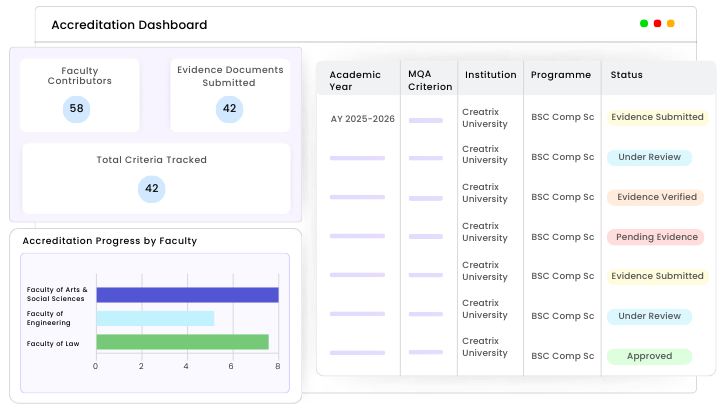
Command Centre · MQA Standards
Accreditation dashboard — faculty participation, documents, metrics and programme-wise readiness

Metrics and credibility signals

  • Clear ownership of evidence and review responsibilities
  • Real-time visibility into programme readiness status
  • Audit trails and version history across submissions
  • Reduced cross-department coordination during reviews
  • Faster documentation retrieval across faculties
  • Concurrent tracking of multiple programmes and frameworks

Built for every role in the cycle

One system of record, a view for every stakeholder.

The Quality module gives each role the exact view they need, from institutional oversight down to programme evidence.

QA / Accreditation Director

Institution-wide readiness at a glance, with drill-down to any programme, standard or gap.

Vice-Chancellor / Provost

Board-ready readiness and risk signals across the institution, without waiting on manual reports.

Deans

Faculty-level progress by programme and standard, with clear ownership across departments.

Department Heads

Accountable for their unit's evidence, they see exactly what is complete, thin or missing.

Programme Coordinators

Own CLO-PLO mapping and evidence capture inside everyday workflows, not a separate sprint.

Faculty & ICT teams

Contribute evidence and integrations securely, with role-based access and full audit trails.

Trusted by universities in the UAE, Malaysia, India and Singapore

Loading…

Malaysia FAQ

Common Questions from Malaysian QA Leaders

Straight answers on frameworks, data, integrations and what changes for your teams.

It covers MQA and COPPA, and the same evidence extends to SETARA, MyRA and MOHE reporting. Evidence is generated once and reused across frameworks, so you map it a single time instead of rebuilding it for each review.
IQAF 2025 programme standards and areas of evaluation are mapped as configuration in the standards engine. When MQA updates a criterion, it is a rule change rather than a rebuild, and evidence you already hold re-maps to the new structure.
As documents and records enter the system, AI reads them and suggests the standards, criteria and programmes each piece of evidence supports, along with the right owner. Your QA team reviews and confirms the tags, so the classification is fast but stays under human control and fully auditable.
Evidence is stored once and mapped to many criteria at the same time. A single record, such as a programme review or assessment result, can satisfy the relevant MQA, SETARA, MyRA, AACSB or AUN-QA criteria simultaneously, so you map it once instead of duplicating it for each framework.
Programme evidence and attainment aggregate automatically into faculty and institution-level views. Leadership sees a single institutional readiness picture built from the same programme records, with drill-down to any programme, standard or piece of evidence behind the number.
Compliance is the floor. Beyond meeting criteria, Creatrix closes the loop with continuous CLO-PLO-PEO attainment tracking, trend analysis and improvement actions, so review findings feed real change rather than a one-off submission. Quality becomes continuous instead of episodic.
Evidence is captured inside everyday academic workflows, so there is no separate compilation sprint before a review. Clear ownership by faculty and programme replaces the manual chasing that usually falls on the QA office.
Data protection is aligned to PDPA 2010 and backed by our ISO/IEC 27001 information-security certification, with role-based access and audit trails across every submission.
Yes. PTPTN and LHDN e-invoicing with SST are supported, and the platform works as a shared system of record that coexists with the tools your faculties already use rather than replacing them.
Structured ownership and live tracking start from day one. Most teams see readiness visibility improve within the first cycle, rather than waiting for the next audit window.