
On this page
Admissions teams are often asked to shorten decision times.
The obvious response is to make reviewers work faster.
But that assumes the reviewer is where the delay begins.
Often, it begins much earlier.
A file reaches review without a required document. An eligibility condition still needs clarification. A programme requirement has not been resolved. The wrong reviewer receives the application. A straightforward case sits beside one requiring specialist academic judgement.
The reviewer opens the file, stops, asks a question, sends it back, waits for an update, and returns later.
Multiply that across hundreds or thousands of applications and the review queue begins to look slow.
The problem is not always reviewer speed. It is how much unfinished work reaches the reviewer.
A faster admissions process therefore begins by making applications decision-ready before valuable human attention is used.
Quick answer
Admissions review becomes faster when the institution determines application completeness, eligibility status, unresolved exceptions, review ownership, and next-step readiness before human judgement begins. The goal is not to automate the admissions decision. It is to remove avoidable triage so Admissions and academic reviewers spend their time on cases that genuinely require interpretation, judgement, or approval.
Article summary
| Problem | Reviewers spend time resolving incomplete files and routine readiness questions during the review itself. |
| Who this is for | Admissions Directors, Enrollment leaders, Registrars, Academic Reviewers, Compliance teams, Deans, and CIOs. |
| What changes | Admissions moves from review-time triage to readiness-led review. |
| Why it matters | Every false start adds waiting time without moving the applicant closer to a decision. |
| Outcome | Cleaner queues, better use of reviewer time, stronger decision traceability, and shorter applicant waiting periods. |
Key takeaways
- Faster admissions review should come from better preparation, not rushed judgement.
- Reviewers should not be the first people identifying routine completeness problems.
- Eligibility rules need consistent application while exceptions remain visible for human review.
- Review ownership should become clear before the file enters another queue.
- A strong review process preserves the reasoning behind decisions as they happen.
Why This Matters
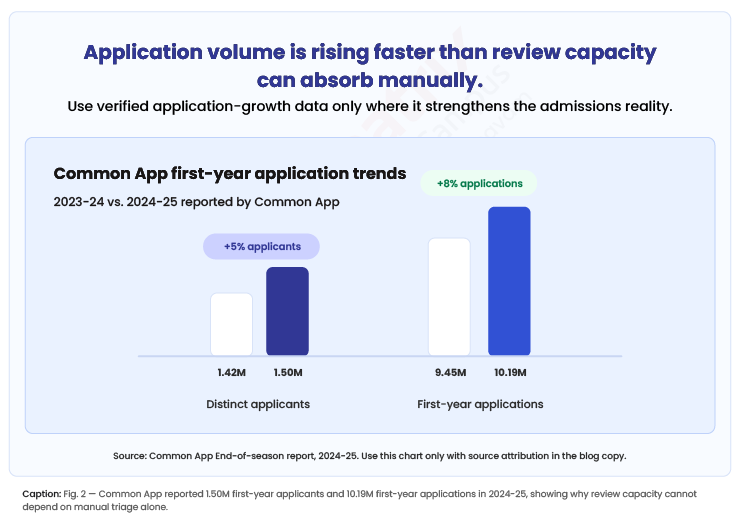
Admissions review sits where applicant experience, institutional policy, academic judgement, and enrollment pressure meet. Common App reported 10,193,579 first-year applications from 1,498,199 applicants in 2024–25, illustrating the scale admissions teams can face during peak periods. As volume increases, the strategic question is not simply how many files reviewers can process each day, but how much time they spend reviewing applicants rather than preparing applications for review.
Why Review Speed Breaks Before Review Begins
Consider two applications entering the same review queue.
The first has verified documents, clearly satisfied basic requirements, the appropriate programme context, and no unresolved exception.
The second appears complete but has one uncertain document, a programme-specific eligibility question, and an exception requiring clarification.
Both may be labelled “ready for review.”
They are not equally ready.
When readiness is unclear, reviewers become investigators before they can become decision-makers. Files move backwards. Clarification requests multiply. Applications are opened several times instead of once.
This creates one of the quietest forms of admissions delay: false starts.
The application appears to have entered review, but no meaningful decision work can yet happen.
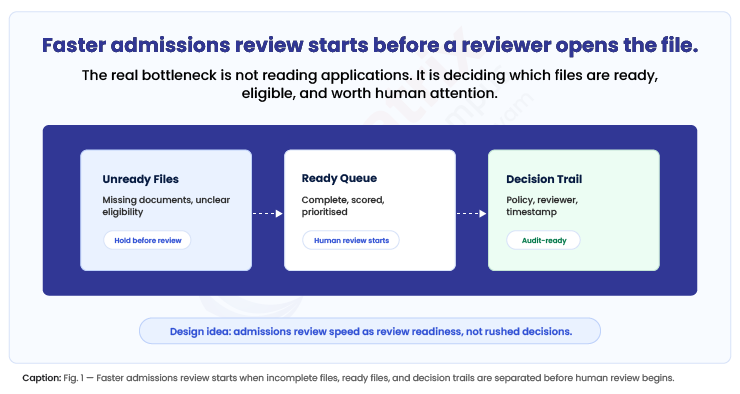
A stronger workflow separates:
Application received → Application ready → Human review → Decision
rather than treating submission itself as permission to enter the review queue.
Where Admissions Teams Lose Time
The biggest delays are often made up of small activities repeated at scale.
| Hidden review work | What it does to the queue |
| Checking whether documents are complete | Uses reviewer time before judgement begins |
| Reinterpreting routine eligibility rules | Creates inconsistent handling and repeated questions |
| Sending unclear cases between teams | Adds waiting between every handoff |
| Searching for the latest applicant update | Forces staff to reconstruct current status |
| Deciding manually what should be reviewed first | Makes priority dependent on individual judgement |
| Rebuilding the reason behind an earlier decision | Creates compliance work later |
None of these activities feels enormous.
That is precisely why they survive.
But ten minutes of avoidable triage repeated across thousands of applications becomes a significant operational burden.
For applicants, that burden appears differently.
They see another day without a decision, another request for information, or another status that has not changed.
Internal friction becomes applicant waiting time.
Why Readiness Must Come Before Human Judgement
Not every part of admissions review requires the same kind of thinking.
Checking whether a required document is present is not the same task as deciding whether a candidate is academically suitable for a competitive programme.
Confirming whether a defined eligibility condition has been satisfied is different from interpreting an unusual qualification, reviewing a scholarship case, or considering an approved exception.
Institutions should protect that distinction.
Routine readiness work can be structured through defined checks, rules, workflow states, and routing. Cases requiring interpretation can then reach the appropriate human reviewer with enough context to make the decision.
This is also where AI and automation need boundaries.
Creatrix Campus applies automation within governed processes and keeps people in control of AI-supported decisions. AI or workflow automation can assist institutional decisions, but human oversight remains part of governed decision-making.
The goal is therefore not:
“How much of admissions can we remove people from?”
It is:
“Which work genuinely needs their judgement?”
A good review workflow does not replace the reviewer.
It protects the reviewer's attention from work that should already have been settled.
What a Faster Review Model Should Show
Admissions leaders should be able to look at the review pipeline and understand more than how many applications are waiting.
They should be able to distinguish:
- applications that are still incomplete,
- complete files requiring verification,
- applications that satisfy routine eligibility conditions,
- cases containing unresolved exceptions,
- applications ready for academic judgement,
- applications awaiting a particular reviewer or decision,
- cases whose previous decisions and approvals remain traceable.
That creates a very different review queue.
Instead of one large pile labelled pending, the institution sees the state of the work.
In practice, every application should have a clear status, every transition should follow defined rules, and every decision should leave a traceable record.
The connection with the student information system also matters because the admissions decision is not the end of the applicant's institutional journey.
An admitted applicant will soon become a student record. Eligibility will influence registration. Programme information will become academic context. Financial and enrollment processes will follow.
A clean admissions decision creates a cleaner starting point for everything that comes next.
Where Creatrix Campus Fits
Creatrix Campus connects the admissions journey from prospect and application through decision, offer, and enrollment. Approvals and routing follow defined workflows, while institutional policies guide how requirements and exceptions are handled. That means application status, document readiness, eligibility context, reviewer ownership, decision history, and the transition toward enrollment don't behave like separate administrative events.
Admissions teams get a clearer distinction between work still being prepared and work genuinely ready for review, academic reviewers receive better-prepared cases with less routine checking, and registrars and institutional leaders can follow important decisions more easily because approvals and exceptions are part of the workflow rather than personal knowledge that has to be reconstructed later. Once the admission decision is complete, that context can continue into student lifecycle management instead of ending at another system boundary.
The result should not be rushed admissions. It should be fewer applications wasting time in a queue they were never ready to enter.
Conclusion
Faster admissions review is not primarily about asking people to make important decisions more quickly. It is about removing the avoidable work surrounding those decisions so reviewers begin with files that are complete, understandable, appropriately routed, and ready for judgement.
If you opened your admissions review queue today, how many applications are truly waiting for a decision, and how many are actually waiting to become decision-ready? Build faster admissions review readiness.
Quick recap
Admissions review slows when incomplete files, routine eligibility questions, unresolved exceptions, and unclear ownership reach human reviewers too early. A stronger model establishes readiness before review, keeps important decisions traceable, and reserves human attention for the cases where judgement genuinely matters. The fastest review queue is not the one where people read faster. It is the one with fewer false starts.
Frequently asked questions
Why do admissions application reviews take so long?
Does faster admissions review mean making quicker decisions?
What should happen before an application reaches academic review?
Can admissions review be fully automated?
Why is the admissions decision trail important?
How can Creatrix Campus support admissions review readiness?
Join the conversation
Want to contribute?
We welcome thought leaders to share ideas and write for our blog.
Become a guest author