
On this page
Faculty performance reviews rarely fail because universities have no criteria.
They become difficult because the criteria are applied to work that is only partly visible.
One faculty member may carry a heavy teaching and advising load. Another may have stronger research expectations. Someone else may contribute extensively through curriculum redesign, accreditation work, committees, mentoring, or academic leadership.
By review time, a few outputs are easy to see. Much of the work behind them is not.
That is where credibility starts to weaken.
Faculty performance transparency should not mean watching faculty more closely. It should mean making expectations, contribution, workload, and evidence visible enough for both faculty and leadership to understand how a judgement was reached.
Quick answer
Faculty performance transparency fails without workload context because outputs alone cannot explain contribution fairly. Teaching, research, advising, service, administrative responsibilities, and institutional work need to be interpreted alongside the workload and expectations under which they were performed. Transparent evaluation therefore requires shared criteria, contextual evidence, and visibility into the work behind the result.
Article summary
| Problem | Faculty reviews can rely on visible outputs while missing important differences in workload and institutional contribution. |
| Who this is for | Deans, HoDs, Faculty Affairs, Academic Affairs, Provost offices, HR leaders, and Faculty Review Committees. |
| What changes | Evaluation moves from comparing outputs to understanding contribution in context. |
| Why it matters | A review loses credibility when faculty and reviewers cannot see the same workload, criteria, and supporting evidence. |
| Outcome | Fairer conversations, clearer development decisions, and fewer disputes about how performance was judged. |
Key takeaways
- Transparency is about clarity, not surveillance.
- Workload context is essential to interpreting faculty performance fairly.
- Teaching, research, advising, service, and institutional contribution should not be judged as isolated numbers.
- Faculty and reviewers need access to a consistent evidence base.
- The goal is not to eliminate academic judgement, but to make that judgement easier to explain and defend.
Why This Matters
Faculty evaluation influences promotion, recognition, professional development, workload planning, morale, and institutional trust. Yet some forms of academic contribution are far easier to document than others.
Research outputs may be clearly recorded. Teaching may be reduced to a few indicators. Advising, mentoring, curriculum work, committee responsibilities, accreditation contributions, and administrative duties may be known locally but not represented consistently in the review.
AAUP discusses teaching, research, and service as traditional areas of faculty evaluation, while their interpretation and weighting differ across institutional contexts.
That variation is exactly why context matters.
A review can follow the same process for everyone and still produce an unfair comparison if the work being compared was fundamentally different.
Why Transparency Without Context Becomes Unfair
Performance dashboards can easily create the appearance of objectivity.
Who published more? Who taught more courses? Who received stronger student feedback? Who contributed more service?
Those questions may provide useful evidence, but none is sufficient on its own.
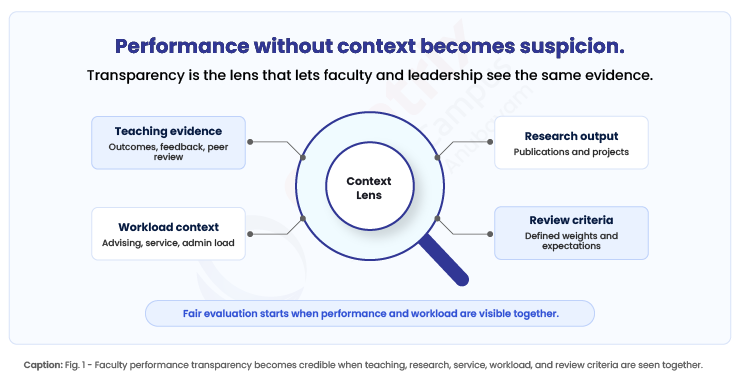
Consider two faculty members with different teaching loads, cohort sizes, course intensities, advising responsibilities, research expectations, committee assignments, and administrative duties. Their outputs cannot be interpreted responsibly without understanding those differences.
That is why faculty workload visibility belongs inside the performance conversation rather than beside it.
| Visible output | Context needed to interpret it |
| Teaching volume | Course type, intensity, cohort size, delivery responsibilities |
| Student feedback | Course context, cohort characteristics, and broader teaching evidence |
| Research output | Role expectations, discipline, career stage, allocated research time |
| Advising | Number and complexity of assigned students |
| Service | Committee, governance, accreditation, mentoring, and institutional responsibilities |
Transparency without context can become measurement. Transparency with context becomes explanation.
What Faculty Performance Reviews Often Miss
Universities tend to capture the parts of academic work that are easiest to count.
Research may appear through publications, grants, projects, or citations. Teaching evidence may include course assignments, student feedback, assessment activity, or peer review.
Service is often less visible despite consuming significant academic time. Curriculum redesign, accreditation support, student mentoring, programme leadership, committee responsibilities, outreach, and other forms of institutional contribution may remain scattered across records or depend on people remembering who did what.
This does not mean every contribution should be converted into a numerical score.
In fact, that can create another problem.
Assessment evidence and other academic data can strengthen a performance conversation when used responsibly, but they should provide context for judgement rather than become shortcuts for judging people.
A credible review should make the shape of a faculty member’s contribution visible, not flatten it into one number.
What Fair Evaluation Needs to Make Visible
A stronger review model needs five things working together.
Clear expectations. Faculty should understand which areas matter for their role and how those expectations differ by discipline, appointment, career stage, or institutional responsibility.
Workload context. Reviewers need to see the teaching, advising, service, and administrative responsibilities surrounding the outputs they are evaluating.
Relevant evidence. Teaching, research, service, advising, development, and institutional contribution should be supported by evidence appropriate to the work.
Contextual interpretation. Identical output expectations do not automatically make sense across very different faculty roles.
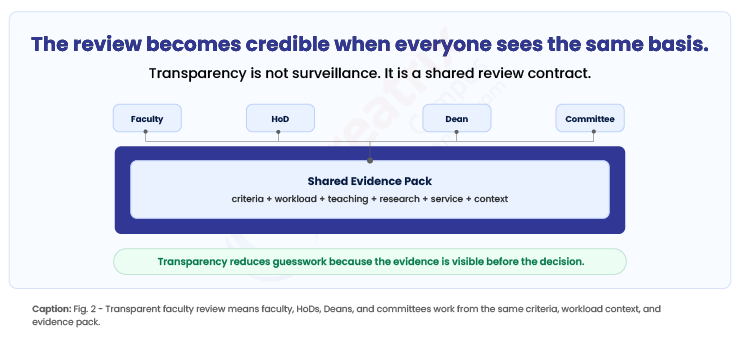
A shared evidence base. Faculty members and review committees should not enter the conversation working from different versions of the record.
The principle is simple:
Consistency should mean applying a clear evaluation logic consistently, not pretending every faculty role is identical.
Where Creatrix Campus Fits
This is where Creatrix Campus becomes relevant.
Not as a faculty surveillance system, but as a way to connect the institutional evidence needed for more contextual performance conversations.
Creatrix Campus connects faculty workload, teaching assignments, research activity, service contribution, advising, development goals, performance criteria, and review evidence within a connected faculty operating model.
For HoDs and Deans, that can provide better workload and contribution context before review. For Faculty Affairs and review committees, it can create a more consistent evidence base. For faculty members, the important benefit is greater clarity around what is being considered and how their work contributes to the review.
The value is not more data about faculty.
It is a more credible basis for discussing faculty contribution.
Conclusion
Faculty performance transparency is not achieved by making more activity visible. It comes from helping faculty and leadership understand expectations, workload, evidence, and contribution in the right context.
If a faculty member challenged a review decision tomorrow, could the institution clearly explain not only the score or rating, but the workload, evidence, and judgement behind it? Explore fair faculty performance visibility with Creatrix Campus.
Quick recap
Faculty evaluation becomes difficult when visible outputs are separated from the workload and responsibilities that produced them. A stronger model brings criteria, teaching, research, service, advising, institutional contribution, and workload context into the same conversation. The goal is not to remove academic judgement or reduce faculty work to numbers. It is to make important judgements clearer, fairer, and easier to defend.
Frequently asked questions
What is faculty performance transparency?
Is faculty performance transparency the same as monitoring?
Why does workload context matter in faculty evaluation?
What evidence can contribute to faculty performance review?
How can transparency reduce faculty review disputes?
How can Creatrix Campus support faculty performance transparency?
Join the conversation
Want to contribute?
We welcome thought leaders to share ideas and write for our blog.
Become a guest author