
On this page
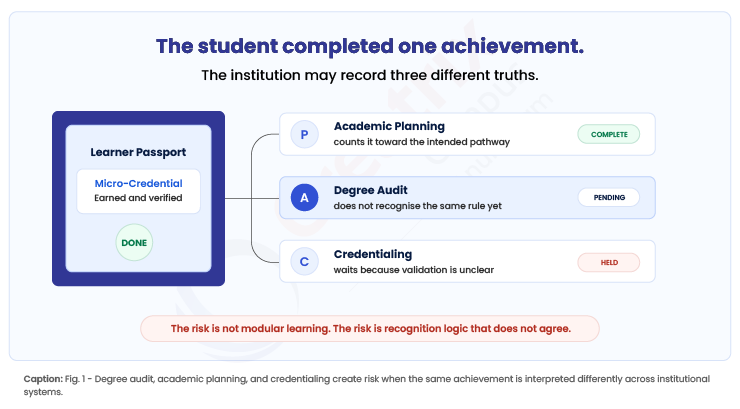
A student completes a micro-credential.
The academic plan says it fits the pathway. Degree audit still shows a requirement outstanding. Credentialing cannot issue the award because another validation step is missing.
The student has completed the learning.
The institution has not agreed on what that learning means.
That problem becomes more serious as universities introduce micro-credentials, stackable certificates, transfer pathways, competency-based recognition, interim awards, and other flexible forms of learning.
Traditional processes were built around a simpler sequence: plan the degree, complete the requirements, audit the record, issue the credential.
Recognition now happens throughout the journey.
The challenge is therefore no longer simply creating more credential options. It is ensuring that academic planning, degree audit, and credentialing recognise the same achievement through the same academic rules.
Quick answer
Degree audit, academic planning, and credentialing can no longer operate separately because students increasingly earn learning in modular and stackable forms before final degree completion. Institutions need common academic rules so the pathway a student is advised to follow is the same pathway degree audit validates and credentialing ultimately recognises.
Article summary
| Problem | Planning, audit, and credentialing can interpret the same student achievement differently. |
| Who this is for | Registrars, Academic Affairs leaders, Curriculum teams, Credentialing teams, Deans, Student Records, and Accreditation teams. |
| What changes | Recognition moves from a final graduation check to continuous academic validation. |
| Why it matters | Flexible credentials create more recognition points and more opportunities for institutional rules to disagree. |
| Outcome | Fewer recognition disputes, cleaner progression, stronger credential integrity, and less manual reconciliation. |
Key takeaways
- Degree audit now needs to understand more than final degree completion.
- Flexible pathways create risk when planning, audit, and credentialing use different rules.
- A student should not discover at the end that an institution-approved pathway does not audit correctly.
- Credential integrity depends on traceable recognition logic throughout the journey.
- The goal is not more credentials. It is institutional confidence in what those credentials represent.
Where the Recognition Gap Begins
The gap starts because planning, audit, and credentialing answer different questions.
Academic planning asks:
What can the student take next?
Degree audit asks:
What has the student completed against programme requirements?
Credentialing asks:
What is the institution authorised to recognise and issue?
In a linear degree structure, those questions usually converged near graduation.
Flexible learning changes the timing.
A student may complete a micro-credential in the first year, apply it toward a certificate later, stack the certificate toward a degree, or use the credential independently before graduation.
Recognition therefore needs to happen earlier and repeatedly.
A connected student information system provides an important student-record foundation, but the larger issue is whether the academic rules surrounding that record remain consistent across planning, progression, audit, and credentialing.
Why Degree Audit Must Validate More Than Degrees
Degree audit traditionally answered an end-stage question:
Has this student met the requirements for the degree?
That is still essential, but flexible learning adds several other possibilities: transfer credit, substitutions, interim awards, modular learning, competencies, certificates, and stackable credentials.
The difficulty appears when those forms of recognition are approved academically but are not represented consistently in audit logic.
A department may approve a substitution while the audit still shows a deficit. A micro-credential may satisfy part of the programme pathway but remain invisible to another process. An interim award may be valid academically while credentialing still requires manual confirmation.
At that point, the student is not really facing a completion problem.
The institution is facing a recognition problem.
Learning outcomes can form part of that wider academic context by helping institutions connect what was intended, what was demonstrated, and what the institution recognises.
Why Academic Planning Needs Recognition Logic
Academic planning has also become more complex than selecting next semester’s courses.
A student pathway may now combine core courses, electives, transferred learning, internships, competency-based units, certificates, or micro-credentials.
An advisor can therefore build a path that appears academically sensible while another institutional process interprets it differently later.
That is the failure universities need to prevent.
The student should not follow an approved plan for two years only to hear:
“The audit does not recognise part of this pathway.”
When that happens, the institution has pushed internal rule inconsistency onto the student.
A stronger planning model needs enough recognition logic to answer an important question before the student commits:
If the student follows this pathway, will the institution recognise it in the way everyone currently expects?
That turns academic planning from route selection into governed progression.
What Aligned Recognition Should Look Like
Aligned recognition means the academic rule does not change depending on which system or office is looking at it.
| Stage | What needs to stay consistent |
| Credential design | What the learning represents and how it may count |
| Academic planning | Where the achievement fits in the student pathway |
| Degree audit | Which requirements the achievement satisfies |
| Validation | Whether completion meets institutional rules |
| Credentialing | What recognition can officially be issued |
| Stacking | How that recognition contributes to later awards |
The stronger model is:
Design → Plan → Audit → Validate → Credential → Stack
Each stage carries the same recognition logic forward instead of asking the next office to reinterpret what happened.
That also strengthens accreditation readiness, because recognition decisions become easier to trace and explain.
Credential integrity is not created when the certificate is issued. It is created when every academic decision leading to that certificate agrees.
Where Creatrix Campus Fits
Creatrix Campus connects credentialing with the academic processes behind recognition. Curriculum rules, student planning, degree audits, outcome validation, progression tracking, credentialing requirements, and accreditation evidence remain connected within one academic environment.
For Registrars, the value is greater consistency in how requirements are interpreted. For Academic Affairs and Curriculum teams, it is stronger alignment between designed pathways and recognised pathways. For Credentialing teams, it reduces the need to resolve academic ambiguity at the final stage. For students, it means greater confidence that what the institution tells them will count actually counts.
The outcome is not simply faster credential issuance.
It is trust in the institution’s recognition logic.
Conclusion
Flexible credentials create more opportunity for students, but they also create more moments when institutional rules can disagree. Academic planning, degree audit, and credentialing therefore need to operate from shared recognition logic rather than reconcile differences after students have already completed the learning.
If a student follows an institution-approved pathway today, can you be certain the degree audit and credentialing process will recognise it the same way tomorrow? Explore connected credential integrity with Creatrix Campus.
Quick recap
Degree audit, academic planning, and credentialing were easier to separate when recognition happened mostly at graduation. Micro-credentials, transfer pathways, modular learning, interim awards, and stackable credentials have changed that model. Universities now need recognition rules that remain consistent from pathway design through planning, audit, validation, and credential issuance. Flexible learning works only when institutional recognition is equally flexible and far more disciplined.
Frequently asked questions
Why can degree audit no longer focus only on the final degree?
What happens when academic planning and degree audit use different rules?
Why is credentialing no longer only a graduation process?
What is credential integrity?
How can disconnected recognition affect accreditation readiness?
How can Creatrix Campus support alignment between degree audit and credentialing?
Join the conversation
Want to contribute?
We welcome thought leaders to share ideas and write for our blog.
Become a guest author