
On this page
Most Deans and curriculum leaders do not need another explanation of Bloom’s Taxonomy.
They already know the progression from remembering and understanding through applying, analyzing, evaluating, and creating.
The harder question is whether that progression is actually visible in the curriculum.
A CLO may use a higher-order verb. The course outline may look aligned. The assessment may appear appropriate. But if programme review or accreditation asks for evidence, can the institution show that students were genuinely required to perform at the cognitive level the curriculum claims?
That is where Bloom’s becomes more than a teaching framework.
A curriculum does not become cognitively rigorous because the right verb appears in the outcome. It becomes rigorous when assessment and student evidence support that claim.
Quick answer
Bloom’s Taxonomy still matters because universities need to validate the cognitive demand built into curriculum outcomes, assessments, rubrics, and student work. Its real value is not helping faculty choose stronger verbs. It is giving academic leaders a way to examine whether intended learning, assessed learning, and demonstrated learning operate at the same cognitive level.
Article summary
| Problem | Curriculum outcomes may claim one cognitive level while assessment evidence demonstrates another. |
| Who this is for | Deans, Academic Heads, Curriculum leaders, QA Directors, Programme Chairs, Assessment teams, and Accreditation leaders. |
| What changes | Bloom’s moves from an outcome-writing aid to a curriculum-validation lens. |
| Why it matters | Programme quality becomes difficult to defend when cognitive expectations and actual assessment demand do not align. |
| Outcome | Stronger curriculum design, better assessment validity, clearer programme-level evidence, and more defensible academic quality. |
Key takeaways
- Bloom’s verbs are useful, but verbs alone do not prove cognitive rigor.
- Institutions need to validate whether assessments match the cognitive level claimed by outcomes.
- Programme-level visibility can reveal over-reliance on lower-order learning.
- Rubrics and student evidence matter as much as curriculum mapping.
- Bloom’s becomes more useful for QA when cognitive alignment remains traceable from outcome through assessment and evidence.
Why This Matters
The Harvard Bok Center notes that the Anderson and Krathwohl revision of Bloom’s Taxonomy reframed the categories using actionable language and placed creating above evaluating.
For universities, however, the more important issue is not memorising the hierarchy.
It is making sure curriculum design actually progresses through meaningful levels of cognitive demand.
A programme may claim critical thinking, judgement, application, or creation as graduate capabilities while assessments remain dominated by recall. Another may use sophisticated CLO language without giving students enough opportunities to demonstrate that level of learning.
The curriculum claim and the assessment reality can look aligned on paper while being very different in practice.
Why Bloom’s Is Not Enough as a Verb List
Bloom’s often enters curriculum design through action verbs.
Define. Explain. Apply. Analyze. Evaluate. Create.
That is useful because verbs help faculty express what students are expected to do.
But verbs can also create false confidence.
An outcome can say “analyze” while the assessment asks students to reproduce known information. An outcome can say “evaluate” while the rubric rewards description rather than judgement. A programme can claim higher-order learning while much of its actual assessment remains concentrated at lower levels.
That is why Bloom’s should not stop at outcome writing.
Academic teams need to follow the cognitive claim into assessment design, rubric criteria, and the evidence students eventually produce.
The verb is the promise. The assessment reveals whether the promise was real.
Where Cognitive Alignment Breaks
Cognitive misalignment often survives because each individual document looks reasonable.
The outcome contains the right verb. The assessment exists. The rubric is complete. Student work has been graded.
The weakness only becomes visible when someone asks whether those elements are demanding the same kind of thinking.
| Curriculum claim | What should be checked |
| Understand | Does the task require explanation or interpretation rather than simple recall? |
| Apply | Must students use knowledge in a meaningful situation? |
| Analyze | Are students required to examine relationships, structure, or evidence? |
| Evaluate | Does the task require justified judgement against criteria? |
| Create | Are students producing something genuinely new from the learning? |
Misalignment can also appear across sections.
One faculty member may assess a CLO through a complex problem while another section relies on a much simpler task. Both sections technically cover the same outcome, but the cognitive expectation is no longer equivalent.
That is where outcome-based education becomes relevant.
Outcome alignment should not simply show where a CLO maps.
It should help the institution ask whether what students are being asked to demonstrate matches what the curriculum says they should be able to do.
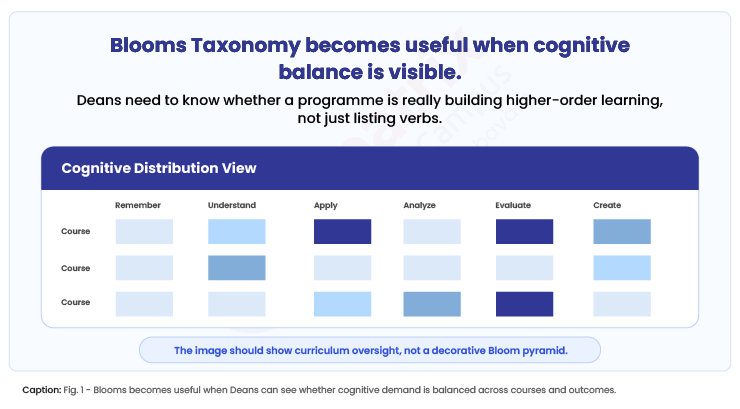
Why Deans Need Cognitive Distribution Visibility
A Dean does not need to inspect every assessment question personally.
But academic leadership does need a programme-level picture.
Where is foundational knowledge concentrated?
Do students encounter progressively more demanding cognitive work as they advance?
Are some programme outcomes dependent on higher-order thinking while the supporting CLOs remain predominantly lower-level?
Are particular courses carrying too much of the programme’s critical-thinking or problem-solving responsibility?
Are different sections applying comparable expectations?
These questions matter because curriculum quality is cumulative.
A single strong capstone cannot compensate for years in which students were rarely required to analyze, evaluate, or create.
This is where assessment evidence becomes essential.
Without evidence from actual assessment, cognitive distribution remains a curriculum-design assumption.
Programme rigor should be visible in the pattern of learning students are asked to demonstrate, not simply in the language used to describe the programme.
What Evidence-Ready Bloom’s Alignment Should Show
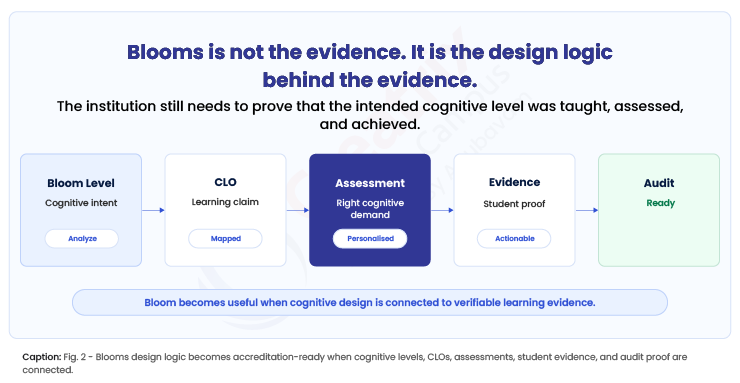
Evidence-ready cognitive alignment should allow academic and QA teams to follow the logic from intended learning to demonstrated learning.
That means understanding the cognitive level intended by the CLO, which assessment was designed to measure it, what the rubric expected, how students performed, and whether the resulting evidence supports the original curriculum claim.
When gaps appear, the institution should also be able to see what happened next.
Was the assessment redesigned?
Was the CLO reconsidered?
Did faculty calibrate rubric interpretation?
Did the programme discover that higher-order learning appeared too late in the curriculum?
Was the effect of that change reviewed later?
This is where accreditation readiness becomes easier to sustain.
The accreditation team should not need to create cognitive alignment retrospectively from course outlines, assessment folders, and faculty explanations.
The academic process itself should already contain the evidence.
The stronger question is no longer “Did we use Bloom’s?” It is “Can we prove the cognitive progression our curriculum claims?”
Where Creatrix Campus Fits
This is where Creatrix Campus becomes relevant.
Not as a tool for adding Bloom’s verbs to CLOs, but in connecting curriculum design with assessment, outcomes, evidence, and quality review.
Creatrix Campus connects cognitive alignment, course learning outcomes, assessment design, rubric-based evaluation, student evidence, and accreditation workflows.
For Curriculum teams, that can create stronger continuity between intended cognitive demand and the assessments designed around it. For Assessment teams, rubric and performance evidence can help validate whether that demand was actually demonstrated. For Deans and Programme Chairs, programme-level patterns can reveal where cognitive progression deserves attention.
For QA and Accreditation teams, the benefit is evidence that emerges from academic work rather than a cognitive-alignment story reconstructed near review.
The result is not simply better use of Bloom’s Taxonomy.
It is stronger evidence that the curriculum is delivering the level of thinking it promises.
Conclusion
Bloom’s Taxonomy still matters because universities increasingly need to defend the quality of the learning they claim to deliver. The issue is no longer whether outcomes contain appropriate verbs, but whether assessment and student evidence support the cognitive demand behind those words.
If your programme claims students graduate able to analyze, evaluate, and create, how easily could you show where those abilities are actually assessed and evidenced across the curriculum? Turn curriculum design into evidence-ready alignment.
Quick recap
Bloom’s Taxonomy becomes strategically useful when universities move beyond verb selection and examine cognitive integrity across outcomes, assessment, rubrics, and student evidence. Deans need to know whether cognitive demand develops logically across the programme and whether higher-order learning is genuinely being assessed. The goal is not to prove that Bloom’s appears in the curriculum. It is to prove that the curriculum asks students to think at the level it promises.
Frequently asked questions
Why does Bloom’s Taxonomy still matter in higher education?
Is using Bloom’s verbs enough?
How does Bloom’s connect with outcome-based education?
Why do Deans need cognitive distribution visibility?
How does assessment evidence strengthen Bloom’s alignment?
How can Creatrix Campus support cognitive alignment?
Join the conversation
Want to contribute?
We welcome thought leaders to share ideas and write for our blog.
Become a guest author