
On this page
Most universities run somewhere between eight and twelve disconnected systems across admissions, records, learning, scheduling, and accreditation. Each one solves its own narrow problem well enough. The harder question CIOs and strategic leaders are increasingly asking is not which system to add next, but whether the institution can keep coordinating all of them at all.
Quick answer
Running one platform instead of multiple disconnected vendors changes more than licensing costs. It removes the ongoing work of keeping data synchronized across systems, closes the gaps where compliance and accreditation evidence fall through, and gives leadership one consistent record instead of several partial ones that have to be reconciled by hand.
Article summary
Institutions that run many separate systems for admissions, learning, scheduling, and accreditation often treat the arrangement as manageable because each individual tool works fine. The real cost shows up in the coordination between them: IT teams spend disproportionate time maintaining integrations rather than improving systems, compliance evidence sits scattered across databases that don't share a common structure, and academic operations move slower than institutional strategy requires. This article looks at what changes, operationally rather than just financially, when that coordination work is removed by consolidating onto one platform.
Key takeaways
- The cost of running many vendors is mostly coordination overhead, not licensing fees.
- Data silos make audit and accreditation evidence harder to assemble, not just harder to analyze.
- A single platform does not mean fewer capabilities. It means one shared record behind all of them.
- Consolidation changes how fast an institution can adapt curriculum, scheduling, and reporting, not just how much it spends.
What Running Many Vendors Actually Costs
The visible cost of running separate systems for admissions, learning, scheduling, and accreditation is licensing and support fees. The larger cost is harder to see on a line-item budget because it shows up as time: IT staff maintaining integrations between systems that were never designed to talk to each other, faculty re-entering the same information into multiple tools, and compliance teams manually reconciling records that live in different databases with different formats.
| Cost Type | What It Looks Like Day to Day | Why It's Easy to Miss |
| Integration costs | IT time spent building and maintaining connections between systems | Rarely appears as its own budget line |
| IT overhead | Staff troubleshooting sync failures instead of improving systems | Gets absorbed into general IT workload |
| Data silos | Reports that don't match because source systems define data differently | Only surfaces when someone compares two reports directly |
| Total cost of ownership | Combined licensing, integration, training, and maintenance across systems | Each vendor's cost looks reasonable in isolation |
None of these costs disappear because each individual system performs well. They exist specifically in the space between systems, which is exactly where no single vendor is responsible for the outcome.
The Real Problem Is Coordination, Not Software Count
It is tempting to frame this as a software count problem: fewer vendors, fewer headaches. The more accurate framing is that ten specialized systems create ten sources of truth, and reconciling them is a coordination task nobody was hired to do full time. When admissions data, curriculum records, faculty assignments, and accreditation evidence all live in separate systems, interoperability becomes something the institution has to build and maintain itself, one integration at a time.
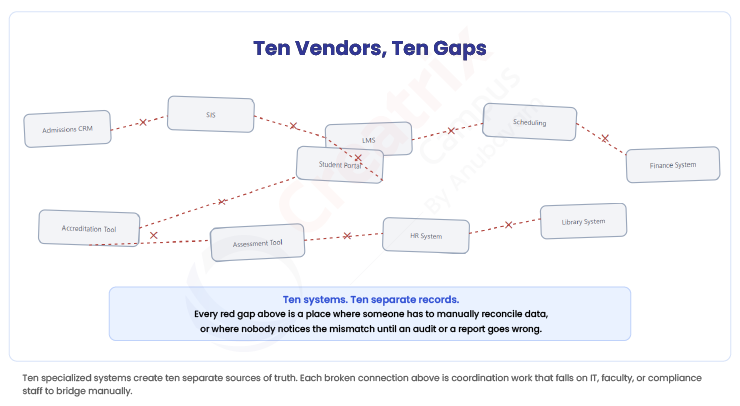
That coordination work compounds over the life of the institution. Every new system added increases the number of connections that could break, every staff turnover risks losing informal knowledge about how two systems were made to work together, and every audit or accreditation cycle requires pulling the same fragmented picture back into one place, again.
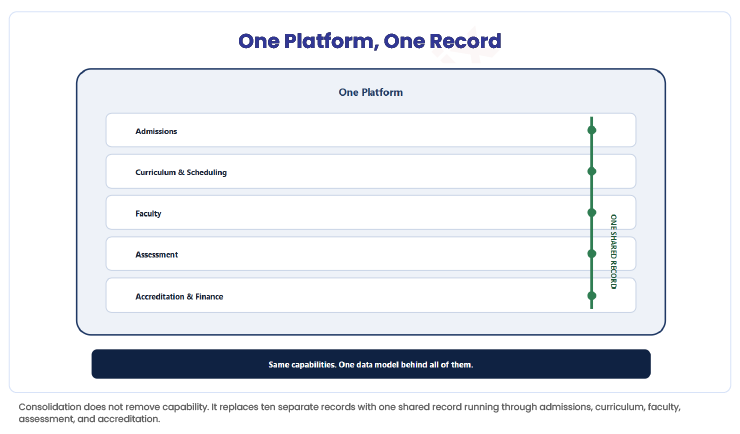
The alternative is not fewer capabilities. It is one shared record that admissions, curriculum, faculty, and accreditation activity all write to and read from, so interoperability is not something IT builds after the fact.
What Changes When One Platform Replaces Ten
Consolidating onto one platform does not mean losing functionality that separate best-of-breed tools once provided. It means the functionality sits on one data model instead of ten, so information created in one part of the institution is immediately visible and consistent everywhere else it matters.
| Fragmented Systems | One Platform |
| Data synchronized through periodic integrations | Data shared through one common record |
| Compliance evidence assembled from multiple databases | Compliance evidence traceable from a single source |
| Curriculum and scheduling changes take weeks to propagate | Changes reflect across the institution as they happen |
| IT time spent maintaining connections between systems | IT time spent on institutional priorities instead of plumbing |
This is an operating comparison based on what changes structurally, not a claim that every fragmented deployment fails or every consolidated one succeeds by default. The difference is in how much coordination work the institution has to do manually versus how much the platform itself absorbs.
Where Creatrix Campus Fits
Creatrix Campus is built as one platform across the academic lifecycle, admissions, curriculum, faculty, assessment, and accreditation evidence, rather than as separate products stitched together afterward. That means data created in one part of the institution, a curriculum change, a faculty assignment, an assessment result, is already visible where accreditation, reporting, and academic governance need it, instead of waiting on an integration to move it there. You can see the reasoning behind this approach in more detail on why disconnected systems create coordination problems. Consolidating onto Creatrix does not eliminate the need for institutional judgement about data, policy, or process. It removes the manual work of keeping ten separate systems' data consistent with each other.
Conclusion
Ten specialized systems were never really ten separate decisions. They were one accumulated coordination problem that nobody chose deliberately and everybody has to manage anyway. See how Creatrix Campus can help you replace that coordination work with one shared platform.
Quick recap
Running many disconnected vendors costs more in coordination time than in licensing fees, and that cost is hardest to see until an audit, migration, or leadership change forces someone to reconcile several inconsistent records into one. Consolidating onto one platform does not mean fewer capabilities. It means one shared record behind admissions, curriculum, faculty, and accreditation instead of ten separate ones that have to be kept in sync by hand.
Frequently asked questions
What is the real cost difference between one platform and multiple vendors in higher education?
Does consolidating onto one platform mean losing specialized functionality?
Why do data silos matter beyond reporting inconvenience?
How does a unified platform affect IT overhead?
Is switching from multiple vendors to one platform always the right decision?
Join the conversation
Want to contribute?
We welcome thought leaders to share ideas and write for our blog.
Become a guest author