
On this page
A university can buy a highly rated, well-reviewed software platform and still end up managing more institutional complexity than before. That gap between "well reviewed" and "actually connected" is where most platform evaluations quietly fail.
Quick answer
Universities should look for a platform that integrates beyond basic APIs, maintains a trustworthy shared data model, reflects real institutional governance, scales across institutional complexity rather than just user count, avoids permanent manual reconciliation, and delivers long-term value beyond the license price.
Article summary
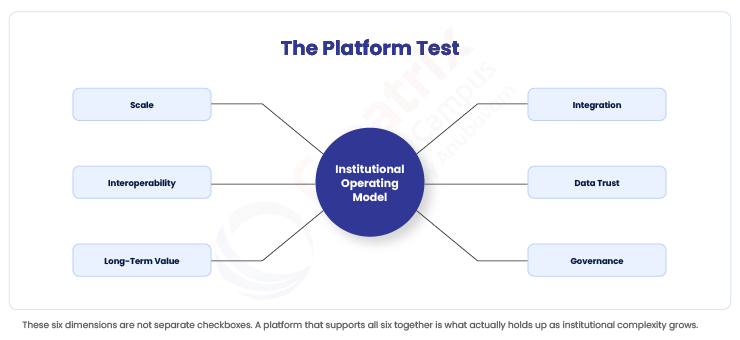
Feature lists and pricing tiers rarely predict whether a platform actually reduces institutional complexity. This article sets out six structural qualities university leadership should evaluate before selecting a platform, distinct from vendor due diligence, focused specifically on what the platform itself must be capable of as complexity grows.
Key takeaways
- A platform can have hundreds of features and still require manual data movement between systems.
- Integration should mean proven workflow continuity, not just the existence of an API.
- Scalability should cover programmes, campuses, and lifecycles, not only user volume.
- Long-term value depends on integration, migration, and support costs, not license price alone.
- The strongest test is whether reporting and reconciliation still require manual work after go-live.
Integration That Goes Beyond APIs
The presence of an API is not the same as proven integration. Leadership should ask whether the platform maintains useful data and workflow continuity with the institution's existing SIS, ERP, LMS, and finance systems, not whether it can theoretically connect to them. This does not mean every existing system needs to be replaced.
A warning sign worth pausing on: if every integration example a vendor offers involves a one-time data export rather than an ongoing, two-way workflow, the integration is likely shallower than it sounds.
A Data Model the Institution Can Trust
Look at whether the platform's underlying data is consistent, owned clearly, traceable back to its source, and updated in a way connected workflows can rely on. This is not the same as claiming one universal source of truth across every system the institution runs.
The warning sign here is subtle: dashboards that look complete but are actually assembled by someone manually reconciling numbers from three different exports before a leadership meeting.
Governance That Reflects How Universities Actually Work
University operations are not generic corporate workflows. Approval chains, academic structures, committee decisions, and role-based permissions vary by institution, and sometimes by department within the same institution. A platform should be able to reflect that structure through configuration.
Pause if governance changes require custom development rather than configuration. That pattern usually means every future policy change becomes its own mini project.
Scalability Across Institutional Complexity
Scale should mean more than adding user licenses. It should cover new programmes, additional campuses, expanding lifecycles, evolving academic structures, and new regulatory requirements as the institution grows or changes shape.
If a vendor's scalability story is entirely about concurrent users and server capacity, ask what happens when the institution adds a new lifecycle stage or academic structure rather than more people using the same one.
Interoperability Without Permanent Manual Reconciliation
This is the strongest test of the six. Ask directly whether staff will still be exporting spreadsheets, reconciling records between systems, and rebuilding reports by hand after implementation is complete. According to 1EdTech, open standards such as OneRoster and Edu-API exist specifically to enable secure, ongoing data exchange between administrative systems like a student information system, rather than one-off transfers, which is the difference between real interoperability and a connection that only works during the sales demo.
If reconciliation work looks the same twelve months after go-live as it did before implementation, the platform has not solved the interoperability problem, regardless of what the proposal promised.
Long-Term Value, Not Just Purchase Price
License cost is the number in the proposal. The real cost includes implementation, integration, data migration, support, ongoing configuration, internal staff effort, future expansion, and the cost of maintaining whatever disconnected systems remain in place.
Treat any pricing conversation that stops at the license fee as incomplete. Ask what the total looks like three years in, after integration work, support renewals, and the inevitable expansion to new departments or campuses.
Here is a quick reference for translating common vendor claims into sharper questions, and the warning signs worth watching for.
| What Vendors Often Say | What University Leaders Should Ask Instead | Warning Sign |
| We integrate with everything | Which workflows and data exchanges are proven with systems like ours? | Integration depends heavily on manual exports |
| We scale easily | What happens when we add programmes, campuses, roles, or workflows? | Scale only means more user licenses
|
| We are highly configurable | Can governance and workflows be configured without fragile custom development? |
Every institutional variation requires code |
| We provide dashboards | Is the underlying information connected and traceable? |
Reporting depends on manual consolidation |
| We offer competitive pricing | What is the long-term operating cost after integration, support, migration, and expansion? | Low entry price hides downstream costs |
Where Creatrix Campus Fits
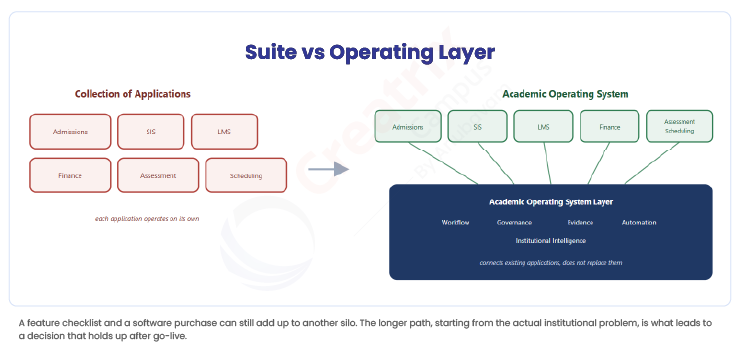
Creatrix Campus is built as an Academic Operating System, a governed layer that connects academic planning, delivery, quality, operations, student success, and institutional intelligence, rather than a single application meant to replace every system a university runs. Institutions typically keep their SIS, ERP, and LMS in place while this layer connects the workflows, governance rules, and evidence that move across them.
Measured against the six factors above, this shows up as configuration-based governance instead of custom development, and as a shared data model that reduces, though does not eliminate, the manual reconciliation work between systems. For context on how this connects existing systems, institutions can review platform, data, and AI within Creatrix Campus, alongside the broader Academic Operating System concept it is built on.
Conclusion
A good university platform does not simply add capability. It reduces the amount of coordination the institution has to perform manually, quarter after quarter. If your team wants to see how that plays out against your own systems, you can request a demo.
Quick recap
Feature lists and pricing rarely predict platform fit. The six factors that matter are integration depth, data trust, governance flexibility, real scalability, freedom from manual reconciliation, and true long-term cost, together, not as isolated checkboxes.
Frequently asked questions
How is this different from a general software buying checklist?
Does scalability just mean supporting more users?
Should a university replace its SIS or ERP to get better platform integration?
Join the conversation
Want to contribute?
We welcome thought leaders to share ideas and write for our blog.
Become a guest author