

On this page
A prospective student fills in an enquiry form late in the evening. The reply arrives three days later, from a different department, and asks for the same details again. By then, the student has moved on to an institution that answered first.
That is a recruitment problem, but it is not a marketing problem. Most recruitment advice lists activities: run campaigns, build a website, host open days. A strategy is different. It names who you are trying to win, the move you will make, why it should work, and how you will know. This guide gives ten strategies, in funnel order, each with a practical example and a measure, so a team can use them next cycle.
Quick answer
Effective student recruitment follows the applicant’s journey: target the right students, be easy to discover, reply fast, prioritise the most likely to enrol, build trust, make applying effortless, decide quickly, make accepting an offer easy, keep accepted students engaged until day one, and close the loop with data. Each strategy should have an owner and a measure.
Article summary
This guide separates recruitment strategies from activities, sets out ten strategies across four funnel stages with examples and measures, and shows where connected systems make each one easier to run.
Key takeaways
- A strategy names a target, a move, a reason it works and a measure. An activity is just a task.
- Applicants are lost at every stage, so ten strategies cover the whole funnel: attract, engage, convert and enrol.
- Speed matters twice: replying to an enquiry and deciding on an application.
- The application itself is a strategy, not a form: fewer fields, save and resume, document capture and instant checks reduce drop-off.
- Recruitment improves when every stage is measured and results feed the next cycle.
Strategies Versus Activities
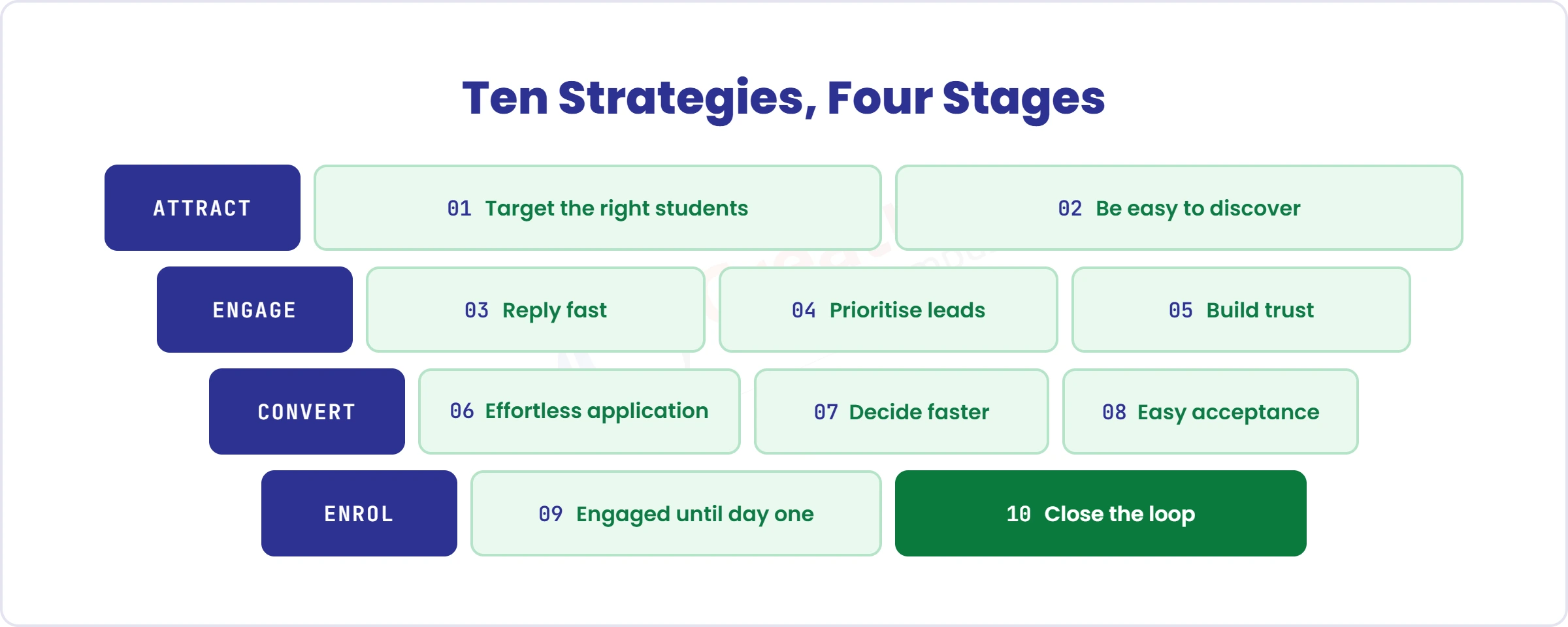
Many recruitment plans are lists of tasks: run social campaigns, update the website, hold open days. They describe what a team does, not why it will work. A strategy answers four questions. Who are we trying to win? What is the move? Why should it work? How will we know?
The ten strategies below follow the applicant’s journey in four stages.
- Attract: target the right students and be easy to discover.
- Engage: reply fast, prioritise leads and build trust.
- Convert: make applying effortless, decide quickly and make accepting easy.
- Enrol: keep accepted students engaged and close the loop with data.
In the US, for example, federal graduate loan limits change from 1 July 2026, so cost questions come earlier and speed and clarity matter more at every stage.
Attract: Strategies 1 and 2
Strategy 1: Target the right students. Recruiting for everyone attracts no one in particular.
The move: write a short applicant profile for each priority programme: who they are, where they are, what they need to succeed, and what decision they are making. Then check your history for which sources produced applicants who enrolled and stayed, not just applied.
Example: a postgraduate analytics programme finds its strongest cohorts come from working professionals referred by employers, not from general social ads, and shifts effort accordingly.
Measure: enrolled and persisting students by source and programme.
Strategy 2: Be easy to discover. Prospects, and the AI tools they ask, look for direct answers before they ever talk to you.
The move: build programme pages that answer the real questions in plain language: fees, entry requirements, duration, outcomes and deadlines, with clear headings. Keep one source of programme facts so the website, brochures and any chatbot agree.
Example: replace a page that says “contact us for fees” with a fee table and payment options, so the enquiries that arrive are better informed.
Measure: visibility for programme and “how to” questions, and the quality of enquiries.
Engage: Strategies 3 to 5
Strategy 3: Reply fast, and reply well. The first response sets the tone, and a slow one hands the prospect to a competitor.
The move: capture enquiries from every channel in one place, acknowledge them instantly, and route each to the right counsellor by programme, region or language. Agree a reply-time standard and measure it. Bring agents and partners into the same view, so duplicates and ownership disputes disappear.
Example: an enquiry that arrives at 9 pm gets an immediate acknowledgement with programme-specific next steps, and a named counsellor by morning.
Measure: time to first human reply, and the share of enquiries answered within the standard.
Strategy 4: Prioritise the leads most likely to enrol. Counsellors cannot give every lead the same time.
The move: score leads on fit (programme match, qualifications, location) and engagement (replies, event attendance, application progress). Route the highest scores to counsellors first, review the rules regularly, and keep a human in the decision.
Example: a lead who attended an open day and started an application is called today. A lead who only downloaded a brochure receives a nurture sequence.
Measure: conversion by score band, and counsellor time spent on the top band.
Strategy 5: Build trust before the application. Applicants commit money and years, so they want proof, not promotion.
The move: publish costs, financial aid and scholarship criteria clearly, show outcomes with context, connect prospects with students and alumni, and offer campus or virtual experiences. Answer the hard questions honestly.
Example: a financial aid page with eligibility criteria, deadlines and a worked cost example for a typical applicant.
Measure: enquiry-to-application rate, and the rate from the aid page to application.
Convert: Strategies 6 to 8
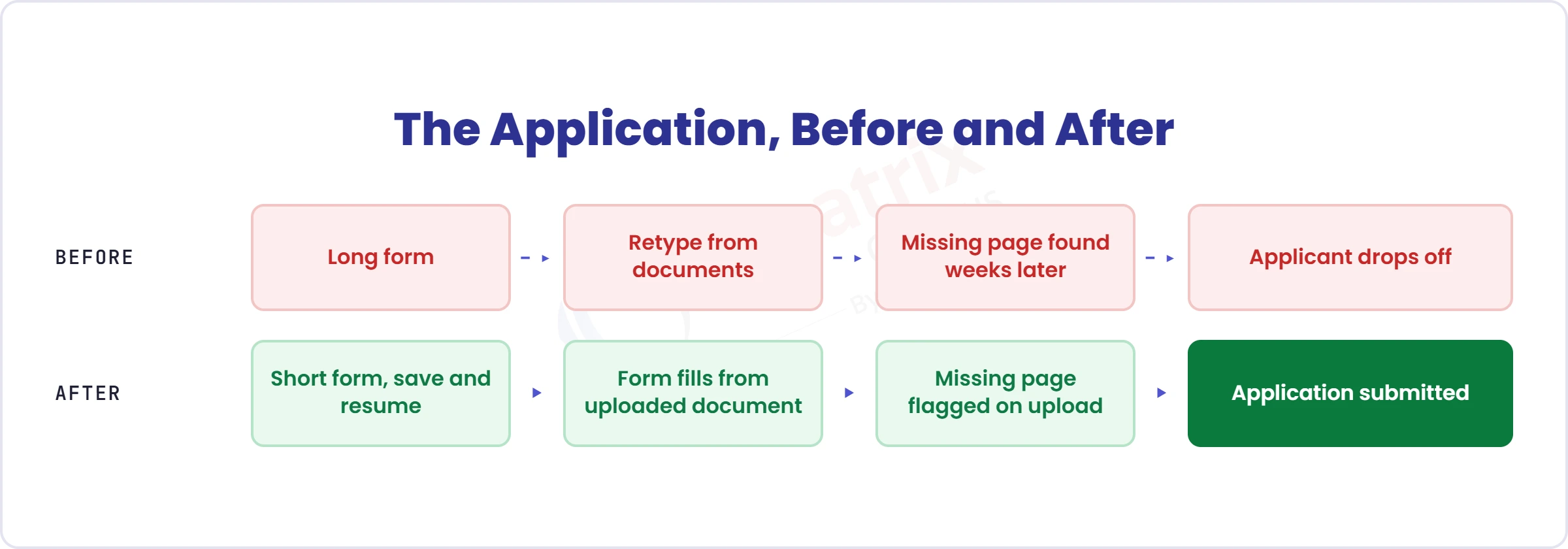
Strategy 6: Make the application effortless. Every unnecessary field loses applicants who were already convinced.
The move: ask only what you need at application and collect the rest after the offer. Let applicants save and resume, apply on a phone, upload a document once and have the form fill from it, and check completeness at the point of upload. Show status at every stage.
Example: an applicant uploads a transcript, the form reads the grades from it, the system flags a missing page immediately, and the applicant fixes it in the same session instead of weeks later.
Measure: start-to-submit rate, and where in the form applicants abandon.
Strategy 7: Verify and decide faster. Waiting is the quiet reason strong applicants accept elsewhere.
The move: verify documents as they arrive, route each application to the right reviewers, schedule interviews and tests from shared slots with capacity limits, score with agreed weights and more than one evaluator, and publish a decision-time standard.
Example: a graduate programme commits to a decision within a set number of working days of a complete application and reports against it weekly.
Measure: days from complete application to decision, and applications waiting on documents.
Strategy 8: Make accepting an offer easy. An offer is not an enrolment. Applicants still weigh cost, timing and doubt.
The move: send offers that say what happens next, with scholarship awards and payment options clear, a simple way to accept and pay the deposit, reminders before deadlines, and a counsellor for questions. Treat the waitlist as an active list.
Example: an offer letter links to an acceptance page that shows the scholarship, the payment plan and the deposit date, with one-click accept.
Measure: offer-to-acceptance rate, and deposits completed before the deadline.
Enrol: Strategies 9 and 10
Strategy 9: Keep accepted students engaged until day one. Accepted is not arrived. The weeks before orientation are when doubts and alternatives surface.
The move: give accepted applicants a checklist (documents, payments, housing or visa where relevant, course selection), welcome content from faculty and current students, and orientation details. Create the student record from the application data, so nothing is asked twice.
Example: an accepted student sees three outstanding checklist items and a reminder two weeks before orientation, instead of finding out on arrival.
Measure: checklist completion, and arrivals as a share of acceptances.
Strategy 10: Close the loop with data. Recruitment improves when every stage is measured and results feed the next cycle.
The move: track conversion at each stage by source, programme and region. Test messages and forms. Listen to applicants, including those who did not enrol. Share results with agents and partners, and review monthly, not once a year.
Example: a review shows applicants from one region drop off at document upload, so the team adds a local-language guide and compares the next cohort.
Measure: stage conversion by source, time and cost to enrol, and yield by programme.
How Connected Systems Support the Ten Strategies
Each strategy leans on connected data. In Creatrix Campus, Student Recruitment & Enrollment covers the journey from first enquiry to matriculation, with recruitment analytics, forecasting, OCR and document capture, digital forms and AI assistants from Platform, Data & AI.
| Strategy | What it needs | Where Creatrix Campus helps |
| 3 Reply fast | One view of enquiries, routing, agent visibility | Lead & Prospect Management, Inquiry Management, Recruitment Network Management |
| 4 Prioritise | Scoring rules and analytics | Recruitment analytics and predictive analytics |
| 6 Application | Digital forms, document capture and checks | Applications, Document Management, OCR and document capture |
| 7 Decide faster | Routing, slots, weighted scoring | Admissions Workflow, Interview & Selection Management, Decision Management |
| 8 Offers | Offers, scholarships, deposits | Offer Management, Acceptance Management, Student Financials |
| 9 Day one | Checklist, orientation, student record | Enrollment Checklist, Orientation Management, Student ID Creation |
| 10 Close the loop | Stage conversion and forecasting | Recruitment analytics and forecasting |
Where an external CRM is mandated, it can remain the system of record for pre-application engagement, with a governed handoff from application onward.
Conclusion
Recruitment is won in the gaps between stages: the reply that came late, the form that asked twice, the offer that did not say what happens next. Ten strategies, each with an owner and a measure, turn those gaps into things a team can fix.
If you want to see where your own journey loses applicants, talk to us about a Tailored Proof Session.
Quick recap
Target, discover, reply fast, prioritise, build trust, simplify the application, decide faster, make accepting easy, stay engaged until day one, and close the loop. Give each strategy an owner and a measure.
Frequently asked questions
What is the difference between a recruitment strategy and a recruitment activity?
What are the most effective student recruitment strategies?
How do you reduce application drop-off?
What is lead scoring in student recruitment?
How do you convert offers into enrolments?
How does Creatrix Campus support student recruitment?
Join the conversation
Want to contribute?
We welcome thought leaders to share ideas and write for our blog.
Become a guest author