
On this page
An instructor teaching a hybrid course spends Sunday night building Monday's lesson. Slides for the in-person session. A separate recording, made later in the week, for the online students who won't be in the room. Two versions of the same material, built at two different times, by one person who now has to remember to update both whenever anything changes.
This is an ordinary week for a lot of faculty teaching in blended formats, and it's rarely discussed as a systems problem. It gets treated as a workload complaint, faculty are just busy, rather than what it usually is: a delivery management gap, where the technology used to teach in person and the technology used to teach online were never built to share the same underlying content.
Teaching and learning delivery management is the discipline of closing that gap, so a lesson gets authored once and reaches students consistently, whichever mode they're attending in, without an instructor manually maintaining two or three parallel versions of the same material.
Quick answer
Teaching and learning delivery management improves academic delivery by letting an instructor author a lesson once and deliver it consistently across in-person, online, and blended modes, rather than manually building and maintaining separate versions for each. The real cost of not solving this isn't just faculty time. It's that the two versions drift apart, so students in different modes end up with a materially different course.
Article summary
The case for genuine delivery management rests on three things: why hybrid and blended teaching quietly doubles an instructor's content-building workload, what the POD Network's decades-long focus on educational development suggests about how seriously the sector treats this challenge, and what to check for so a course stays consistent across delivery modes instead of drifting into two different experiences.
Key takeaways
- Hybrid and blended courses often mean an instructor builds the same lesson twice, once for the room and once for online students, without institutional visibility into that extra workload.
- The POD Network represents over 1,700 members across nearly 1,300 centers for teaching and learning, evidence that supporting faculty through exactly this kind of delivery complexity is a recognized, sector-wide institutional function.
- When two versions of a lesson exist, a later update to one rarely gets reliably carried over to the other, so the two versions drift apart over a term.
- Students in different delivery modes of the same nominal course can end up with a materially different experience, without anyone officially deciding that should happen.
- The institutions that solve this evaluate for whether content is authored once and delivered across modes, not for how many delivery formats a system technically supports.
The Double Build Nobody Budgeted For
The double-build problem tends to be invisible to everyone except the instructor living it. Administrators see a course listed as "hybrid" and assume the delivery logistics are handled. Students in each mode experience their own version of the course and have no reason to know a separate version exists. Only the instructor sees both halves of the extra work, and the fact that a change made to one version doesn't automatically appear in the other.
The POD Network, which describes itself as North America's largest educational development community, representing over 1,700 members across nearly 1,300 centers for teaching and learning, has supported faculty development in this exact space since 1976, per the POD Network's own site. That scale, nearly 1,300 dedicated centers focused specifically on teaching effectiveness, is a fair signal that supporting faculty through exactly this kind of delivery complexity is a recognized, ongoing institutional function, not something any one department should be expected to solve informally.
What Consistent Delivery Actually Looks Like
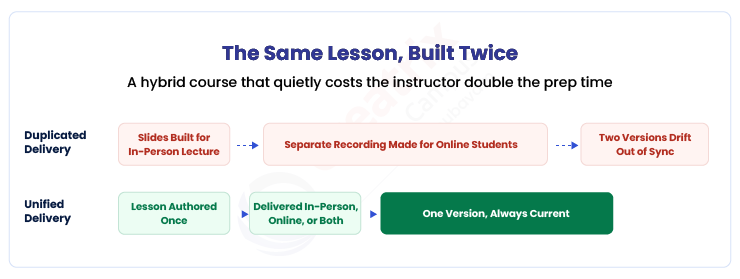
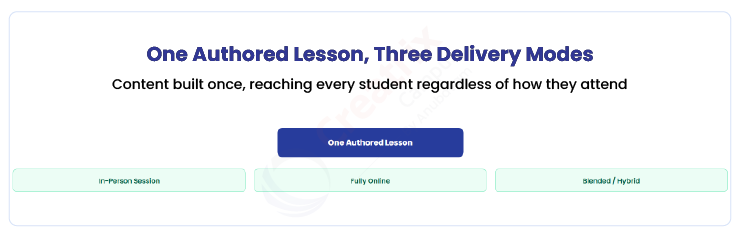
In a genuinely unified delivery system, an instructor authors a lesson once, and that same authored content reaches students whether they're sitting in the room, joining fully online, or moving between the two across a term. A change made to a reading, a due date, or an assessment updates everywhere that lesson is delivered, rather than requiring the instructor to remember every place a manual copy exists.
This isn't only a time-savings argument, though it is that. It's also a consistency argument: two students technically enrolled in the same course shouldn't be working from materially different versions of it just because one attends in person and the other online.
What to Check Before Trusting "Supports Hybrid"
| Claim | What it might actually mean | What to ask instead |
| "Supports hybrid and blended delivery" | Can host separate content for in-person and online, without connecting the two | Ask whether one authored lesson updates automatically across every mode, or whether faculty maintain separate versions |
| "Faculty productivity tools" | Templates and shortcuts that still require building content twice | Ask specifically what happens when a due date or reading changes after initial content is built |
| "Assessment delivery across formats" | Separate assessment tools for in-person and online that don't share results | Ask whether assessment results from every delivery mode roll up into one gradebook automatically |
The clearest test is asking a vendor what an instructor actually does the Sunday night before a hybrid week: build one lesson that reaches every mode, or still assemble two or three versions by hand, just inside a nicer interface than before.
Where Creatrix Campus Fits
Creatrix Campus lets faculty author a lesson once, content, readings, due dates, assessments, and deliver it consistently whether a student attends in person, fully online, or in a blended pattern across the term.
A change made to any part of that lesson updates across every mode it's delivered in, so faculty aren't manually maintaining parallel versions, and students in different modes of the same course are working from the same current material rather than two versions that quietly drifted apart.
Conclusion
The extra work of teaching a hybrid or blended course rarely shows up on any institutional dashboard. It shows up privately, in the hours an instructor spends building the same lesson twice, and in the quiet drift between two versions of a course that were never actually the same thing after week three.
Institutions that solve delivery management properly let faculty author once and deliver consistently across modes. The rest keep calling a course "hybrid" while one person maintains two courses under that single label.
If you want to see how Creatrix Campus lets faculty build a lesson once and deliver it everywhere, talk to us about teaching and learning delivery management.
Quick recap
Teaching and learning delivery management should let faculty author a lesson once and deliver it consistently across in-person, online, and blended modes, rather than manually building and maintaining separate versions that drift apart over a term. Institutions should evaluate for whether content and assessments genuinely update across every mode from one source, not for how many formats a system claims to support.
Frequently asked questions
How does technology improve academic delivery management?
Why does teaching a hybrid course often take more time than expected?
What happens when a hybrid course's in-person and online versions aren't connected?
What should institutions check before trusting a "supports hybrid" claim?
How does Creatrix Campus support delivery management?
Join the conversation
Want to contribute?
We welcome thought leaders to share ideas and write for our blog.
Become a guest author