
On this page
A university can integrate its systems and still leave the student waiting.
Admissions has approved the student, but registration does not yet see the right record. A course has been dropped, but Finance still sees the previous load. A grade has been submitted, but progression or transcript processing is working from something older.
Technically, every system may be functioning.
Operationally, the institution is disagreeing with itself.
That is the limitation of treating SIS integration as an IT project.
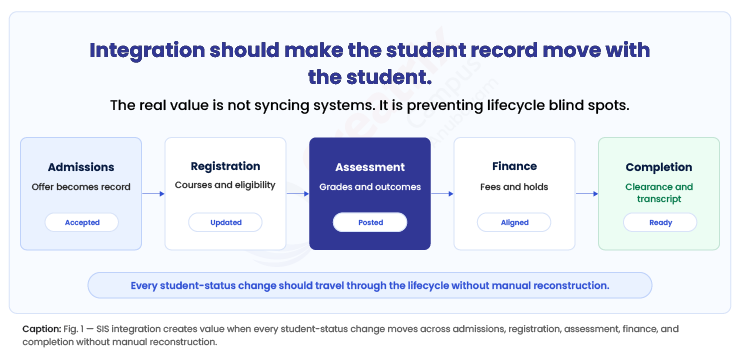
The real requirement is student lifecycle visibility: when a student's status changes, every office that depends on that change needs an accurate and usable version of the record at the point it has to make a decision.
Integration moves data. Lifecycle visibility preserves meaning as the student moves.
Quick answer
Student lifecycle visibility breaks when SIS integration focuses on transferring data between systems without ensuring that student-status changes remain accurate, timely, and usable across admissions, registration, assessment, finance, progression, and completion. A strong integration model should protect the decisions that depend on the student record, not simply prove that two systems can exchange data.
Article summary
| Problem | Systems may exchange data while different offices still work from different versions of the student's current status. |
| Who this is for | Registrars, CIOs, Student Records teams, Academic Operations, Finance leaders, Assessment teams, and university leadership. |
| What changes | Integration moves from technical connectivity to lifecycle decision continuity. |
| Why it matters | Registration, fees, progression, transcripts, and graduation all depend on the record being correct at the moment of decision. |
| Outcome | Less reconciliation, fewer delayed decisions, clearer ownership, and greater trust in the student record. |
Key takeaways
- Technical integration does not automatically create lifecycle visibility.
- The most serious record gaps usually appear at handoffs between offices.
- Registrars often inherit responsibility for records produced by many different institutional processes.
- Integration should protect the timing and meaning of student-status changes, not simply data transfer.
- The goal is one trustworthy student state at each important lifecycle decision.
Why This Matters
The student record is not simply information the university stores.
It determines what happens next.
Can the student register? Is the current fee correct? Can a result be used for progression? Is a hold still valid? Can a transcript be issued? Has the student satisfied the conditions for graduation?
When the underlying record is late or inconsistent, those institutional decisions become late or inconsistent too.
The student experiences this as conflicting answers between departments. Staff experience it as manual checking, reconciliation, exceptions, and repeated confirmation.
For the Registrar, it often becomes something harder: responsibility for explaining a record whose inputs were created somewhere else.
A student record becomes valuable not when it is stored correctly somewhere, but when every dependent decision can trust it at the right time.
Why SIS Integration Is Often Misunderstood
Integration projects often begin with a system map.
Connect Admissions. Connect the LMS. Connect Finance. Connect Assessment. Connect reporting.
That work matters.
But a technical connection can succeed while an operational handoff still fails.
A record may synchronise overnight when registration needs it immediately. A course change may update one application without triggering the corresponding financial process. A result may transfer correctly but still not carry the information required for progression rules.
The integration question is therefore not simply:
“Did the data move?”
It is:
“Did the institution understand that something changed, and did every process that depends on that change respond correctly?”
Integration connects systems. A lifecycle operating model does something different: it preserves context, governs rules, and coordinates what should happen next.
Where Student Record Gaps Usually Appear
Record problems tend to appear at transitions because that is where one team's completed action becomes another team's starting point.
| Lifecycle handoff | What can go wrong | What the student experiences |
| Admissions → Registration | Admitted status or programme details are incomplete | Delayed registration or repeated information |
| Registration → Finance | Course-load changes are not reflected financially | Incorrect balances or recalculation |
| Assessment → Academic record | Results do not reach the appropriate student state | Progression or transcript delay |
| Finance → Clearance | Holds or payments are not current | Unexpected blocks |
| Progression → Graduation | Requirements and clearances are reconciled separately | Last-minute completion issues |
This is why student information system integration cannot be judged only by the number of connected applications.
The more useful test is whether the student's institutional state remains consistent as responsibility moves from one office to another.
Most student-record failures happen at the moment one department believes its work is finished and another assumes the record is ready.
Why Registrars Need Lifecycle Visibility
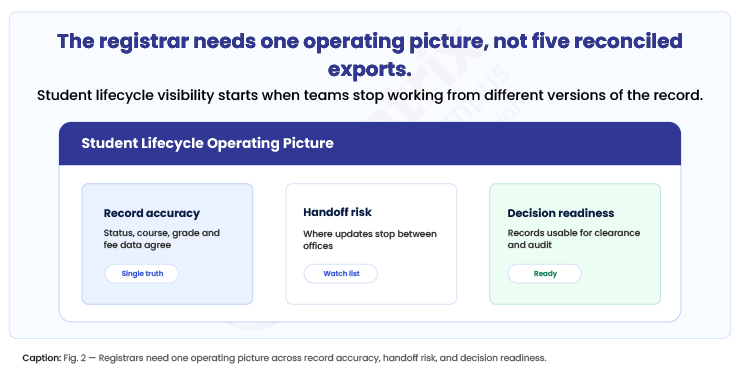
Registrars are responsible for the reliability of records whose truth is created across the institution.
Admissions establishes the initial student state. Academic departments approve programme and course changes. Faculty generate grades. Finance manages account status. Examination processes influence eligibility. Graduation teams rely on the final academic record.
The Registrar does not create all of that information.
Yet the Registrar is often expected to certify that it is correct.
That is why access to more databases does not necessarily solve the Registrar's problem.
Lifecycle visibility should answer a different set of questions:
Who changed the student's status?
Which rule allowed the change?
Has every dependent process received it?
Is anything still pending?
Which version is authoritative now?
This is where student records governance becomes more than data administration.
The Registrar is protecting the institution's confidence that the student's official state means the same thing everywhere it matters.
What Connected Student Records Should Make Possible
Connected records should reduce the number of moments when staff have to ask another office, “Can you confirm this?”
At important decision points, teams should be able to understand whether:
- an admitted student is genuinely ready to register,
- course changes have reached both academic and financial processes,
- assessment results are available for progression decisions,
- current holds and clearances reflect the latest student state,
- graduation requirements are supported by complete information,
- relevant status changes have reached every office that needs them.
This is where student lifecycle management becomes the broader operating question.
The student moves continuously.
The institutional record should not become fragmented every time responsibility changes hands.
A connected record should remove reconciliation from ordinary student movement, not simply make reconciliation faster.
Where Creatrix Campus Fits
This is where Creatrix Campus becomes relevant, but not as another integration layer whose success is measured only by the number of APIs connected.
Creatrix Campus works as a lifecycle-aware operating layer that sits alongside existing institutional systems while governing workflows, state, rules, and cross-department context. That's a different job from traditional integration, which improves data movement without necessarily unifying how the institution operates.
Across the student lifecycle, that can connect areas such as admissions, registration, academic records, assessment information, financial updates, progression, and completion.
For Registrars, the benefit is stronger confidence in the current student state. For CIOs, integration can be evaluated by operational continuity rather than interface count. For Finance and Academic Operations, updates become easier to interpret in the context of what happened before and what needs to happen next.
Assessment evidence, for example, becomes more useful when the appropriate results can participate in progression and records workflows rather than remain isolated inside the assessment process.
The outcome is not simply connected systems.
It is an institution that can trust what the student record says when a decision depends on it.
Conclusion
SIS integration becomes valuable when it protects student movement, not merely system connectivity. Admissions, registration, assessment, finance, progression, and completion all depend on student-status changes reaching the right process with the right meaning at the right time.
If a student's status changed this morning, could every office making a decision this afternoon trust that it was working from the current institutional truth? Build connected student lifecycle visibility.
Quick recap
Student lifecycle visibility breaks when universities measure integration by whether data moves instead of whether decisions stay connected. The important question is not how many systems exchange records, but whether Admissions, the Registrar, Finance, Assessment, and Academic Operations can rely on the same student state when action is required. The strongest integration model is therefore one that makes manual reconciliation the exception rather than the normal way the student lifecycle works.
Frequently asked questions
Why is student lifecycle visibility important?
Is SIS integration only an IT project?
Where do student-record gaps usually occur?
Why do Registrars need lifecycle visibility?
Does connecting systems automatically create a single source of truth?
How can Creatrix Campus support student lifecycle visibility?
Join the conversation
Want to contribute?
We welcome thought leaders to share ideas and write for our blog.
Become a guest author