
On this page
Financial aid says a student is enrolled full time. Athletics says the same student is part time, based on a schedule change from two weeks ago that never reached financial aid's system. Both offices are confident. Both are working from what they believe is current information. Only one of them is actually right, and untangling which one takes a phone call, an email, and twenty minutes nobody had budgeted for that afternoon.
This kind of quiet disagreement happens constantly at institutions where the registrar, financial aid, athletics, and advising each maintain their own version of a student's record, updated on their own schedule, from their own export. Nobody set out to create five versions of the truth. It happened because five different offices needed student data and built or bought five different ways to track it.
A student information system exists to end this specific kind of dispute: one governed record that every office reads from, so the question "is this student enrolled full time" has exactly one current answer, not five plausible ones.
Quick answer
A student information system improves campus operations by giving every office, the registrar, financial aid, athletics, advising, one governed student record instead of separate department-maintained copies. The real benefit isn't centralizing paperwork. It's that a change in enrollment status, made once, is reflected everywhere that status is used, so different offices stop arriving at different answers for the same student.
Article summary
The case for a genuine SIS rests on three things: why departments end up disagreeing about the same student's status even when nobody is careless, what AACRAO's scale suggests about how structural this challenge is across the sector, and what to check for so a system actually ends the disagreement instead of just centralizing where the disagreement gets stored.
Key takeaways
- Financial aid, athletics, the registrar, and advising can each hold a different, confidently-believed version of the same student's enrollment status.
- These discrepancies usually surface at the worst moments: audits, eligibility reviews, and verification requests, not routine daily work.
- AACRAO represents more than 22,000 professionals across roughly 2,100 institutions and over 16.4 million enrolled learners, evidence that record integrity is a sector-wide, ongoing discipline, not a one-time fix.
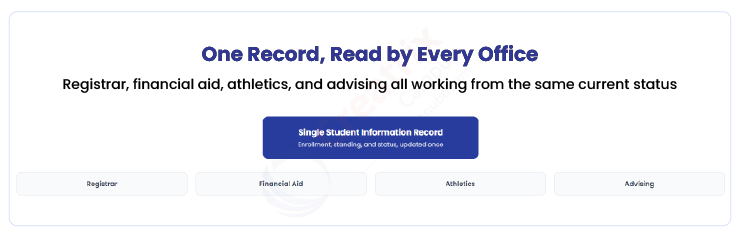
- A genuine SIS doesn't just store student data centrally. It makes a status change made once immediately visible to every office that depends on it.
- The institutions that get real value from an SIS evaluate for whether departments are actually reading from the same current record, not for how comprehensive the data fields look in a demo.
The Disagreement Nobody Notices Until It Matters
Most of the time, small discrepancies between departments go unnoticed, because nobody happens to compare notes on a specific student that week. They surface at the worst possible moments: a compliance audit, an athletic eligibility review, a financial aid verification, when two offices are asked the same question and give two different answers, and someone has to explain why.
AACRAO, the American Association of Collegiate Registrars and Admissions Officers, represents more than 22,000 higher education professionals across roughly 2,100 institutions in over 30 countries, collectively responsible for more than 16.4 million enrolled learners. An association of that scale exists in large part because the integrity of the academic record, keeping it consistent, accurate, and portable across offices, is a genuinely difficult, ongoing discipline across the entire sector, not a one-time technical fix.
What One Governed Record Actually Changes
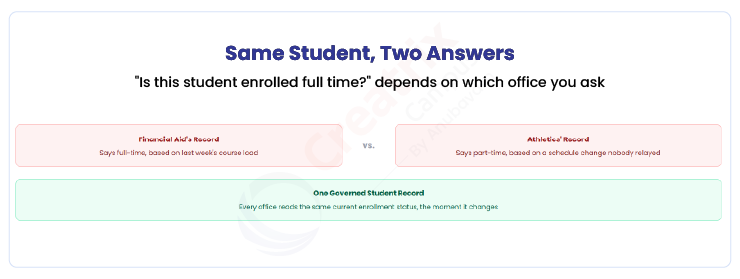
The fix isn't simply putting all the data in one database. Plenty of systems store student data centrally while still allowing departments to maintain their own working copies or exports that drift out of sync the moment anyone updates the source. A genuine SIS closes that gap: when the registrar records a schedule change, athletics and financial aid see the same updated status immediately, not on their own next export cycle.
That distinction, centralized storage versus a genuinely shared, current record, is the difference between an SIS that looks unified in a sales demo and one that actually stops departments from disagreeing about the same student in practice.
What to Check Before Trusting "Centralized" Records
| Approach | What it looks like from each office | Where it breaks down |
| Separate department systems | Each office keeps its own record, updated on its own schedule | Enrollment status, standing, or contact information drift out of sync between offices |
| Centralized database, siloed access | One underlying database, but departments still work from their own exports or cached views | Looks unified, but a change in one office doesn't reliably or immediately reach another |
| Genuinely shared, current record | Every office queries or views the same live status | Requires verifying real-time visibility across departments, not just a shared database claim |
The honest test during evaluation is specific: ask a vendor what happens the moment the registrar updates a student's enrollment status, and whether financial aid and athletics see that change immediately or on their own separate refresh cycle. If the answer involves a scheduled export or a manual pull, the system is centralized in name, not in practice.
Where Creatrix Campus Fits
Creatrix Campus gives the registrar, financial aid, athletics, and advising one governed student record, rather than department-specific copies that can drift out of sync.
A change made in one place, an enrollment update, a standing change, a schedule adjustment, is visible to every office that depends on it immediately, so the question "is this student enrolled full time" has one current, shared answer rather than five plausible department-specific ones.
Conclusion
Most institutions don't notice how many small disagreements exist between departments about the same students, until an audit, an eligibility review, or a verification request forces two offices to compare notes and discover they don't match.
A student information system's real value isn't storing data centrally. It's ensuring that a change made once, in one office, is the same answer every other office sees, immediately. Institutions that evaluate for that get a genuine single source of truth. The rest get a database that looks unified until someone actually checks.
If you want to see how Creatrix Campus gives every office one current student record, talk to us about our student information system.
Quick recap
A student information system should give the registrar, financial aid, athletics, and advising one governed, current student record, not just a centralized database that departments still access through their own out-of-sync copies. Institutions should evaluate for whether a status change made once is immediately visible everywhere it matters, not for how comprehensive the data fields look in a demo.
Frequently asked questions
How does a student information system improve campus operations?
Why do different departments sometimes have different answers about the same student?
Is a centralized database the same as a genuine single source of truth?
How can an institution verify that its SIS provides real-time shared records?
How does Creatrix Campus handle student information management?
Join the conversation
Want to contribute?
We welcome thought leaders to share ideas and write for our blog.
Become a guest author