
On this page
Attendance looks simple when reduced to a register: present, absent, excused, unexcused.
Student behaviour is rarely that simple.
A missed class might reflect academic difficulty, timetable pressure, financial stress, weak belonging, a personal issue, or nothing more than an isolated absence. The institution cannot know which from the attendance record alone.
That is why attendance becomes more useful when it starts a student-support question rather than ends with a compliance answer.
Absence tells the institution that something changed. It does not automatically tell the institution why.
The opportunity is to notice meaningful patterns early, combine them with the right student context, and help Advisors or support teams decide whether outreach is needed while there is still time to make a difference.
Quick answer
Student attendance tracking becomes more valuable when it supports early intervention rather than stopping at compliance reporting. Institutions need to recognise meaningful attendance patterns, interpret them alongside academic and student context, and help the right support team decide what response is appropriate. The goal is not to treat every absence as risk, but to recognise when a pattern deserves attention.
Article summary
| Problem | Attendance is often recorded without enough context to determine whether a student needs support. |
| Who this is for | Student Success leaders, Academic Advisors, Registrars, Deans, Faculty leaders, and Academic Affairs teams. |
| What changes | Attendance moves from a compliance record to one input in student-support decisions. |
| Why it matters | Responding too late misses the intervention window, while responding without context can misread the student’s situation. |
| Outcome | More informed outreach, better prioritisation, and earlier support for students showing meaningful disengagement patterns. |
Key takeaways
- Attendance is an indicator, not a complete explanation of student risk.
- Patterns are more useful than isolated absences.
- Advisors need context before deciding how to respond.
- Student support should distinguish between temporary absence and sustained disengagement.
- The goal is not increased monitoring. It is better-informed support at the right time.
Why This Matters
NCES tracks retention and graduation as important postsecondary outcomes, but the conditions that eventually influence continuation often become visible much earlier. Attendance can be one useful signal within that earlier picture. The challenge is using it without assuming that every missed class means the same thing.
Why Attendance Is Often Misunderstood
Attendance systems naturally reduce behaviour into categories and percentages.
That works for recording what happened.
It is much less useful for explaining why it happened.
A 90% attendance rate can mean one thing for a student whose participation and academic performance remain strong, and something very different for a student whose attendance has been declining alongside missed assessments and repeated Advisor concerns.
The same is true of absence.
One missed class may require no intervention. Repeated absence from one difficult course may point to an academic issue. A sudden drop across several courses may deserve a different conversation altogether.
Student support begins when the institution stops asking only how much attendance changed and starts asking what kind of change it is seeing.
What Absence Patterns Can Tell Institutions
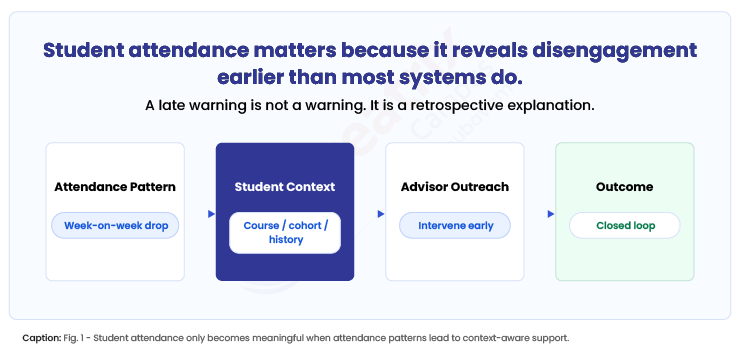
Attendance becomes more informative when institutions look for patterns rather than isolated events.
| Pattern | Question worth asking |
| Repeated absence in one course | Is the student struggling with that subject or delivery format? |
| Declining attendance across courses | Is broader disengagement forming? |
| Sudden attendance drop | Has something changed recently in the student's situation? |
| Absence following assessment difficulty | Does the student need academic support? |
| Attendance change near another lifecycle event | Is there relevant academic or student context to review? |
None of these patterns proves the cause.
That distinction matters.
A university should not turn attendance analytics into a machine for labelling students. It should use the pattern to determine whether somebody needs to look more closely.
The strongest attendance signal is not the one that predicts the student perfectly. It is the one that prompts the right question early enough.
Why Context Changes the Response
The same attendance pattern can require very different support.
A first-year student repeatedly missing foundational classes may need proactive academic outreach. A final-year student with otherwise strong progression may need a different conversation. A student whose attendance and assessment performance are both declining creates a different picture again.
This is why attendance becomes more useful when it can be understood alongside relevant academic information.
Learning outcomes and assessment evidence, for example, may help academic teams understand whether attendance change is occurring alongside learning difficulty. Continuous improvement activity can also help institutions recognise broader programme-level patterns rather than treating every case as purely individual.
The point is not to combine every available data point into a risk score.
It is to give the person supporting the student enough context to avoid two mistakes:
ignoring a meaningful pattern or overreacting to an innocent one.
Moving From Tracking to Support
A compliance-led attendance process asks:
“Was the student present?”
A support-led process asks:
“Does this pattern suggest we should understand what is happening?”
That change sounds small, but it alters the workflow.
Attendance patterns become visible. The appropriate Advisor or support team receives enough context to review the situation. Outreach is recorded. The institution can see whether support happened and, where appropriate, whether the student re-engaged.
This also improves prioritisation.
Student Success teams do not need every absence converted into an alert. They need help distinguishing between routine variation and patterns that genuinely deserve attention.
Good attendance visibility should reduce noise for Advisors, not create another queue they cannot realistically manage.
Where Creatrix Campus Fits
This is where Creatrix Campus becomes relevant.
Not simply as a system for recording who attended, but in connecting attendance information with the wider student context needed for more informed support.
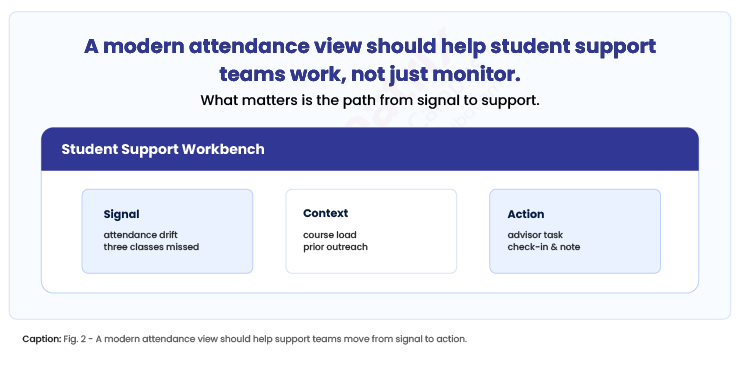
Creatrix Campus connects attendance patterns, student context, Advisor visibility, academic progress, intervention records, and follow-up actions within a connected student-support model.
For Advisors, that can mean approaching a student with more context than an absence percentage alone. For Student Success teams, it creates a clearer basis for prioritising outreach. For Registrars and Academic Affairs leaders, attendance remains visible without becoming disconnected from the student's wider academic journey.
The larger value is not more monitoring.
It is helping the institution distinguish between a student who missed class and a student who may be beginning to lose connection with the university.
Conclusion
Attendance can be an early student-support signal, but only when institutions resist the temptation to treat absence as an answer by itself. The stronger model combines pattern, context, judgement, and timely outreach so support teams can respond proportionately rather than simply react to percentages.
When attendance changes at your institution, does the Advisor receive another alert, or enough context to understand whether the student actually needs help? Connect attendance signals to student support.
Quick recap
Student attendance tracking becomes more useful when institutions move beyond counting absence and start interpreting meaningful patterns in context. Not every absence indicates risk, and not every student needs the same intervention. The goal is to help Student Success and advising teams recognise which changes deserve attention, what else is happening around the student, and what kind of support makes sense next.
Frequently asked questions
Why is student attendance tracking important?
Is attendance enough to identify student risk?
Should attendance tracking be used only for compliance?
What makes attendance visibility useful for Advisors?
Can attendance alerts create too much noise?
How can Creatrix Campus support student attendance visibility?
Join the conversation
Want to contribute?
We welcome thought leaders to share ideas and write for our blog.
Become a guest author