
On this page
Eighty-four percent of senior finance professionals, according to recent surveys, believe their universities should use financial data more effectively to support decision-making. Strategic planning is where that belief meets practice: setting goals, understanding the environment, committing resources and checking whether the plan is working.
Writing the plan is the easier part. The harder part is showing, at any point in the year, which initiatives are on track and which KPIs have moved. In 2026 that matters beyond the planning office, because accreditors and ministries increasingly ask for evidence of execution. This guide covers the four steps, the initiatives and challenges, and what is changing.
Quick answer
Strategic planning in higher education is the organised process of setting goals, analysing the environment, developing action plans and monitoring progress against a long-term vision. In 2026 it works best as a continuous practice: initiatives with owners and KPIs, tracked through the year, so the same data supports leadership decisions and accreditation evidence.
Article summary
This guide covers the four steps of strategic planning in higher education, example initiatives, the challenges that stall plans, and the 2026 shift from annual planning to continuous tracking.
Key takeaways
- Strategic planning has four steps: set goals, analyse the environment, develop action plans, and monitor and adjust.
- A strategic initiative needs an owner, a measurable KPI and a timeline, or it stays an intention.
- Plans usually stall on agility, monitoring, resistance to change, shifting goals, collaboration and data, not on the quality of the plan itself.
- Scenario planning treats uncertainty as a prompt to prepare for several futures.
- In 2026, KPIs and action plans also serve as accreditation evidence, so planning data should be captured once.
The Four Steps of Strategic Planning
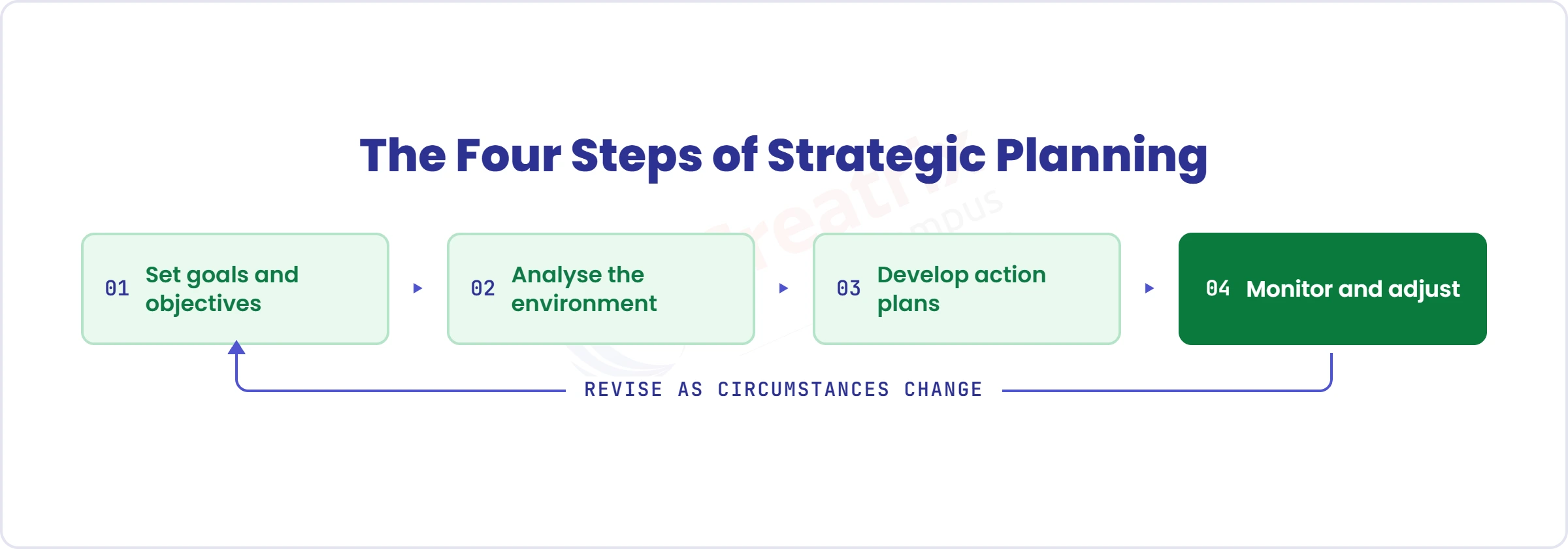
Strategic planning takes an institution along an organised route: defining clear objectives, examining internal and external landscapes, developing executable strategies, and continuously monitoring progress to stay aligned with its long-term vision.
Step 1: Set goals and objectives. Define where the institution is going and what success looks like, in measurable terms.
Step 2: Analyse the environment and identify opportunities. Examine internal strengths and constraints, and external factors such as population change and regulation.
Step 3: Develop action plans and initiatives. Turn priorities into initiatives with owners, resources and timelines.
Step 4: Monitor progress and adjust. Track performance against objectives and revise strategies as circumstances change.
Strategic Initiatives in Universities and Colleges
Strategic initiatives are the proactive steps universities take to address present issues, seize opportunities and reach long-term objectives. Typical examples include enhanced student engagement, improved academic programmes, strengthened institutional infrastructure, enhanced career services, expanded research opportunities, diversity and inclusion programmes, enhanced student support, innovative teaching methodologies, strategic partnerships with industry, and sustainable campus initiatives.
In practice, that might mean co-curricular activities, technology for more interactive learning, curricula updated to match industry needs, funding for faculty growth, or alliances with industry for relevance. What separates a strategic initiative from a wish is an owner, a measurable KPI and a timeline.
Why Plans Stall: Seven Challenges
| Challenge | What it looks like | What helps |
| Agile decision-making | Slow response to emerging trends, no real-time analysis or stakeholder feedback | Real-time data and a regular feedback loop |
| Environmental monitoring | Changes in population or regulation noticed late | Ongoing monitoring of internal and external variables, with owners |
| Opposition to change | Stakeholders resist new processes or technology | Deliberate change management, with stakeholders involved early |
| Dynamic goal-setting | Long-term plans that cannot adapt to shifting priorities | Flexible frameworks with iterative revisions |
| Cooperation and openness | Departments and leadership levels not aligned | Clear communication, shared insights and ownership of strategic projects |
| Decision-making | Choices made without timely data | Data and analytics, so budgets and strategies anticipate trends |
| Scenario planning | Planning for a single future | Imagining several futures and preparing for each |
Uncertainty is not a peril for the institutional playbook. It is an invitation to prepare for several futures.
What Is Changing in 2026
The long-standing trends still hold: decisions based on data insights, personalised and adaptable learning formats, lifelong learning, sustainability and diversity built into decisions, close links with industry and global partners, and agile leadership.
What is new in 2026 is that planning is tested externally, and regulators in several regions show how. The UAE’s Outcome-Based Evaluation Framework (OBEF) scores institutions on 24 KPIs at institution and programme level. In Malaysia, the MQA institutional quality framework IQAF 2025 replaces COPIA 2009, with audits under the new framework beginning in 2026. India’s National Assessment and Accreditation Council (NAAC) has moved to binary accreditation. In the US, federal graduate loan limits change from 1 July 2026, affecting programme viability. The systems differ, but each rewards an institution that can show its KPIs and action plans as evidence of execution.
Where Creatrix Campus Fits
In Creatrix Campus, strategic planning sits in Academic Governance under Institutional Effectiveness, alongside operational planning, KPI management, institutional performance, risk management, action plans, internal programme reviews and continuous improvement. Academic Affairs, Institutional Research and the Strategic Planning Office use it.
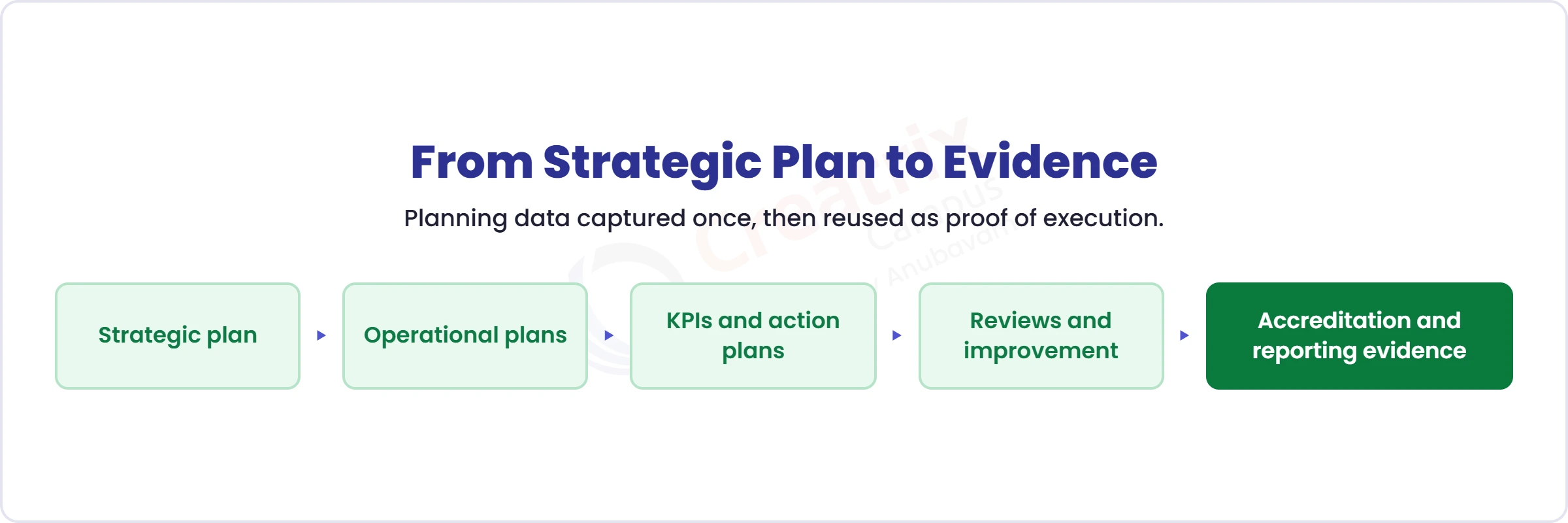
Academic Governance is the system of record for institutional strategy, planning and KPIs, so those artefacts become evidence: Quality Assurance & Accreditation consumes institutional plans, reviews and KPIs, and Ranking Management draws on the same performance data. Planning data is captured once and used wherever it is needed.
Conclusion
A strategic plan is only as strong as the evidence that it is being executed. Institutions that give every initiative an owner and a KPI, track both through the year, and reuse that data for accreditation turn planning from an annual document into a continuous practice.
If you want to see how plans, KPIs and evidence connect on one record, [talk to us about a Tailored Proof Session].
Quick recap
Four steps, owned initiatives, measurable KPIs, and continuous tracking. The same planning data should serve leadership decisions and accreditation evidence.
Frequently asked questions
What is strategic planning in higher education?
What are the key steps in higher education strategic planning?
What are examples of strategic initiatives in universities?
Why do strategic plans stall?
How does Creatrix Campus support strategic planning?
Strategic planning, KPI management and action plans sit in Academic Governance, and their outputs feed accreditation evidence and ranking submissions.
Join the conversation
Want to contribute?
We welcome thought leaders to share ideas and write for our blog.
Become a guest author