
On this page
Most learning outcomes pass every checklist a curriculum committee uses. They start with an action verb, they name a topic, and they're technically measurable. What they rarely say is how deep the student's understanding is supposed to go. SOLO Taxonomy, developed by John Biggs and Kevin Collis, was built to answer a narrower and more useful question than "what should students do." Can this outcome show how connected and transferable a student's understanding needs to become, or does it only describe which content they touched?
Quick answer
SOLO Taxonomy (Structure of Observed Learning Outcomes) describes five levels of increasing structural complexity in student understanding: Pre-structural, Uni-structural, Multi-structural, Relational, and Extended Abstract. Used well, it helps curriculum and assessment leaders write outcomes that specify not just what a student should cover, but how connected and transferable that understanding is meant to be, and it gives assessment design a concrete target to check against.
Article summary
This article moves past the standard SOLO Taxonomy explainer. It keeps the five levels, because they're genuinely useful, but frames them around a sharper question: does a learning outcome reveal the depth of understanding it expects, or just the activity a student performs? It looks at how SOLO relates to Bloom's Taxonomy without treating them as rivals, and at what happens when an outcome's intended depth and its assessment don't actually match. It closes with where outcome design connects to curriculum mapping, rubrics, and attainment evidence, the parts of the process that decide whether a well written outcome ever gets verified.
Key takeaways
- A learning outcome can be measurable and still hide its intended depth of understanding. SOLO Taxonomy exists to make that depth explicit.
- The five SOLO levels, from Pre-structural through Extended Abstract, describe how connected a student's understanding is, not which cognitive process they used.
- SOLO and Bloom's Taxonomy answer different questions and work best read together, not as competing frameworks.
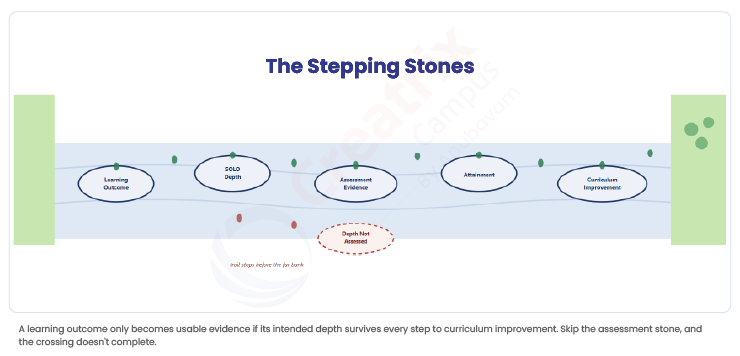
- An outcome written at Relational or Extended Abstract level only means something if the assessment is actually capable of detecting that level of connection.
- Outcome depth becomes an institutional asset, not a course level habit, once it's mapped through curriculum design, rubrics, and attainment evidence.
The Outcome Should Show Depth, Not Just Activity
Let's be honest about how most learning outcomes get written. Someone opens a verb list, picks something that sounds appropriately rigorous, "analyze," "evaluate," "synthesize," and attaches it to a topic. The outcome is grammatically fine. It's measurable in the narrow sense that you can check whether the activity happened. What it doesn't tell you is whether "analyze the causes of the French Revolution" means listing three causes side by side, or explaining how those causes interacted to produce an outcome no single cause would have produced alone. Those are wildly different depths of understanding, and the verb alone can't distinguish them.
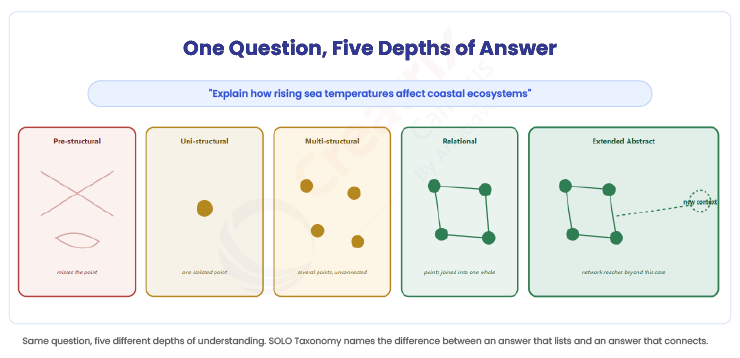
This is the problem SOLO Taxonomy was built for. Rather than categorizing outcomes by cognitive process, the way Bloom's Taxonomy does, SOLO categorizes them by how structurally complex the expected understanding actually is. It asks whether a student is meant to hold isolated facts, connect several facts within one context, or generalize a connection to a context they haven't seen before. Five levels capture that progression.
| SOLO Level | What Student Understanding Looks Like | Outcome / Assessment Implication |
| Pre-structural | Little or no grasp of the task; response misses the point or relies on irrelevant information | Not a target for a learning outcome. Indicates the student hasn't engaged the content yet |
| Uni-structural | One relevant idea or fact is identified and used, in isolation | Outcome verbs like "identify" or "define." Assessment checks for a single correct point, not connections |
| Multi-structural | Several relevant facts or ideas are identified, but handled separately rather than connected | Outcome verbs like "list" or "describe." Assessment can reward breadth even without integration, a common false ceiling |
| Relational | Facts and ideas are connected into a coherent whole, within the context they were taught | Outcome verbs like "compare," "analyze," "explain how." Assessment must require students to show the connections, not just state them |
| Extended Abstract | Understanding is generalized to new, unfamiliar contexts and used to generate new ideas | Outcome verbs like "create," "evaluate," "justify." Assessment must present a genuinely novel scenario, not a rehearsed one |
Notice what the table doesn't do. It doesn't ask "what should students know." It asks "how far does their understanding need to reach." That's the distinction the old version of learning outcome guidance tends to skip, and it's the one that actually changes how an outcome gets written.
Here's a habit worth watching for. Multi-structural outcomes are dangerously easy to write and dangerously easy to mistake for something more rigorous. "Describe the key stakeholders in a curriculum redesign" sounds substantial. It's still Multi-structural if a student can score full marks by listing stakeholders without explaining how their interests interact. Curriculum leaders auditing outcomes for depth should treat Multi-structural as the level where an article, and an outcome, most often overstates itself.
Can Assessment Actually See the Level You Designed?
Now imagine this. A programme chair writes an outcome at the Relational level: "Students will explain how curriculum design decisions affect student retention outcomes." It's a well constructed outcome. It names a real connection, not just a topic. Then the accompanying assessment asks students to define retention, define curriculum design, and list three factors that influence each. That assessment is Multi-structural. It can't detect a Relational answer even if one exists, because it never asks a student to connect the two ideas.
This is where a lot of outcome design effort quietly goes to waste. The outcome specifies a depth. The assessment specifies a different, usually lower, depth. Whoever grades the work ends up scoring what the assessment actually measures, not what the outcome intended. On paper, the outcome was met. In practice, no one can say whether the deeper understanding it described was ever demonstrated.
SOLO and Bloom's Aren't Competing Frameworks
Few institutions realize they don't have to choose between SOLO and Bloom's Taxonomy, because the two frameworks aren't answering the same question. Bloom's describes the cognitive process a student performs: remembering, applying, evaluating, creating. SOLO describes the structural complexity of what that process produces: isolated, connected within context, or generalized beyond it. A student can "analyze" (a Bloom's process) at a Multi-structural level, producing a list of disconnected observations, or at a Relational level, producing an integrated explanation. Bloom's tells you the verb. SOLO tells you whether the answer actually holds together.
| Aspect | Bloom's Taxonomy | SOLO Taxonomy |
| What it describes | The cognitive process a student performs (Remember, Understand, Apply, Analyze, Evaluate, Create) | The structural complexity and connectedness of the understanding a student demonstrates |
| Best used for | Choosing the type of thinking an outcome or activity should require | Checking whether the expected depth of that thinking is explicit and assessable |
| How they combine | Sets the process | Sets the depth expected within that process |
Used together, they cover two different failure points. Bloom's helps catch an outcome that asks for too little cognitive work. SOLO helps catch an outcome, and an assessment, that never specifies how connected the resulting understanding needs to be. Neither one replaces the other, and treating them as rivals in curriculum discussions usually just means neither gets applied carefully.
Where Creatrix Campus Fits
Writing an outcome at the right SOLO level is a design decision. Making sure that decision survives contact with curriculum mapping, assessment design, and attainment reporting is an operational one, and it's usually where the depth gets lost. Creatrix Campus connects outcome design to curriculum management and to assessment and attainment tracking within one governed system, so a rubric, an assessment item, and the outcome it's meant to verify stay linked rather than living in separate documents that drift apart over time.
That connection doesn't write better outcomes, and it doesn't decide what SOLO level a course should target; that judgment stays with faculty and curriculum leaders. What it does is make the intended depth of an outcome traceable through to the evidence that's supposed to confirm it, so a programme review can show not just that outcomes were met, but that the assessments actually had the reach to check the depth those outcomes described.
Conclusion
A measurable outcome says what students should demonstrate. A well designed SOLO outcome also makes the expected depth of that understanding visible, and visible enough that an assessment can actually be built to check it. That second part is where most outcome design work quietly stops short. Before the next curriculum review, it's worth asking your committee one question: for our Relational and Extended Abstract outcomes, does the assessment attached to each one actually have the structural reach to detect that level, or only the level below it? If you're ready to see how outcome design, curriculum mapping, and attainment evidence can stay connected instead of drifting apart, request a demo of Creatrix Campus.
Quick recap
- SOLO Taxonomy has five levels, Pre-structural, Uni-structural, Multi-structural, Relational, Extended Abstract, describing how connected student understanding is, not which cognitive process was used.
- Multi-structural outcomes are the easiest to mistake for something more rigorous; they reward breadth without requiring connection.
- SOLO and Bloom's Taxonomy answer different questions and are meant to be used together, not compared as rivals.
- An outcome's intended depth only counts if the assessment attached to it can actually detect that depth.
Frequently asked questions
What does SOLO stand for in SOLO Taxonomy?
Is SOLO Taxonomy better than Bloom's Taxonomy?
How do I know if my outcome is Multi-structural instead of Relational?
Can an assessment be at a lower SOLO level than the outcome it's meant to measure?
Join the conversation
Want to contribute?
We welcome thought leaders to share ideas and write for our blog.
Become a guest author