

On this page
Attendance systems are very good at answering one question:
Was the student there?
The more useful question for Advisors and academic leaders is different:
Has something changed?
One missed class may mean very little. A student who suddenly stops attending a previously consistent course may deserve attention. Repeated Friday absences may reveal a pattern. Growing absence across a cohort may point to something larger than individual disengagement.
The attendance register captures the event.
The institution still has to interpret the signal.
The value of attendance is not simply knowing who was absent. It is recognising meaningful change early enough to respond appropriately.
Quick answer
Attendance tracking becomes more useful when institutions look beyond individual absences and identify meaningful changes in attendance behaviour, connect those changes with relevant student context, and give Advisors or support teams enough information to decide what should happen next. The aim is not to turn every absence into an alert. It is to recognise the patterns that deserve attention before disengagement becomes harder to reverse.
Article summary
| Problem | Attendance systems often record absence without helping teams distinguish routine absence from meaningful change. |
| Who this is for | Student Support leaders, Registrars, Advisors, Deans, Faculty leaders, Retention teams, and Academic Operations. |
| What changes | Attendance moves from a static record to an early student-support signal. |
| Why it matters | Earlier context gives institutions more opportunity to support a student before stronger academic problems appear. |
| Outcome | More focused intervention, less alert noise, and better use of attendance information. |
Key takeaways
- One absence is information. A meaningful change in pattern can be a signal.
- Attendance should prompt questions, not automatic conclusions about a student.
- Advisors need context before they need more alerts.
- The objective is proportionate early support, not surveillance or unnecessary intervention.
Why This Matters
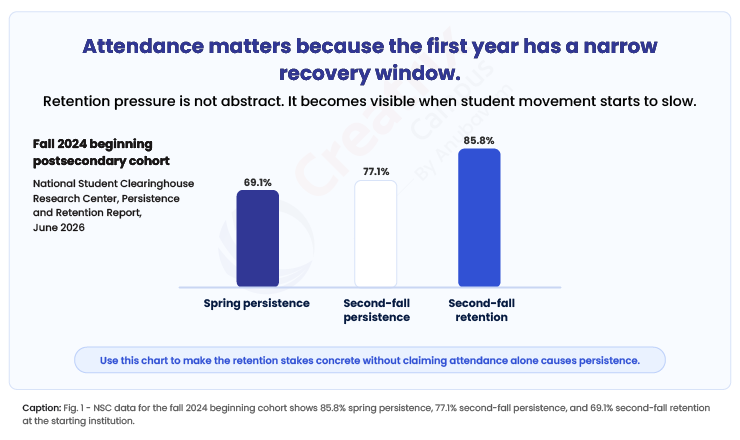
The National Student Clearinghouse Research Center reports persistence and retention data that shows how student continuation changes between terms and academic years.
Universities usually see the final retention outcome much later than the behaviours that preceded it.
Attendance can be one of those earlier signals.
But that does not mean every absence predicts dropout. The stronger institutional capability is knowing when attendance has changed enough to justify a closer look.
Attendance should help the university ask a better question earlier, not reach a conclusion earlier.
Why Counting Absence Is Too Small
Traditional attendance reporting flattens very different situations into the same status: absent.
But the surrounding pattern can change what that absence means.
| Attendance pattern | Question worth asking |
| One isolated absence | Is any action necessary at all? |
| Repeated absence from one course | Is something specific happening around this course or schedule? |
| Sudden decline from a previously consistent student | What changed? |
| Similar decline across a cohort | Is this an individual issue or a wider academic/operational pattern? |
| Repeated missed practical sessions | Is the student at risk of falling behind in a component that is difficult to recover? |
This is an important distinction because a risk signal is not a diagnosis.
A student may be dealing with an academic difficulty, work pressure, timetable friction, financial stress, health or personal circumstances, or something entirely unrelated to risk.
Attendance gives the institution a reason to look.
It should not pretend to know the answer before someone has spoken to the student.
Why Advisors Need Context, Not Just Alerts
It is easy to automate another alert.
It is much harder to make that alert useful.
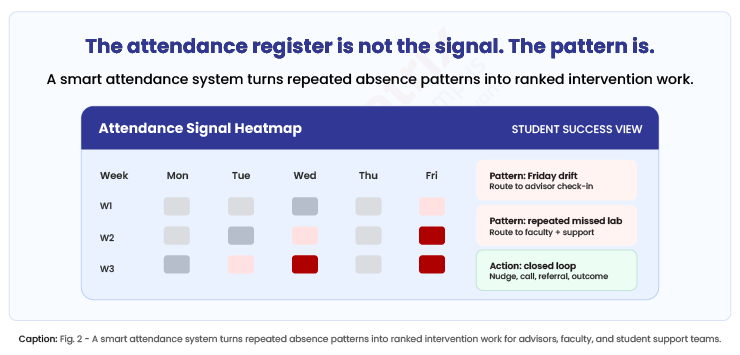
An Advisor who receives dozens of “student absent” notifications still has to work out which ones matter. Before reaching out, they may need to know whether the pattern is new, whether academic performance has also changed, whether the student has already spoken with someone, or whether another institutional issue provides useful context.
This is why student success advising matters.
Creatrix Campus Student Advising supports a 360-degree student view that includes academic standing, attendance, risk factors, and financial holds. The Advisor Workbench also includes alerts, case notes, communication logs, while the student experience includes nudges and appointment scheduling.
The point is not to make an Advisor react to more information.
It is to help them decide:
Who needs attention now, and what do I need to know before I contact them?
That turns attendance from notification volume into better advising context.
What Smart Attendance Visibility Should Show
A useful attendance view should make a small number of things clear:
- where attendance behaviour has meaningfully changed,
- whether the pattern is isolated or recurring,
- what relevant student context is already available,
- whether someone has already responded,
- what follow-up has been recorded,
- whether the pattern continues after support.
That connection with student lifecycle management matters because attendance is not an isolated student record. Attendance sits within institutional operations, while student records and progression sit within the student lifecycle, and role-aware visibility matters here because intelligence should follow trustworthy, connected structure rather than sit above fragmented data.
A student information system may preserve the record. The wider operating question is whether the right person sees enough context to do something useful with it.
Where Creatrix Campus Fits
This is where Creatrix Campus becomes relevant.
The stronger positioning is not “AI watches attendance and predicts who will fail.”
That would oversimplify both students and the product.
Creatrix Campus Student Advising already brings together academic standing, attendance, risk factors, financial holds, alerts, Advisor notes, communication history, predictive advising, and smart nudges within the advising experience.
Within the wider Creatrix operating model, attendance also belongs to the academic Operations lifecycle rather than existing as an isolated tracking feature.
That creates a more useful role for attendance.
Faculty can record what is happening. Advisors can see wider student context. Students can receive appropriate nudges or support. Leaders can understand patterns without reducing every student to an absence percentage.
The result is not stricter attendance monitoring.
It is a better chance of noticing change while a conversation can still help.
Conclusion
Attendance tracking becomes useful when institutions stop treating every absence as equally meaningful and start recognising the patterns that deserve human attention. The goal is not to predict a student's future from a register, but to give the right person enough context to ask the right question early.
If one of your previously consistent students stopped attending this week, how long would it take before the right person noticed the change and knew whether anyone had already responded? Turn attendance into student support signals.
Quick recap
Attendance is valuable as an early signal, not simply a compliance record. The stronger model looks for meaningful changes, combines attendance with relevant student context, avoids unnecessary alert noise, and gives Advisors a clearer basis for timely support. The goal is not to turn absence into a prediction. It is to turn a meaningful change into an earlier conversation.
Frequently asked questions
Why is attendance important in higher education?
Does one absence mean a student is at risk?
What is an attendance risk signal?
Should every attendance alert trigger an intervention?
Should attendance tracking be used for surveillance?
How can Creatrix Campus support attendance-led intervention?
Join the conversation
Want to contribute?
We welcome thought leaders to share ideas and write for our blog.
Become a guest author