
On this page
A timetable problem rarely begins as a major failure.
It starts with small compromises: one extra faculty section, a required lab squeezed into the available slot, a shared course overlapping another programme, or a room assumed to be suitable without checking the full delivery requirement.
Individually, each decision may look manageable. Together, they create risk.
For a Head of Department, the real question is therefore not whether the timetable is ready to publish. It is whether the department understands the academic consequences hidden inside it.
The timetable may go live in one day. Its consequences can last the entire term.
Quick answer
Scheduling risk starts before the timetable goes live because small compromises around faculty workload, required-course access, rooms, labs, programme sequencing, and late changes can create larger problems after publication. Departments need to identify those risks before release, when they can still correct them without disrupting students, faculty, or academic delivery.
Article summary
| Problem | Departments often discover scheduling risk only after students and faculty are affected. |
| Who this is for | Heads of Department, Deans, Registrars, Academic Operations leaders, Scheduling teams, and Faculty Workload planners. |
| What changes | Scheduling moves from timetable production to pre-publication risk control. |
| Why it matters | Small allocation decisions can affect workload, progression, facilities, and academic governance. |
| Outcome | Earlier risk visibility, fewer disruptive corrections, and stronger confidence before publication. |
Key takeaways
- Scheduling risk is created before students see the timetable.
- Heads of Department inherit the academic consequences of hidden scheduling compromises.
- Most problems arise from interactions between constraints, not one bad time slot.
- Pre-publication validation should cover workload, progression, resources, change impact, and decision traceability.
- The goal is not simply faster scheduling. It is a timetable the department can defend and deliver.
Why This Matters
AACRAO examines class scheduling through practice, policy, data use, and technology, which reflects how much more scheduling involves than filling rooms and time slots.
For Heads of Department, that becomes obvious after publication. Students report clashes, faculty question workload, Programme Heads identify progression problems, and Registrars handle corrections. Yet many of those problems were visible earlier in the scheduling decisions themselves.
Departments do not primarily need a better way to manage complaints. They need a better way to see risk before complaints exist.
Why Scheduling Risk Is a Department Governance Problem
A timetable records academic choices.
It shows who teaches, when courses are available, whether required sequences work, how facilities are allocated, and how teaching responsibilities are distributed.
That makes scheduling part of academic governance.
A course clash can affect progression. A workload imbalance can affect delivery quality. A room mismatch can disrupt the intended teaching format. A late change can create new conflicts across programmes.
The problem is that these consequences often appear after the scheduling decision has already been approved.
That is why a connected faculty workload view matters. A schedule may appear balanced by number of sessions while hiding very different teaching demands across laboratories, large classes, shared programmes, or back-to-back delivery.
Scheduling fairness cannot be judged from the timetable grid alone.
The Five Risks Departments Usually See Too Late
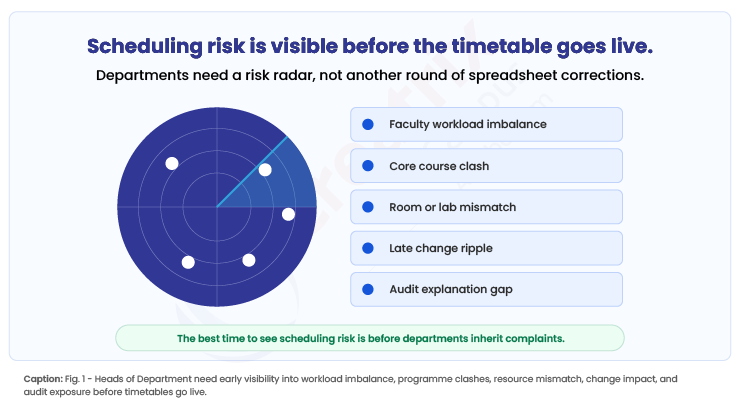
Most departments are not missing these risks because they are careless. The problem is that each one can look minor before publication.
| Risk | Before publication | After publication |
| Faculty workload imbalance | An extra section appears manageable | Workload disputes and delivery pressure |
| Core course clashes | Two required subjects share a slot | Student progression is disrupted |
| Resource mismatch | A room or lab appears available | Delivery requirements cannot be met |
| Late-change ripple | One adjustment looks harmless | New conflicts appear elsewhere |
| Weak allocation evidence | The decision is understood informally | The department cannot easily explain the logic later |
The important lesson is that these risks are connected.
Moving one class may resolve a room problem but create a faculty conflict. Balancing faculty workload may shift a required course into a slot that affects students. Accommodating one programme can create another programme’s clash.
The scheduling risk is usually in the relationship between decisions.
Why Manual Scheduling Makes Risk Harder to See
Manual scheduling can work well while the department is small enough for people to carry much of the complexity in their heads.
Growth changes that.
More programmes mean more shared courses. More faculty create more availability constraints. More electives create more possible student pathways. Specialist rooms and laboratories introduce further dependencies.
Spreadsheets can show each constraint, but teams still have to mentally calculate how those constraints affect one another.
That becomes especially important for student progression. A required course may technically be scheduled and still be difficult for the intended cohort to access because another compulsory activity occupies the same period.
The issue is therefore not that manual scheduling is inherently poor.
It is that academic complexity eventually becomes larger than manual visibility.
What Departments Should Validate Before Publication
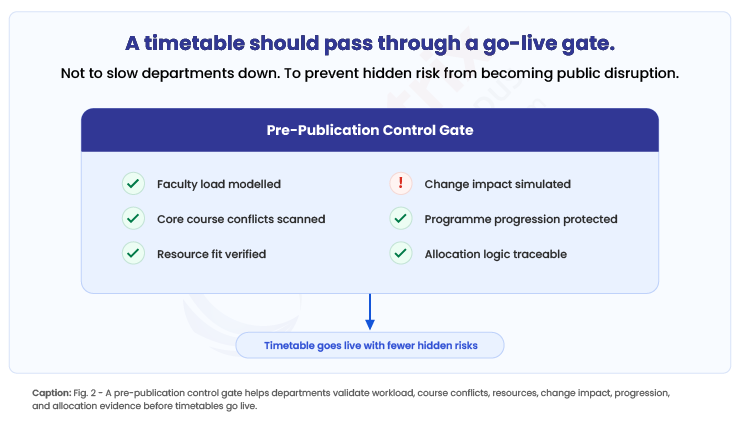
Before approving a timetable, a department should be able to answer five questions.
Is workload genuinely balanced?
Look beyond session counts to teaching intensity, laboratories, shared-programme responsibilities, and scheduling patterns.
Can students progress without avoidable clashes?
Required and prerequisite courses need workable pathways, not simply available slots.
Do the resources match the teaching requirement?
Rooms, laboratories, equipment, capacity, and delivery format all matter.
What happens if something changes?
A timetable is interconnected. Departments need to understand the downstream effect of moving one section.
Can the allocation decision be explained later?
Scheduling logic should remain traceable, particularly where decisions affect workload, programme delivery, or academic governance.
That last point also connects to accreditation readiness. The institution may eventually need to explain how teaching capacity, student access, and academic delivery were governed.
The strongest pre-publication check is therefore not:
“Have we filled every slot?”
It is:
“Have we seen the risks created by the slots we filled?”
Where Creatrix Campus Fits
Creatrix Campus becomes relevant at this pre-publication stage.
Not simply as a way to generate a timetable, but as a way to bring more of the scheduling context together before the department commits to it.
Creatrix Campus connects academic scheduling, faculty workload, programme requirements, student pathways, rooms and resources, timetable changes, and decision traceability.
For Heads of Department, that means greater visibility before issues become public. Scheduling teams can identify potential clashes earlier, Deans can see workload and programme-delivery pressures more clearly, and late changes can be assessed with better understanding of their wider impact.
The outcome is not simply a cleaner timetable.
It is greater confidence that the timetable will hold once academic delivery begins.
Conclusion
Scheduling risk does not begin when the timetable fails. It begins when small academic compromises are approved without enough visibility into their wider consequences.
Before your next timetable goes live, can your department see which decisions are likely to return later as workload disputes, student clashes, or academic exceptions? Run a pre-publication scheduling check with Creatrix Campus.
Quick recap
Scheduling risk starts before publication because faculty workload, programme pathways, rooms, shared courses, and last-minute changes are interconnected. Departments that validate those relationships early can move from correcting timetable problems after students feel them to governing academic delivery before the term begins.
Frequently asked questions
What are the main scheduling risks for higher education departments?
Why are scheduling risks important for Heads of Department?
Why does manual scheduling become harder as departments grow?
What should departments check before publishing a timetable?
How can scheduling affect accreditation readiness?
How can Creatrix Campus support department scheduling?
Join the conversation
Want to contribute?
We welcome thought leaders to share ideas and write for our blog.
Become a guest author