

On this page
On a Monday morning, a dean is asked a simple question: is teaching workload fair across the school? The honest answer sits in four spreadsheets, two timetables and a stack of emails. By the time it is assembled, the question has moved on.
Deans are the academic leaders of a school or faculty. They shape curriculum, support faculty, steer teaching quality and answer for student outcomes, often with data they have to build by hand. This guide covers what deans do, what makes the role hard, eight strategies deans use to foster innovation, a real example from a pharmacy school, and how connected systems help.
Quick answer
The dean is the academic leader of a school or faculty, responsible for curriculum quality, faculty development and workload, teaching and learning, research direction, student outcomes and accountability for evidence. Effective deans combine academic vision with shared, visible data, so decisions about workload, curriculum and innovation can be explained and trusted.
Article summary
This guide explains the dean’s role, the challenges that make it hard, eight strategies for fostering innovation in teaching and engagement, and how connected systems give deans the evidence they need.
Key takeaways
- A dean’s influence reaches curriculum, faculty, teaching quality, research and student engagement, and so does their accountability.
- The hardest parts of the role are often operational: workload equity, curriculum complexity, timetabling and thin evidence.
- Innovation works best when deans back it with faculty development, student feedback loops and safe room to experiment.
- Faculty trust a system when they can see their workload and how decisions are made.
- Evidence that is connected across curriculum, timetable and workload lets deans lead with confidence, not guesswork.
What Does a Dean Do in Higher Education?
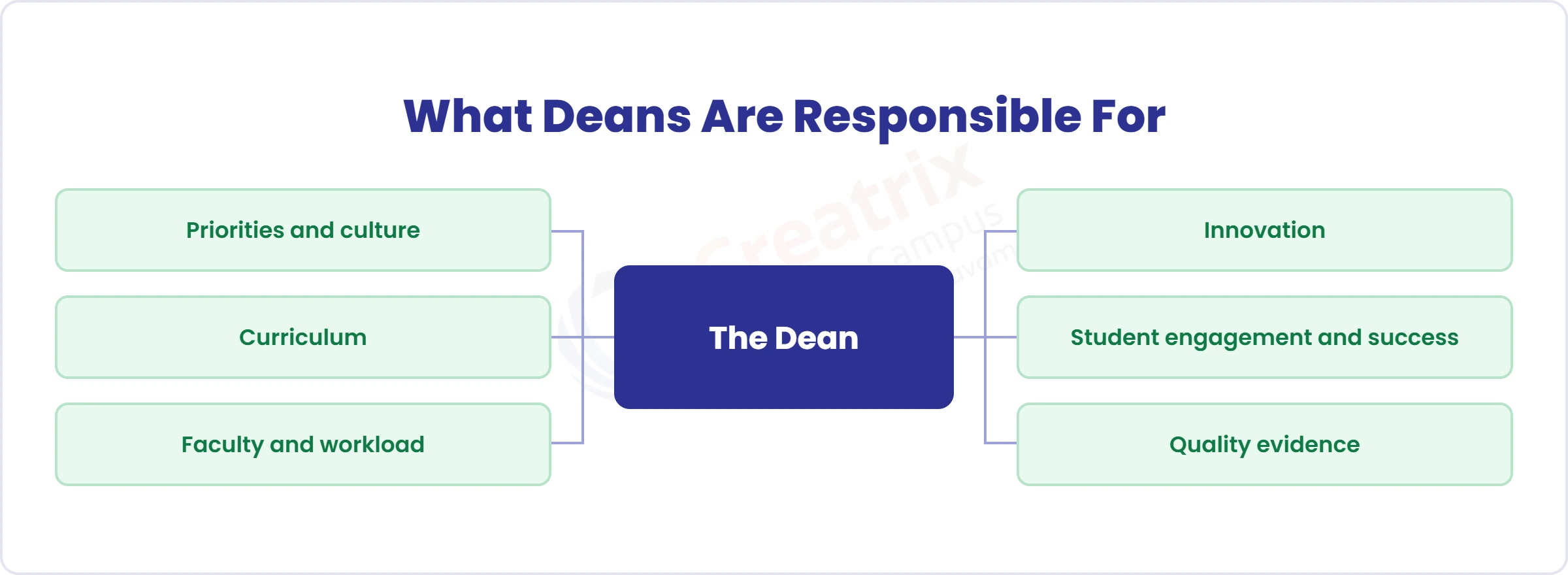
Across all parts of the institution’s learning environment, deans sit at the centre of academic leadership. Their influence reaches student outcomes, research and teaching, alongside administrative tasks. Typical responsibilities include:
- Setting priorities and academic culture. Defining the vision for the school and the culture around it.
- Guiding curriculum development. Making sure courses reflect current developments in the field.
- Empowering faculty. Recruiting, developing, evaluating and supporting educators, and allocating workload fairly.
- Driving innovation. Encouraging new teaching approaches and technology.
- Boosting student engagement and success. Backing initiatives that improve involvement, retention and performance.
- Accounting for quality. Providing evidence to accreditors, leadership and the community.
What Makes the Dean’s Job Hard?
The role asks a dean to lead people and process at once. Six pressures come up repeatedly.
| Challenge | What it looks like | What helps |
| Workload equity | Unequal teaching, research and admin loads, with processes faculty cannot see | Transparent workload data that faculty and deans view together |
| Curriculum complexity | Multiple layers to manage, such as learning outcomes, competency frameworks and professional standards | A single curriculum and outcome map |
| Scheduling conflicts | Manual timetabling for courses, faculty and rooms | Automated scheduling with conflict alerts |
| Performance blind spots | Evaluation and promotion decisions made without a complete picture | Evaluation frameworks and promotion tracking in one place |
| Faculty trust | Systems adopted slowly, or avoided | Visible rules, fair treatment and training that people can follow |
| Evidence for quality | Accreditation data assembled late | Evidence generated as the work happens |
Faculty adoption of any system depends on faculty trust in it, so fairness and transparency are not extras. They decide whether the system gets used.
Eight Strategies Deans Use to Foster Innovation
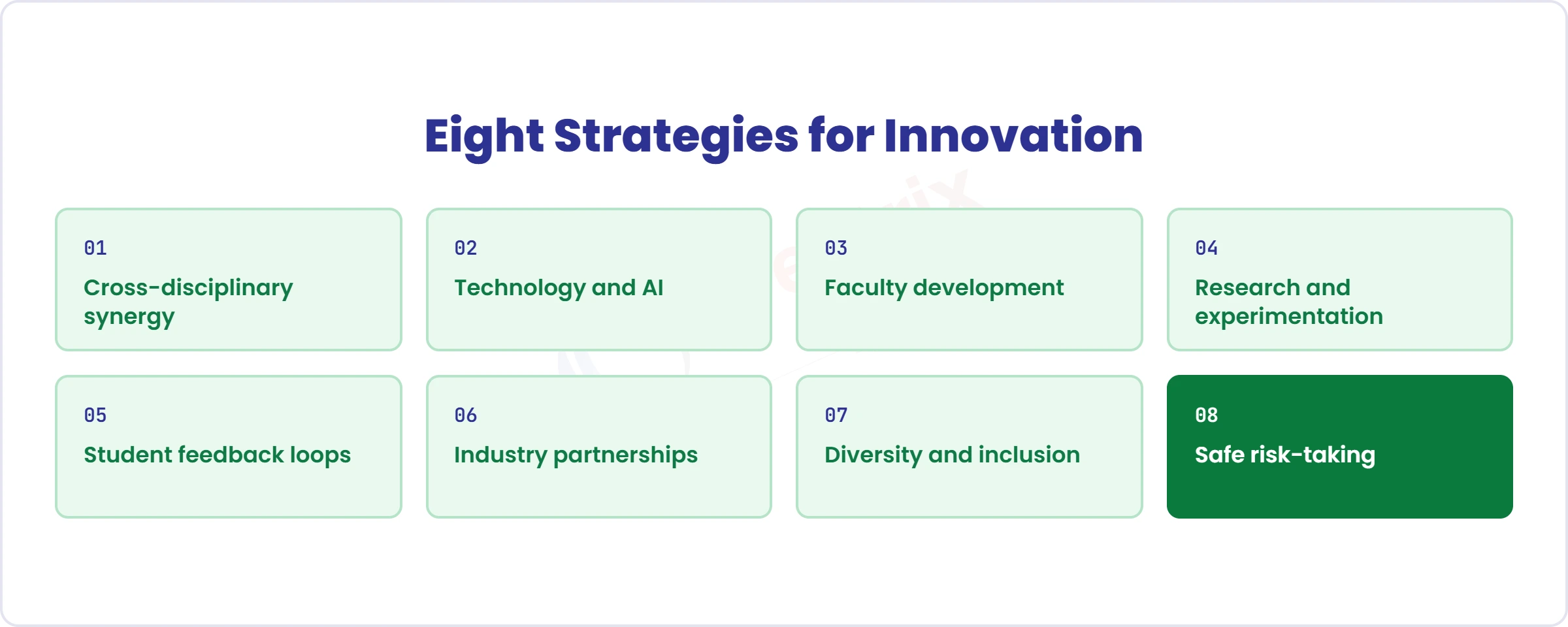
Deans who lead innovation well tend to do eight things.
- Create synergy across disciplines. Bring students and faculty from different fields together on real problems, which builds critical thinking and teamwork.
- Use technology to accelerate learning. From immersive and gamified tools to AI, with clear guidance on faculty AI literacy and assessment integrity.
- Invest in faculty development. Give educators time and training to redesign teaching around active learning and student-centred methods.
- Support research and experimentation. Fund faculty to test new curricula and teaching models, and map the results back to the curriculum.
- Build feedback loops. Use student evaluations, surveys and faculty evaluation tools to learn what works, and change course delivery accordingly.
- Partner with industry. Create experiential learning that prepares students for work.
- Treat diversity and inclusion as innovation drivers. Diverse perspectives bring richer discussion and new ideas.
- Make it safe to take risks. Give faculty and students room to try, learn and adapt without fear of failing.
A Pharmacy School Example: University of Otago
The University of Otago’s School of Pharmacy shows what connected evidence changes. Dean Stephen Duffull said: “Creatrix’s curriculum mind mapping based on learning outcomes, competency standards, and graduate attributes is excellent.”
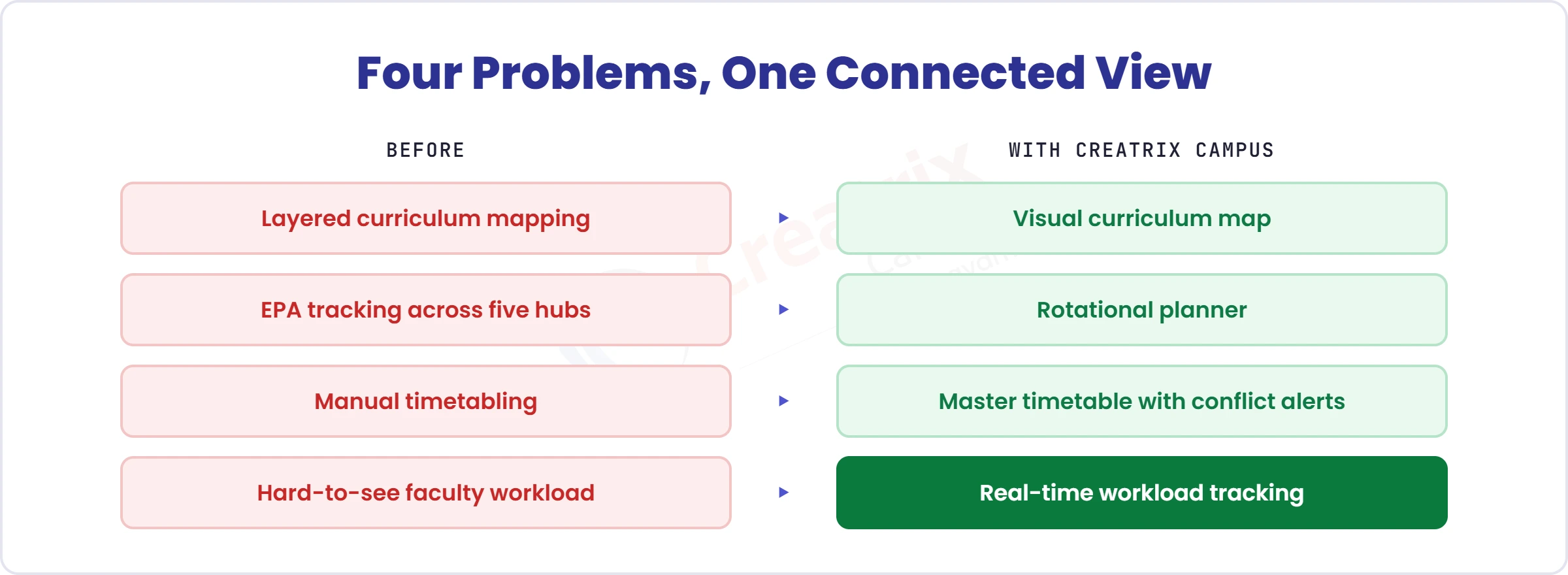
The school was juggling four things. Curriculum mapping had many layers, including learning outcomes, student learning outcomes, entrustable professional activities (EPAs), competency frameworks and professional standards, and was hard to manage by hand. EPA tracking and rotational planning spanned five hubs. Timetabling was manual and caused conflicts. And faculty workload needed a more transparent, automated way to be measured and balanced.
With Creatrix Campus, the school moved to a visual curriculum map tying outcomes, assessments and professional competencies together, a rotational planner for EPA tracking, an automated master timetable with conflict alerts that works with Google Calendar, and real-time workload tracking with visual analysis. The reported results were faster implementation, reduced admin overhead, more balanced workloads and one system for curriculum and EPA management.
Where Creatrix Campus Fits
Creatrix Campus gives deans the connected view the Otago example describes. Curriculum and outcome mapping are authored in Academic Governance and measured in Assessment & Outcomes. For medical, nursing, pharmacy and other placement-based programmes, Work-Based & Clinical Learning adds rotations, logbooks and EPAs, and activates by institution type. Timetabling and Scheduling in Academic Operations handles courses, faculty and rooms, and Faculty Lifecycle holds workload, appraisal and progression.
For deans and Faculty Affairs leaders, that means one place for workload, teaching, research and progression, with the equity and accountability view they need.
Conclusion
Deans do not lack ideas. They lack the shared evidence to carry them out and defend them. When curriculum, timetable and workload sit in one connected view, a dean can answer the Monday-morning question in minutes and spend the rest of the week on teaching, faculty and students.
If you want to see how that would look for your school, talk to us about a Tailored Proof Session.
Quick recap
Lead with vision, back it with visible evidence. Fair workload, clear curriculum maps and conflict-free timetables are what make innovation sustainable.
Frequently asked questions
What does a dean do in higher education?
How can deans foster innovation in teaching?
What challenges do deans face?
How can deans make faculty workload fair and transparent?
How does Creatrix Campus support deans?
Join the conversation
Want to contribute?
We welcome thought leaders to share ideas and write for our blog.
Become a guest author