
On this page
Most universities don't keep running old systems because those systems still work well. They keep running them because the current setup, however flawed, is known, and replacing it looks like trading a familiar problem for an unfamiliar one. That hesitation is reasonable. It is also how legacy systems quietly become permanent.
Quick answer
Universities struggle to replace legacy systems mainly because of migration debt, the accumulated data lock-in, custom integrations, and staff workarounds built up over years, which make switching feel riskier than staying put. The friction is real, but it points to a fix: choosing a platform built to be adopted lifecycle by lifecycle rather than one requiring a single disruptive migration.
Article summary
Institutions rarely delay system replacement out of denial. They delay because years of custom integrations, workarounds, and institutional knowledge tied to the current system make switching look expensive and risky, while staying put has no visible cost on any single day. That asymmetry is what keeps legacy systems in place long after they stop serving the institution well. This article explains why that friction builds up, and why the answer is not more willingness to change, but a different kind of platform, one that can be adopted gradually instead of requiring a full replacement at once.
Key takeaways
- Legacy systems persist because switching costs are visible and immediate, while staying-put costs are hidden and gradual.
- Migration debt, data lock-in, integration debt, and faculty retraining accumulate quietly over years.
- A single disruptive migration is the wrong comparison. Modular, lifecycle-based adoption changes the risk calculation entirely.
- Institutions that can replace one system at a time avoid ever facing an all-or-nothing migration decision again.
Why Staying Put Feels Safer Than It Is
Most universities already know their current systems have real limitations. Data sits in silos, reports take longer than they should, and approvals move slower than the institution's own plans. None of that is news to the people running it. The reason systems stay in place anyway is that the cost of switching is immediate and visible, new training, migration risk, a transition period, while the cost of staying is spread out and easy to defer.
Each department develops its own workarounds for the limits it lives with. Staff learn exactly which reports to double check and which shortcuts get the job done. Replacing the system means interrupting all of that at once, which makes the risk feel concentrated even when the underlying problems are already costing the institution time every single week.
| Visible Costs of Staying | Hidden Costs of Staying |
| Licensing and maintenance fees on the current system | Staff time spent on manual reconciliation and re-entry |
| Cost of point integrations added over time | Reduced audit and accreditation readiness from scattered data |
| Training on outdated interfaces | Declining staff confidence in the numbers they report |
| Vendor charges for customization | Slower response when leadership needs current information |
The Real Barrier Is Migration Debt, Not Willingness
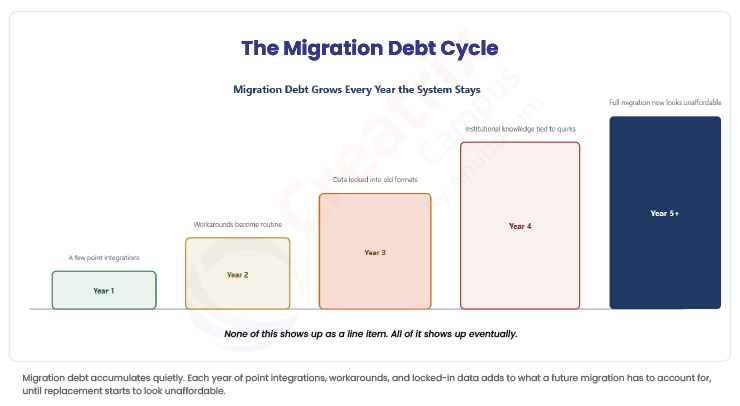
It is tempting to treat this as a change management problem: get leadership aligned, communicate clearly, and staff will come around. That underestimates what is actually accumulating underneath the surface. Every custom integration built to connect the legacy system to something newer adds a dependency that has to be accounted for before any migration. Every year of data entered in a format specific to that system adds to what has to be cleaned or converted. Every staff member who has learned the system's quirks represents institutional knowledge that a rushed migration can lose.
This is migration debt, and it behaves like other forms of debt: it is easy to accumulate a little at a time and expensive to pay off all at once. The longer an institution waits, the larger a single migration project becomes, and the more it starts to look like the kind of all-or-nothing risk nobody wants to own.
The mistake is treating the solution as more resolve to push through one big migration. The more durable fix is choosing a platform that never requires that kind of all-or-nothing decision again.
What Changes When the Platform Is Built to Be Replaced Gradually
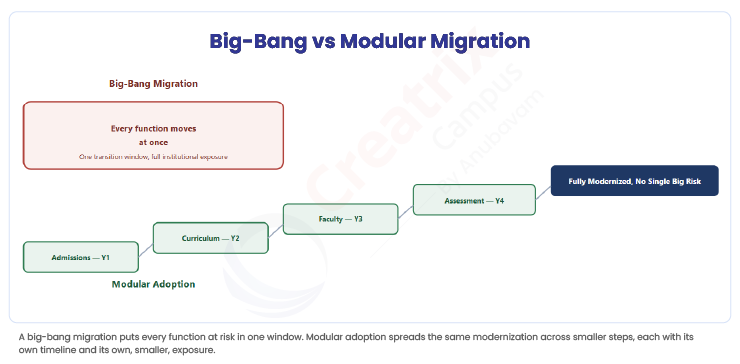
A platform designed around separate academic lifecycles, admissions, curriculum, faculty, assessment, can be adopted one lifecycle at a time. That changes the nature of the decision entirely. Instead of a single high-risk migration covering every function at once, an institution can replace admissions this year and curriculum the next, while the rest of operations continues on schedule.
| Big-Bang Migration | Modular, Lifecycle-Based Adoption |
| Every function must move at once | Each lifecycle can move on its own timeline |
| Risk concentrated into one transition window | Risk spread across smaller, manageable transitions |
| Old and new systems rarely coexist cleanly | Institution can run old and new side by side during transition |
| A failed migration affects the whole institution | A rough transition in one area doesn't stall the rest |
This is a structural comparison based on how the two approaches distribute risk, not a claim that modular adoption removes risk entirely. It changes how much of the institution is exposed to any single transition at one time.
Where Creatrix Campus Fits
Creatrix Campus is built around separate academic lifecycles, admissions, curriculum, faculty, assessment, and accreditation, so institutions can modernize one area at a time instead of committing to a single migration across every function. A university might start with student records while its existing systems continue running elsewhere, and expand from there as each transition proves out. You can see the reasoning behind this lifecycle-based approach on how the platform is structured to work this way. This does not remove the real work of data migration and staff training. It reduces how much of the institution has to change at the same moment.
Conclusion
The friction universities feel when considering system replacement is not a sign they should wait longer. It is a sign the replacement approach matters as much as the decision to replace. See how Creatrix Campus can help you modernize one lifecycle at a time.
Quick recap
Universities delay replacing legacy systems because switching costs are immediate and visible while staying-put costs build up quietly over years, through migration debt, data lock-in, and integration dependencies nobody planned for. The fix is not more willingness to endure a disruptive migration. It is choosing a platform built around separate academic lifecycles, so modernization can happen one area at a time instead of all at once.
Frequently asked questions
Why do universities struggle to replace legacy systems?
What is migration debt in higher education technology?
Is a single large system migration the only way to modernize?
How does data lock-in affect the decision to switch systems?
Does modular adoption remove the risk of switching systems entirely?
Join the conversation
Want to contribute?
We welcome thought leaders to share ideas and write for our blog.
Become a guest author