

On this page
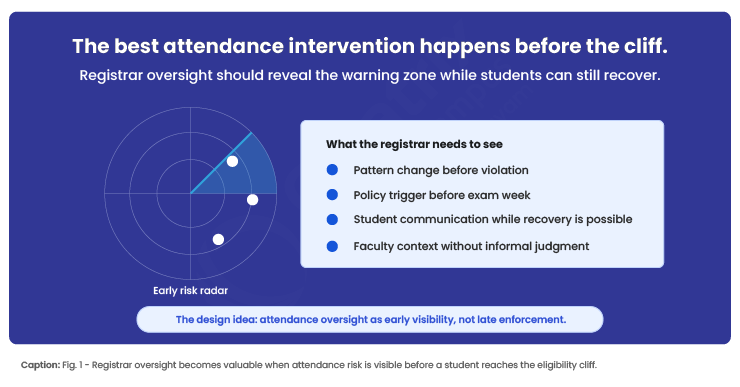
Attendance problems rarely become serious on the day a student loses eligibility.
They become serious earlier, when absence patterns are already visible but the institution has not yet connected them to warning thresholds, communication, faculty context, or intervention.
Then the policy threshold is crossed.
What was previously an attendance concern becomes a question of exam eligibility, fairness, exceptions, appeals, and evidence.
That is where the Registrar gets pulled in.
Not because the Registrar should police classroom attendance, but because the office is often expected to answer a much harder question:
Can the institution prove that the student was treated fairly before the consequence was applied?
If that question is being asked for the first time at exam clearance, the intervention has already started too late.
Quick answer
Attendance problems become Registrar disputes when institutions detect absence but fail to connect that risk early enough to policy thresholds, student communication, faculty context, exception handling, and documented intervention. A stronger model identifies the warning zone before eligibility is affected, giving students time to respond while keeping institutional decisions consistent and defensible.
Article summary
| Problem | Attendance risk is often visible before eligibility is affected, but institutional intervention starts too late. |
| Who this is for | Registrars, Academic Affairs, Exam offices, Deans, Compliance teams, Student Records, and Student Support leaders. |
| What changes | Attendance moves from late enforcement to early, policy-led intervention. |
| Why it matters | Once eligibility is challenged, every missing warning, exception, or approval can become a fairness issue. |
| Outcome | Earlier intervention, fewer exam-time disputes, clearer exceptions, and stronger appeal-ready evidence. |
Key takeaways
- Recording absence is not the same as identifying attendance risk.
- Students should know they are approaching a policy threshold before consequences become final.
- Faculty context and Registrar oversight have different but complementary roles.
- Attendance exceptions become risky when they remain outside the student record.
- Strong attendance governance protects the student, faculty, institution, and evidence trail.
Why This Matters
Attendance often begins as a classroom matter and becomes an institutional matter only when academic eligibility is affected.
That is too late to start building the evidence trail.
By then, the questions are more difficult. Was the student warned? Was the same policy applied across programmes? Was an approved absence recorded? Did faculty context reach the final decision? Was the student given enough time to respond?
These are not end-stage questions.
They should shape the attendance process while intervention can still change the outcome.
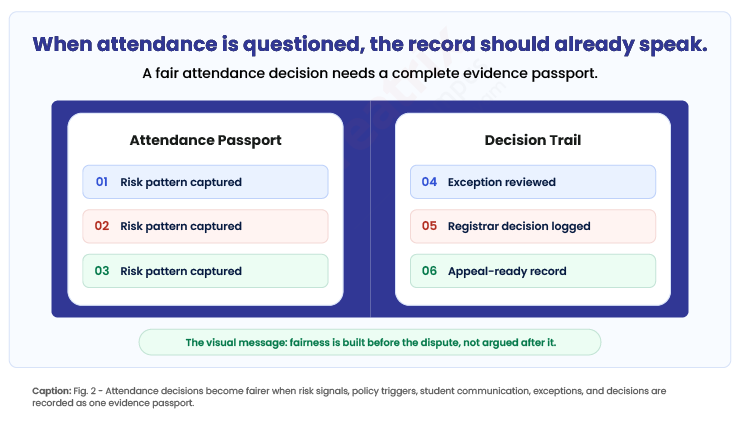
Fairness is much easier to demonstrate when it has been built into the process than when it has to be reconstructed during an appeal.
Why Attendance Becomes Visible Too Late
Most attendance systems can tell the institution how many sessions a student has missed.
The more useful question is whether they can show when that pattern became risky.
There is an important difference between:/lifecycles/academic-operations
- a student with occasional absence,
- a student moving toward a policy threshold,
- a student who has already crossed it.
If the institution treats all three as simple attendance percentages, intervention arrives only when the consequence is already difficult to avoid.
That creates a predictable pattern. Students say they were not warned. Faculty say the concern was visible. Departments request discretion. Exam teams need a quick eligibility decision. Registrars are left interpreting a process that should already have produced a clear record.
A stronger attendance management process therefore needs more than the final percentage. It needs enough context to show the pattern, relevant triggers, communication, intervention, and exceptions before the case becomes contentious.
The Real Registrar Role in Attendance Intervention
The Registrar should not replace academic judgement.
Faculty know the classroom context. Programme teams may understand whether the student is recovering, participating differently, or facing circumstances relevant to the academic decision.
The Registrar has another responsibility: institutional consistency.
That means making sure the same policy logic does not produce radically different treatment depending on programme, faculty member, or department.
| Faculty / Department context | Registrar governance |
| Why the student missed sessions | Whether the policy has been applied consistently |
| Whether participation is improving | Whether required communication occurred |
| Academic context around the absence | Whether an exception was formally approved |
| Programme-specific circumstances | Whether the decision is traceable |
| Recommendation on academic response | Whether final eligibility is defensible |
These roles should reinforce each other.
Faculty provide context. The Registrar protects consistency.
That is what makes attendance intervention supportive without becoming arbitrary.
Where Attendance Exceptions Create Risk
Every institution has legitimate exceptions: medical leave, approved institutional activity, emergencies, accommodations, late documentation, or other programme-specific circumstances.
The existence of exceptions is not the governance problem.
The problem begins when the decision exists only in an email chain, a conversation, or someone’s memory.
If the student later reaches exam clearance or appeals the decision, the official record may show absence without explaining why some absences were accepted, why an exception was granted, who approved it, or which policy was applied.
The institution then has to reconstruct its own reasoning.
That is why attendance decisions need to connect with student progression rather than remain outside the wider student record.
Attendance can affect academic movement.
Its exceptions and decisions therefore need to travel with that movement.
What Registrar-Led Intervention Should Protect
A well-designed attendance process protects four parties at once.
The student needs enough warning and clarity to understand the academic risk while there is still time to respond.
The faculty member needs classroom context to be recognised without becoming solely responsible for defending the eventual institutional decision.
The institution needs policies and exceptions to be applied consistently across departments and cohorts.
The evidence trail needs to show what happened from the first warning through communication, intervention, exception review, and final decision.
That is the real purpose of earlier intervention.
It is not stricter enforcement.
It is reducing the likelihood that a foreseeable attendance problem has to become a formal dispute at all.
Where Creatrix Campus Fits
Creatrix Campus becomes relevant before attendance reaches the final eligibility stage.
Creatrix Campus connects attendance patterns, policy thresholds, communication, exception handling, Registrar review, faculty context, and student success advising within a connected student lifecycle.
For faculty and programme teams, that can mean earlier visibility into students approaching risk. For Registrars and exam teams, it means clearer policy and exception context when eligibility decisions are required. For Student Support teams, attendance risk can become part of an earlier intervention conversation rather than a late disciplinary issue.
The larger value is fairness.
A defensible attendance decision should not begin with the final decision. It should be visible in everything the institution did before reaching it.
Conclusion
Attendance intervention should not begin when a student is denied eligibility. At that point, everyone is under pressure and the institution is forced to prove whether a process that already happened was fair.
If an attendance decision were appealed tomorrow, could your institution show the warning, communication, faculty context, exception history, and policy logic without reconstructing the case manually? Explore earlier attendance intervention with Creatrix Campus.
Quick recap
Attendance becomes a Registrar dispute when the institution waits until policy consequences are unavoidable before connecting risk, communication, faculty context, exceptions, and evidence. The stronger approach identifies the warning zone earlier and keeps the full decision trail connected to the student record. The goal is not tougher attendance enforcement. It is earlier, fairer, and more defensible intervention.
Frequently asked questions
Why do attendance problems become Registrar issues?
What is Registrar-led attendance intervention?
Should Registrars control faculty attendance decisions?
Why are attendance exceptions risky?
How can universities reduce exam-time attendance disputes?
How can Creatrix Campus support attendance intervention?
Join the conversation
Want to contribute?
We welcome thought leaders to share ideas and write for our blog.
Become a guest author