

On this page
Most provosts today have more systems reporting to them than any provost in history. A modern SIS. A learning platform. A workload tool. A BI dashboard someone built two budget cycles ago. Almost every one of those systems was a real digital transformation project, funded, implemented, declared a success.
And most provosts still can't answer a simple question quickly: is this program actually working, and what happens across the institution if we change it.
That gap is worth sitting with, because it isn't a technology gap. It's a leadership tension that more technology hasn't closed, and in some institutions has quietly made worse.
Quick answer
Provosts lead digital transformation well not by adopting more systems, but by making sure academic decisions, curriculum, faculty workload, assessment, and outcomes, move through one coherent institutional model instead of several disconnected ones. The leadership job is coordination and governance, not procurement. Technology only helps once someone has decided what the institution's single version of the truth actually is.
Article summary
Problem: Universities have digitized many individual functions without connecting them into one institutional model, leaving the provost to bridge the gaps personally.
Who this is for: Provosts, DVCs Academic, Vice Chancellors, Deans, and Faculty Affairs leaders.
What changes: From leading technology adoption project by project, to leading one connected academic operating model that technology serves.
Why it matters: A provost's actual mandate is enrollment growth, curriculum quality, and continuous improvement. All three depend on institutional coherence, not system count.
Outcome: Faster, better-evidenced academic decisions and a leadership position built on visibility instead of reconstruction.
Key takeaways
- Digitizing a function and connecting it to the rest of the institution are two different achievements. Most universities have only done the first.
- The provost's real leverage point is coordination across curriculum, faculty, and outcomes, not any single system.
- "Building a data-centric culture" is now a named top-10 priority across higher education leadership, not an IT department goal.
- Faculty buy-in follows coherence. People resist another system faster than they resist a clearer institutional model.
Why this matters
Ask most provosts to describe their job, and you'll hear a version of the same three priorities: grow enrollment, improve curriculum, keep the institution getting better year over year. Look at how academic affairs offices actually publish their own goals today, and a fourth commitment shows up almost every time, one that's easy to miss: strengthen accountability and evidence-based decision-making.
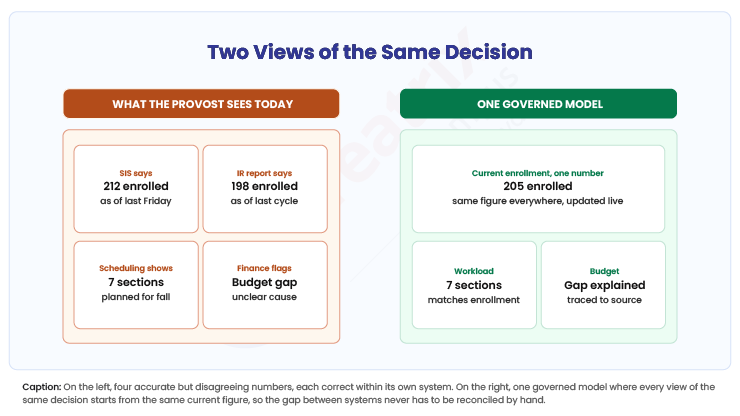
That fourth priority is the one digital transformation projects were supposed to deliver. Instead, most provosts got several separate answers to "what is our evidence," one from the SIS, one from the assessment tool, one from whichever spreadsheet Institutional Research maintains between official reports. Each answer is accurate. None of them is the institution speaking with one voice.
The decision that reveals the gap
Here's where that shows up in practice.
A program is underperforming on enrollment. The provost needs to decide whether to redesign it, consolidate it, or let it run another cycle. That single decision touches five separate records: current enrollment trends from the SIS, assessment and learning outcome data from wherever OBE tracking happens, faculty workload implications from a scheduling tool, budget exposure from finance, and how a change would ripple into related programs sharing courses or faculty.
Each of those systems is modern. Each was implemented as its own transformation win. None of them was built knowing the other four exist.
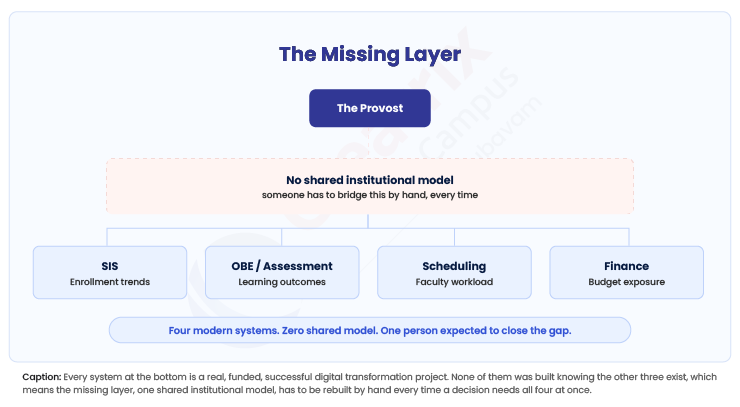
So the provost's office does what every provost's office ends up doing: someone pulls a report from each system, reconciles the numbers by hand, and builds a briefing document that will be out of date the moment anything changes. The decision gets made. It just takes longer, involves more people checking each other's numbers, and produces an answer that's already aging by the time it reaches the meeting.
Multiply that by every program review, every curriculum change, every accreditation cycle running in parallel, and the pattern becomes the job. Not leading transformation. Managing reconciliation.
Leading the model, not the migration
The instinct, when this keeps happening, is to look for one more system, a better dashboard, a data warehouse, an analytics layer that finally pulls everything together. That instinct isn't wrong. It's aimed at the wrong altitude.
A dashboard can display five disconnected data sources side by side. It can't tell you they mean the same thing, because the underlying systems were never governed by one institutional model in the first place. The gap isn't visibility. It's ownership: who decides what "current enrollment" means across every system that reports it, and who's accountable when two of them disagree.
EDUCAUSE's Top 10 for 2026 names building a data-centric culture as one of higher education's leading priorities this year, and not a systems upgrade, but rather a culture shift. That distinction matters. A data-centric culture is a governance decision before it's a technology purchase: which academic facts are owned centrally, which decisions require which evidence, and how a change made in one place is guaranteed to show up correctly everywhere else.
Some institutions have started describing this connected layer as an academic operating system, a single governed model that curriculum, workload, assessment, and outcomes all run through, so a provost isn't reconciling five versions of the truth before every decision.
That's less a product category than a description of what "leading digital transformation" should have meant from the start: not owning more systems, but owning the model that makes all of them agree.
That's also where connected institutional strategy starts to matter more than any individual tool. Strategic planning that spans enrollment, curriculum, and faculty capacity only works if the numbers feeding it come from one governed source, not five reconciled ones.
Conclusion
The provosts managing this well aren't the ones with the most systems. They're the ones who decided, deliberately, what the institution's one version of the truth is, and made every system answer to it instead of the other way around.
What would change if your next program decision took one meeting instead of three, because the evidence already agreed with itself? See what a connected institutional model looks like.
Quick recap
Universities have digitized individual functions faster than they've connected them, leaving provosts to personally reconcile data from systems that were never built to agree with each other. The real leadership job is governing one institutional model that curriculum, workload, and outcomes data all run through, not adopting more technology. Building that kind of data-centric culture is now a named priority across higher education leadership, not just an IT initiative.
Frequently asked questions
Why do provosts struggle with digital transformation even after adopting new systems?
What is a provost's real role in leading digital transformation?
How does faculty buy-in relate to institutional coherence?
What does "building a data-centric culture" actually mean for a university?
How does an academic operating system help provosts specifically?
Join the conversation
Want to contribute?
We welcome thought leaders to share ideas and write for our blog.
Become a guest author