

On this page
It's October, and a career services officer has two hundred unread employer emails, a shared spreadsheet three people are editing at once, and a stack of resumes that were supposed to be sorted by major an hour ago. An employer calls asking why nobody responded to their job posting from Tuesday. Nobody can say for certain whether it was ever added to the sheet.
This isn't a story about an under-resourced office. It's the default condition of placement management at a meaningful share of institutions, because the tools available, email and a shared spreadsheet, were never built to handle the volume or the coordination that recruiting season actually demands.
Placement management software exists to replace that spreadsheet with an actual system: one place where employer postings, student profiles, interview schedules, and outcomes all live together, instead of being reconstructed by hand every time someone needs to know where things stand.
Quick answer
Placement management in colleges works by connecting employer job postings, student profiles, interview scheduling, and graduate outcome tracking into one system, rather than coordinating them across email threads and shared spreadsheets. The genuine advantage isn't digitizing the spreadsheet. It's that an employer posting, a student match, an interview, and an eventual outcome all stay linked to the same record instead of living in disconnected places.
Article summary
The case for placement management software rests on three things: why peak recruiting season still runs on spreadsheets and email at many institutions, what NACE's decades of organizing around this exact professional challenge suggest about its structural nature, and what to look for in a system that actually connects the full cycle from job posting to graduate outcome.
Key takeaways
- Recruiting season chaos usually isn't a staffing problem. It's that job postings, student profiles, interviews, and outcomes each live in a different place.
- NACE has connected career services and recruiting professionals since 1956 and now represents over 18,000 professionals, evidence that this coordination challenge is structural and widespread, not isolated to any one office.
- An interview scheduled in a separate document from the original job posting is one of the most common places placement tracking breaks down.
- Graduate outcomes often go unrecorded formally, even after a successful placement, because there's no single system tying the process together end to end.
- The institutions that get real value from placement management software evaluate for one connected pipeline, not for how many spreadsheets get replaced with a nicer interface.
Peak Season, Reconstructed by Hand
The problem isn't any single step in the placement process. It's that each step lives in a different place. An employer's job posting arrives by email. A staff member manually adds it to a shared sheet. Interested students submit resumes separately. Interviews get scheduled in a second document, or a calendar invite chain, that doesn't talk to the first. By the time an offer happens, the outcome often never gets recorded anywhere formal at all.
NACE, the National Association of Colleges and Employers, has connected career services and recruiting professionals since 1956 and now represents over 18,000 college career services, early talent recruiting, and university relations professionals, per NACE's own site. That an entire, decades-old professional association exists around exactly this work is a fair signal that the coordination problem between institutions and employers is structural, not a symptom of any one office being under-resourced.
What a Connected Placement Pipeline Looks Like
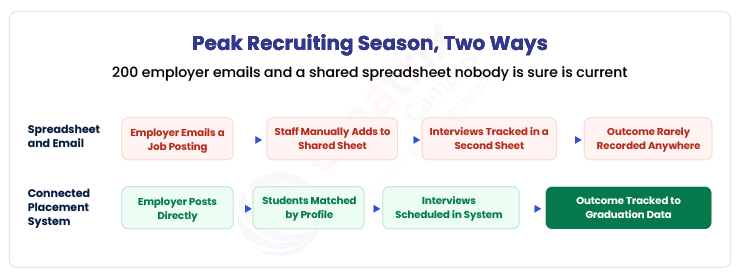
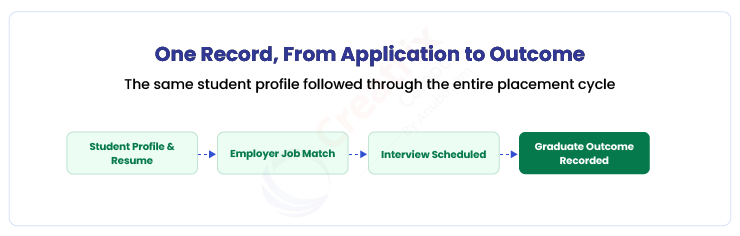
In a connected pipeline, an employer posts a role directly into the system rather than emailing it to a staff member who then transcribes it. Students are matched to postings based on their actual profile, major, interests, prior experience, rather than a manual scan of resumes someone printed out. Interviews get scheduled within the same system that holds the posting and the student match, so nothing requires cross-referencing two separate documents.
The part that matters most long-term is the last link: whether an eventual placement outcome gets tied back to the student's record and the institution's overall graduate outcome data. Without that connection, an institution can run an entire recruiting season successfully and still have no clean, aggregated picture of where its graduates actually ended up.
What to Look For When Evaluating a System
| Capability | Why it matters | What to ask a vendor |
| Direct employer posting | Removes the manual transcription step where postings get delayed or lost | Ask whether employers can post and manage their own listings, or whether staff must enter everything by hand |
| Profile-based student matching | Replaces a manual resume scan with matching based on actual student data | Ask how matching works and what student data it actually draws from |
| Interview scheduling inside the same system | Keeps the posting, the match, and the interview linked instead of scattered across documents | Ask whether interview scheduling lives in the placement system or requires a separate calendar tool |
| Outcome tracking tied to graduate data | Without this, a successful placement season still leaves no clean picture of where students ended up | Ask specifically how a placement outcome gets recorded and connected to institutional graduate outcome reporting |
A vendor who can only describe a nicer version of the spreadsheet, digitized postings, a searchable resume bank, hasn't addressed the actual coordination problem. The real question is whether a posting, a match, an interview, and an outcome stay connected as one record, from the first email an employer would have sent to the last data point a president might ask about at graduation.
Where Creatrix Campus Fits
Creatrix Campus connects employer postings, student profiles, interview scheduling, and graduate outcome tracking in one system, so career services staff aren't reconstructing the recruiting pipeline by hand across email and shared spreadsheets every season.
Employers post roles directly, students get matched against their actual academic and experience profile, interviews are scheduled within the same system that holds the posting, and outcomes feed directly into the institution's graduate outcome data, rather than requiring a separate reporting exercise after the fact.
Conclusion
Recruiting season chaos isn't a sign that a career services office is understaffed or disorganized. It's what happens when job postings, student profiles, interviews, and outcomes each live in a different place, and someone has to reconstruct the connections between them by hand, every single season.
Institutions that evaluate placement management software for one connected pipeline, not just a digitized spreadsheet, get a system that actually tracks a student from first job match to final outcome. The rest keep running October on email and a shared sheet three people are editing at once.
If you want to see how Creatrix Campus connects your placement pipeline end to end, talk to us about placement management software.
Quick recap
Placement management in colleges should connect employer postings, student profiles, interview scheduling, and graduate outcome tracking in one system, replacing the shared spreadsheets and email threads most career services offices default to during peak recruiting season. Institutions should evaluate for one connected pipeline from job posting to outcome, not just a digitized version of the spreadsheet.
Frequently asked questions
How does placement management work in colleges?
Why do career services offices still rely on spreadsheets during recruiting season?
What should institutions look for in placement management software beyond a digitized spreadsheet?
Why does graduate outcome tracking matter in placement management?
How does Creatrix Campus support placement management?
Join the conversation
Want to contribute?
We welcome thought leaders to share ideas and write for our blog.
Become a guest author