
On this page
OBE accreditation readiness means having current, traceable evidence that courses map to programme outcomes, that students are actually attaining them, and that gaps feed back into improvement, available at any point in the year, not assembled the month before a review.
Most institutions running OBE properly still don't have this. Faculty score rubrics every term. CLOs get mapped to PLOs. Attainment gets calculated. All of that work genuinely happens. What doesn't happen is the evidence staying connected to itself: the same mapping, the same scores, and the same improvement decisions that were correct in October often need to be reconstructed in March, because they lived in separate files, separate templates, and separate people's inboxes the whole time.
That reconstruction gap, not a lack of OBE practice, is the real story behind OBE accreditation readiness.
Quick answer
Problem: Institutions practise OBE all year but still reconstruct the evidence of it when accreditation approaches.
For: QA and Accreditation leaders, Academic Heads, Programme Leaders, Provosts, and Deans.
Shift: From treating accreditation evidence as a separate reporting exercise to treating it as one continuous academic cycle.
Outcome: Evidence that's already current when a review team, or your own leadership, asks for it.
Article summary
OBE accreditation readiness isn't a document you prepare before a review. It's what you already have when mapping, assessment, attainment, and improvement decisions stay connected in one continuous cycle throughout the year. Reconstructing evidence at review time is usually a sign the cycle broke somewhere, not that OBE wasn't happening.
Key takeaways
- Most OBE breakdowns aren't weak practice. They're evidence that isn't connected to itself across the year.
- Mapping, assessment, attainment, and improvement are one cycle, not three separate reports.
- Continuous evidence supports readiness. It doesn't guarantee accreditation, that decision belongs to the accrediting body.
- The real test of OBE maturity is showing your evidence today, not assembling it in six weeks.
Mapping, Assessment, and Evidence Are One Cycle, Not Three Reports
Most institutions organize OBE work as three separate activities: mapping happens at the start of the year, assessment happens each term, and accreditation reporting happens once, right before a review. Treated this way, each activity produces its own files, on its own schedule, often owned by different people. Nothing forces them to agree with each other, and by the time someone needs all three together, they usually don't.
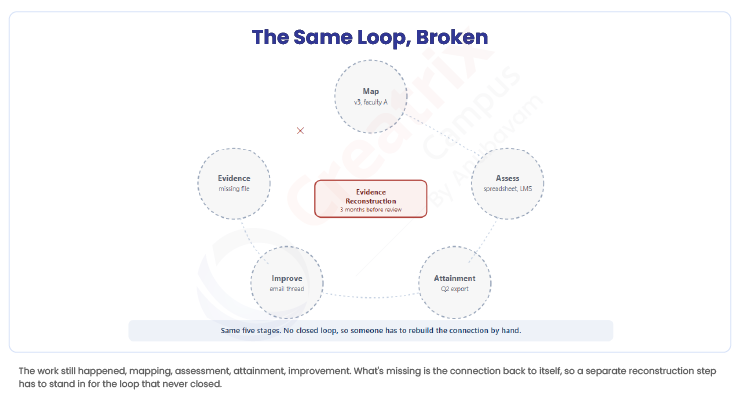
The actual relationship between them is closer than that structure suggests. A CLO-PLO mapping decision is also an assessment design decision, because it determines what a rubric needs to measure. An attainment result is also accreditation evidence, because it's the proof a course did or didn't reach its outcome.
An improvement decision made from that result is also the answer to the "closing the loop" question every accreditor asks. These aren't three reporting exercises that happen to touch similar data. They're one academic cycle wearing three different names depending on who's looking at it.
| Treated as | What it produces | What breaks under review |
| Three separate reports (mapping, assessment, accreditation) | Each report accurate at the moment it's produced | Versions drift apart; nobody notices until they're compared side by side |
| One reconciled report before the visit | A presentable document, assembled under deadline pressure | Traceability back to the original decision is often lost in the reconciliation |
| One continuous cycle | Mapping, assessment, attainment, and improvement staying connected as they happen | Nothing to reconcile; the evidence is already the same record it always was |
What Would It Take to Show Your Evidence Today?
This is the question worth asking a QA team on any random Tuesday, not just before a scheduled review. Could you pull up a specific course, see its current CLO-PLO mapping, see the attainment data behind it, and see what improvement decision came out of it, all as one connected thread, right now? For most institutions, honestly, no. Not because the work wasn't done, but because it was done in enough different places that "right now" would take a few days to assemble.
That gap is what connecting curriculum mapping, assessment, and outcomes into a continuous cycle is meant to close, along with what a connected accreditation evidence layer does with the result: it doesn't create new evidence or make an accreditation outcome more likely, it keeps the evidence that already exists connected to itself, so showing it today and showing it during a review are the same exercise, not two different ones. Continuous evidence supports a stronger case. It doesn't replace the accrediting body's judgment, and no system should be positioned as though it does.
Conclusion
OBE accreditation readiness isn't a strategy problem or a compliance-season sprint. It's what happens when mapping, assessment, attainment, and improvement stay part of one connected record all year, instead of getting reconstructed into one right before someone asks for it. The institutions that avoid the scramble aren't doing more OBE work. They're doing the same work without letting the evidence of it drift apart.
If your QA team could not show today's evidence for a specific course without a multi-day pull-together, that's worth raising before your next review cycle, not during it.
See how a connected OBE and accreditation evidence cycle works for your institution.
Quick recap
Most OBE breakdowns aren't a practice problem, they're a connection problem. Mapping, assessment, attainment, and improvement decisions are one continuous academic cycle, not three separate reports that happen to share data. When they're treated as separate, the evidence drifts apart quietly all year and has to be reconstructed under deadline pressure. When they stay connected, showing your evidence today and showing it during a review become the same exercise. None of this guarantees an accreditation outcome, that judgment belongs to the accrediting body, but it removes the reconstruction gap that turns good OBE practice into a stressful review season.
Frequently asked questions
What does "OBE accreditation readiness" actually mean?
Does continuous OBE evidence guarantee accreditation?
Why do institutions that practise OBE well still struggle at review time?
Is this the same as automating OBE reporting?
Who should be asking whether their institution could show its OBE evidence today?
Join the conversation
Want to contribute?
We welcome thought leaders to share ideas and write for our blog.
Become a guest author