
On this page
Ask most institutions why they moved exams online, and the answer is almost always about speed. Faster grading, faster results, less paper. That is true, but it is also the least interesting reason to do it.
Here is the real problem: exam results are some of the richest evidence an institution generates about whether its programs actually work, and in most colleges, that evidence dies the moment a grade gets entered. It sits in a gradebook, disconnected from the course outcome it was supposed to measure, disconnected from the program outcome that course outcome rolls up into, disconnected from whatever accreditation body will eventually ask for proof that learning actually happened.
This piece covers what examination management software actually needs to do, what most institutions get wrong when evaluating it, and why the exam data itself matters more than the convenience of not printing question papers.
Quick answer
Examination management software is a system for creating, administering, securing, and grading exams online, with the underlying data structured well enough to feed program outcome tracking rather than sitting isolated in a gradebook. It matters because exam results are direct evidence of whether course and program outcomes are actually being met, and that evidence is exactly what accreditation reviews, quality audits, and internal improvement decisions depend on.
Article summary
This piece merges two angles usually treated as separate topics: the practical case for online assessment tools, and the specific mechanics of examination software as a category. Read together, they answer the two questions an institution actually has: why move away from paper and spreadsheets, and what to demand from whatever replaces them.
Key takeaways
- Online exams are not just faster, they generate structured data that paper exams never could.
- Most exam software stops at grading. The data it produces rarely reconnects to course or program outcomes.
- Test security (question banks, shuffled orders, proctoring) matters, but it is not the whole decision.
- Quality Matters, the nonprofit behind widely used course-design rubrics, has spent two decades formalizing what alignment between assessment and learning outcomes should look like.
- The institutions that get the most value treat exam data as continuous evidence, not a once-a-semester report.
What Is Examination Management Software?
Examination management software handles the full lifecycle of a test: building the question bank, assembling a paper, delivering it online or in a proctored setting, grading it, and reporting the results. That is the definition most vendors will give you, and it is accurate as far as it goes.
The category earned its place for concrete reasons, and it is worth being specific about them rather than repeating the same generic list every blog on this topic uses. A digital exam does not need a printed paper, a locked cabinet, or a photocopier queue the week before finals, which removes a genuine logistics burden that grows with every additional section an institution runs. Question banks let an institution reuse and shuffle items across student groups, which is a real security improvement over a single fixed paper that circulates the moment the first student walks out. Auto-grading returns results in hours instead of weeks for objective formats, and even for subjective answers, structured rubrics speed up faculty grading meaningfully. Remote proctoring, done well, extends assessment to students who cannot be physically present without simply trusting the honor system. And evaluation analytics, when anyone actually looks at them, surface patterns a single grader would never notice, which questions an entire cohort struggled with, which sections of a course consistently underperform.
None of that is controversial. Every vendor in this category can deliver some version of it. The differences that actually matter show up somewhere else entirely.
Why Exam Data Needs to Reach Program Outcomes
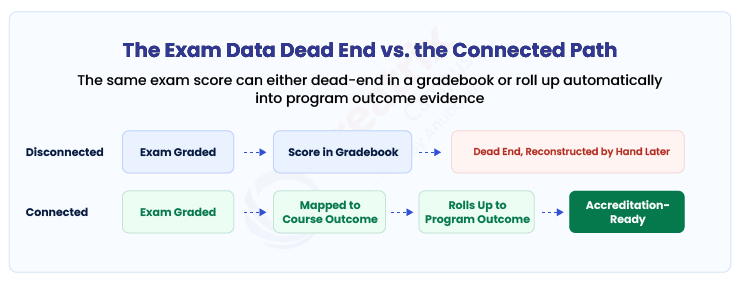
Here is the question almost nobody asks when evaluating exam software: where does the data go after the grade is posted?
In most institutions, the answer is nowhere useful. A student's score sits in the exam system or a spreadsheet, disconnected from the course outcome it was meant to demonstrate, and further disconnected from the program outcome that course outcome rolls up into. When accreditation season arrives, whether it is NBA, NAAC, ABET, or another outcome-based framework, someone has to manually reconstruct the link between exam performance and program outcomes that should have existed all along.
Quality Matters, the US nonprofit that has published research-based rubrics for online and blended course design since 2003, exists precisely because assessment alignment with learning outcomes is not something institutions do consistently on their own, per Quality Matters' own site. Originally built through a FIPSE grant awarded to the MarylandOnline consortium, QM became an independent nonprofit in 2014, and its rubrics are now used by peer reviewers and faculty at institutions worldwide to certify that a course's design, assessment included, actually aligns with what it claims to teach.
That is the real argument for connected examination software. Not that it grades faster, but that it can capture, at the moment a student answers a question, which course outcome that question maps to. Multiply that across a semester and the institution has a live, continuously updating picture of attainment, instead of a report someone assembles under deadline once a year. Few institutions realize that the software they picked mainly to reduce grading time is the same software that determines how painful their next accreditation cycle will be.
How to Evaluate Examination Software Without Getting Distracted by Features
Feature comparisons are where most buying decisions get stuck, because every vendor's list looks similar on paper. A more useful way to evaluate examination software is to ask what happens to the data on the other side of a submitted exam, not just what happens during it.
| Approach | What happens after the exam | What it costs the institution later |
| Paper exams, manual grading | Scores live on paper or in a private spreadsheet | Weeks of grading delay, no outcome traceability, evidence reconstructed by hand at accreditation time |
| Standalone exam software | Scores are digital, fast, and secure, but stay inside the exam tool | Faster results, but the same manual reconstruction problem at accreditation time, just with better-looking spreadsheets |
| Exam software connected to outcomes and academic records | Scores map to course outcomes automatically and roll up to program outcomes | Accreditation evidence accumulates continuously instead of being assembled under deadline |
A short decision framework follows from that table. If an institution is only trying to solve grading speed and paper logistics, most exam platforms on the market will do. If the goal is to also stop dreading the next accreditation cycle, the evaluation has to include a harder question: can this system show, on demand, which questions map to which course outcomes, and can it hand that mapping to whatever program outcome or accreditation report needs it next. Security features (proctoring, shuffled question banks, plagiarism checks) are table stakes and worth confirming, but they should not be the deciding factor, because nearly every serious vendor has some version of them.
Where Creatrix Campus Fits
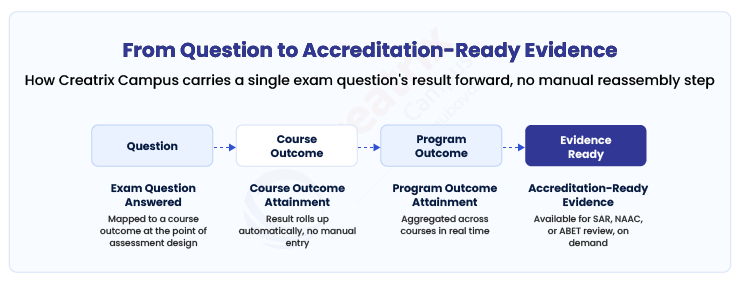
Creatrix Campus treats examination management as one connected part of an Academic Operating System, not a standalone tool that happens to also grade tests.
Question banks, exam delivery, remote proctoring, and auto-grading work the way any serious platform should. The difference shows up after the grade is posted. Every exam question can be mapped to a course outcome at the point of assessment design, so results roll up into course and program outcome attainment automatically, rather than needing a separate manual exercise months later. That same connected data is what a department pulls up when a SAR is due, or when a NAAC or ABET review asks for proof that a program's outcomes are actually being met.
The practical effect is that exam data stops being a dead end. A controller of examinations gets faster, more secure exams the same way any platform would deliver them. A dean or accreditation head also gets a continuously updating evidence trail, without asking anyone to reconstruct it later.
Conclusion
Most institutions choose examination software the way they choose any tool that solves an immediate operational headache: what removes the most friction fastest. That is a reasonable first filter, but it misses the bigger decision hiding underneath it.
Exam data is evidence, whether or not an institution treats it that way. The software that generates that evidence either connects it back to course and program outcomes as a matter of course, or it leaves that reconnection for someone to do by hand, usually right before an accreditation deadline. Institutions that pick the first kind stop thinking of accreditation prep as a separate project.
If you want to see how Creatrix Campus keeps exam data connected to outcome evidence instead of stuck in a separate system, talk to us about connected examination management.
Quick recap
Examination management software should do more than replace paper: it should structure exam data so it connects directly to course and program outcomes, not sit isolated once the grade is posted. Question banks, remote proctoring, and auto-grading are table stakes that most vendors offer; what separates a genuinely useful system is whether it can trace a single exam question back to the outcome it was meant to measure, and hand that evidence to whatever accreditation or quality review needs it next, without anyone reconstructing it by hand.
Frequently asked questions
What is examination management software?
What are the benefits of online examination software over paper exams?
How does examination software support accreditation?
What should institutions look for beyond security features like proctoring?
Is online exam security good enough to replace in-person invigilation?
What is Quality Matters, and why does it matter for assessment design?
How does Creatrix Campus handle examination management?
Join the conversation
Want to contribute?
We welcome thought leaders to share ideas and write for our blog.
Become a guest author