
On this page
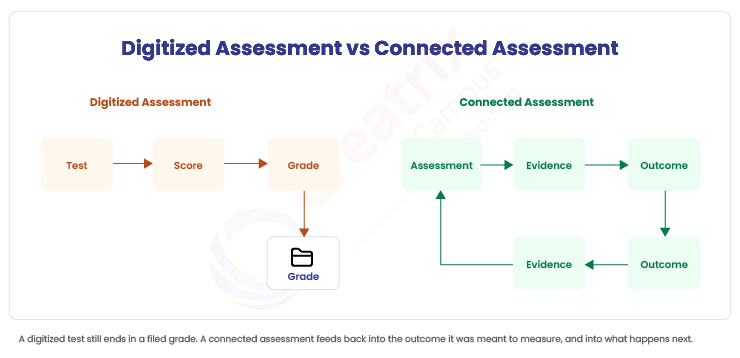
Digitizing a paper exam gets you the same grade, delivered faster. It doesn't tell a programme chair whether students actually achieved the learning outcome the course was built around. That distinction, between a faster grading process and genuine assessment evidence, is where most online assessment initiatives quietly stop short.
Quick answer
Online assessment improves learning outcomes when the data it produces is connected back to the outcomes it was meant to measure, reviewed by faculty, and used to adjust teaching or curriculum. Digitizing a test only speeds up grading. The improvement comes from what happens to the results afterward, not from moving the test onto a screen.
Article summary
This article looks past the convenience case for online assessment, faster grading, less paperwork, easier scheduling, to ask a sharper question: does any of that actually improve learning, or does it just digitize the same process that existed on paper? It distinguishes between an assessment that produces a score and one that produces evidence tied to a learning outcome, and looks at what has to be true for that evidence to actually change what faculty do next.
Key takeaways
- Moving an assessment online speeds up grading. It doesn't automatically improve learning on its own.
- The real gain comes from connecting assessment results to the specific learning outcomes they were designed to measure.
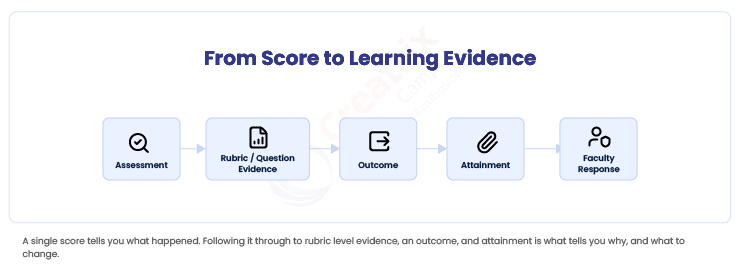
- A score tells you what happened. Evidence tied to an outcome tells you why, and what to do about it.
- Rubric level and question level data matter more than the overall score for identifying where learning fell short.
- None of this helps if the data stops at a gradebook and never reaches a faculty review or curriculum decision
Digital Assessment Is Only the First Step
Here's the real problem underneath most online assessment rollouts. A digital test still asks the same questions, uses the same rubric, and produces the same kind of score a paper test would. The platform changed. What the institution learns from the result usually hasn't.
That matters because a score by itself is a thin signal. Knowing that a student got 72% on an exam tells you almost nothing about which concept they misunderstood, whether the assessment actually tested the learning outcome it claimed to, or whether a whole cohort struggled with the same question for the same reason. The score is the artifact. The useful part is everything the score doesn't show on its own.
The OECD's work on student assessment makes a related point at the systems level: assessment matters because it helps focus attention on the learning progress and outcomes of each student, not simply because it produces a number. That framing applies just as directly inside a single course as it does across an education system. An assessment that isn't designed to reveal learning progress, digital or not, mostly just produces paperwork with a different format.
The Real Value Starts When Scores Become Learning Evidence
Now imagine the same exam, but every question is tagged to the specific course learning outcome it was meant to test. Instead of one overall score, an assessment leader can now see that seventy percent of students missed the two questions tied to a particular outcome, while performing well on everything else. That's a completely different piece of information, and it points to a specific, addressable gap rather than a vague sense that "scores were a bit lower this term."
This is what separates assessment data from assessment evidence. Data is the raw result. Evidence is the raw result read against a specific outcome, aggregated across a rubric or question set, and put in front of someone who can act on it, a programme chair adjusting a unit, a curriculum committee revisiting a sequence, or a QA team building a case for continuous improvement.
| Assessment Element | What It Captures | How It Can Inform Learning Improvement |
| Question level performance | Which specific items students struggled with | Points to a concept or skill needing re teaching |
| Rubric criteria | Performance broken down by specific criteria, not just a total | Shows which part of a task is weak, not just that it is |
| CLO linked assessment | Results tied to a specific course learning outcome | Confirms or challenges whether the outcome was actually met |
| Formative feedback | Ongoing performance signals during a course | Allows adjustment before a final result is fixed |
| Summative results | Final performance against an outcome | Confirms attainment at the end of a course or term |
| Attainment trends | Performance across cohorts or terms | Reveals whether a gap is a one time issue or a pattern |
| Assessment gaps | Where results don't clearly map to any outcome | Flags an assessment that may need redesign, not just the teaching |
| Faculty review | Human interpretation of the above signals | Turns evidence into an actual decision about what to change |
Read the bottom row carefully, because it's the one most institutions skip. Every row above it is still just information until a person reviews it and decides what to do. No amount of question tagging or attainment tracking replaces that step, and treating the data itself as the improvement is a common, avoidable mistake.
Where Creatrix Campus Fits
Creatrix Campus connects assessment design to the learning outcomes it's meant to measure, so results can be reviewed at the rubric and outcome level rather than only as a final score, within one governed system that also holds curriculum and student records. Because attainment is calculated from that connected data rather than assembled separately at reporting time, an assessment leader can trace a result back to the specific outcome it relates to.
What this does not do is improve student outcomes automatically, generate assessments, grade work, or produce accreditation evidence without faculty review. Deciding what a gap in the data means and what to change in response stays with faculty, assessment leaders, and academic governance, exactly where that judgment belongs.
Conclusion
Online assessment creates real value when it helps faculty move from marks to evidence, and from evidence to better academic decisions. Without that second and third step, digitizing a test is just a faster way to file the same grade. Before your next assessment review cycle, it's worth asking a plainer question than whether your platform is efficient: are your assessments producing grades, or are they producing evidence anyone actually reviews. If you want to see how assessment design, outcomes, and attainment can stay connected instead of ending in a spreadsheet, request a demo of Creatrix Campus.
Quick recap
Digitizing an assessment speeds up grading but doesn't by itself improve learning. The improvement comes from connecting results to specific outcomes at the rubric and question level, and putting that evidence in front of faculty who can act on it. A score filed away is data. A score traced back to an outcome and reviewed is evidence.
Frequently asked questions
Does online assessment automatically improve learning outcomes?
What is the difference between assessment data and assessment evidence?
Why does rubric level or question level detail matter more than an overall score?
Can formative assessment data be used the same way as summative results?
Join the conversation
Want to contribute?
We welcome thought leaders to share ideas and write for our blog.
Become a guest author