
On this page
When an institution's NIRF rank changes, the first question is often:
What happened in the submission?
That may be the wrong place to look.
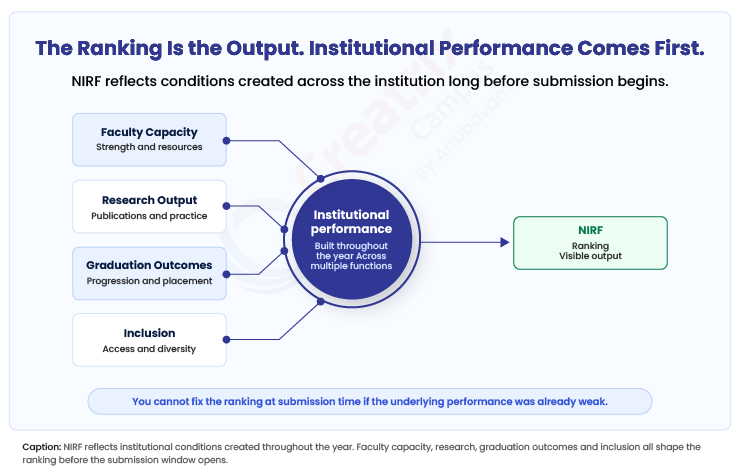
NIRF doesn't rank the quality of a submission exercise. It evaluates institutional performance across teaching and learning resources, research and professional practice, graduation outcomes, outreach and inclusivity, and perception.
Those conditions are created long before anyone logs into the submission portal.
Faculty strength was already determined.
Research was already published.
Students had already graduated, progressed, or found opportunities.
Diversity patterns already existed.
By submission time, much of the institutional story has already been written.
The official NIRF portal shows this operational reality clearly: the India Rankings 2026 data-capture process began on January 6, 2026 and closed on March 16, 2026. The window for reporting was measured in weeks. The performance being reported was built over a much longer period.
That changes the leadership question from:
“How do we prepare for NIRF?”
to:
“Can we see the institutional conditions shaping our NIRF performance before the ranking cycle begins?”
Quick answer
NIRF ranking readiness means continuously understanding the institutional data behind teaching, research, graduation outcomes, inclusion and perception rather than assembling that picture only during submission.
Article summary
Problem: Ranking data is often reviewed too late.
For: Vice Chancellors, Provosts, IQAC leaders, Institutional Effectiveness teams, Registrars and Deans.
Shift: From ranking submission management to year-round institutional performance visibility.
Outcome: Earlier gaps, clearer ownership and better-informed improvement decisions.
Key takeaways
- NIRF performance is created throughout the academic year.
- A clean submission cannot compensate for weak underlying institutional performance.
- Ranking parameters cross faculty, students, research and institutional operations.
- Leaders need visibility before the reporting window opens.
Why This Matters
The five NIRF dimensions do not belong to one office.
Teaching data may sit with Academic Affairs. Research information may sit with faculty or research offices. Graduation outcomes depend on student records and examinations. Inclusion data crosses admissions and institutional reporting.
When leadership sees these only at submission time, there may be very little left to improve.
The ranking is therefore useful for a bigger reason than position alone.
It reveals whether the university can see itself clearly while there is still time to act.
NIRF Is a Mirror, Not a Report Card You Can Rewrite
A university cannot meaningfully improve its NIRF position by polishing data at the end of the year.
If faculty capacity is weak, the ranking reflects it.
If research output has slowed, the ranking reflects it.
If graduation outcomes are changing, that pattern already exists before reporting begins.
That is why ranking readiness is fundamentally an institutional visibility problem.
The question is not whether every department can produce its numbers when asked.
It is whether leadership can see those numbers, understand what is driving them, and act before they become the next ranking result.
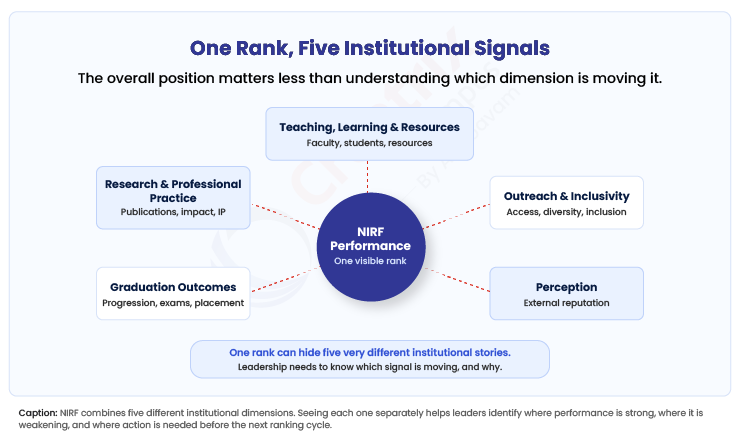
One Ranking Score Hides Five Different Institutional Stories
NIRF is often discussed as though it produces one institutional score.
But underneath that score are five very different stories.
Teaching, Learning & Resources asks questions about faculty strength, student capacity and institutional resources.
Research and Professional Practice reflects publications, research quality, intellectual property and professional activity.
Graduation Outcomes brings student progression, examinations, higher studies and placement into view.
Outreach and Inclusivity exposes who the institution is reaching and supporting.
Perception adds another dimension: how the institution is viewed beyond its own campus.
That breadth matters.
A university may perform strongly in research while graduation outcomes tell a different story. Another may have strong teaching capacity but weaker external perception.
A single rank can hide those differences.
For leadership, the more useful question is:
Which part of our institutional performance is actually moving the ranking, and which part needs attention?
This is where connected Analytics and Dashboards become more useful than a ranking spreadsheet. The purpose is not to predict a rank. It is to make the institutional conditions behind it visible.
Ranking Improvement Starts With Seeing the Gaps Earlier
The old way of thinking about NIRF starts with data collection.
The better approach starts with management visibility.
Imagine discovering during the year that faculty capacity is moving in the wrong direction, research activity is concentrated in too few departments, or graduation outcomes are weakening in particular programmes.
Those are not submission problems.
They are institutional decisions waiting to be made.
And that is why NIRF can become more than an annual ranking exercise.
It can act as a useful lens across academic quality, research, student outcomes and institutional effectiveness.
The role of the IQAC or ranking team then changes too. Instead of spending the reporting window asking different offices for numbers, they can spend more time asking what those numbers mean.
That is a much more valuable conversation.
For institutions trying to connect quality indicators, evidence and improvement activity throughout the year, Accreditation Management can provide a governed view of institutional quality evidence rather than recreating it for each reporting exercise.
Conclusion
NIRF 2026 should not begin when the submission portal opens.
By then, faculty capacity, research output, graduation outcomes and inclusion patterns have already been shaped by months of institutional activity.
The ranking is the visible result.
The more important work happens earlier.
Universities that treat NIRF as a year-round management lens can ask a better question than “What rank did we get?”
They can ask:
“What is our institutional performance telling us to change before the next ranking?”
See how Creatrix Campus connects academic, student, faculty and quality information so leadership can move from periodic reporting to continuous institutional visibility.
Quick recap
NIRF readiness is not about preparing a better submission. It is about seeing the teaching, research, outcome and inclusion signals shaping institutional performance early enough to respond.
Frequently asked questions
What are the five main NIRF ranking parameters?
NIRF evaluates Teaching, Learning & Resources; Research and Professional Practice; Graduation Outcomes; Outreach and Inclusivity; and Perception. The current methodology should always be checked against the official NIRF framework.
When did NIRF 2026 data submission take place?
The official NIRF portal states that India Rankings 2026 data submission opened on January 6, 2026 and closed on March 16, 2026.
Can universities improve NIRF performance only during submission?
Who should own NIRF readiness?
Join the conversation
Want to contribute?
We welcome thought leaders to share ideas and write for our blog.
Become a guest author