
On this page
Ask any principal or dean at an engineering college in India what accreditation means to them, and you will get one of two answers. Either it is proof that their programs meet a real bar of quality, something students and employers can trust. Or it is a periodic scramble to pull together documents nobody kept in one place to begin with.
Both answers are correct. That is the paradox of NBA accreditation. It exists to recognize genuinely strong engineering education, and for a lot of institutions, chasing that recognition is one of the most disruptive things they do all year.
This page is written for the people who actually carry that weight: registrars, IQAC heads, deans, and directors preparing a program for its next cycle. It walks through what NBA accreditation actually is, how the process works from start to finish, what it is worth to an institution once it is earned, and where the real friction tends to come from. None of it is theoretical. Every institution offering AICTE-approved technical programs eventually has this conversation, usually right around the time a new batch of graduates is about to enter a job market that increasingly checks for it.
Quick answer
NBA accreditation is a periodic, outcome-based evaluation of a specific engineering program, not the institution as a whole, run by India's National Board of Accreditation under AICTE. Programs that keep their outcomes, assessment, and faculty data connected year-round move through the six-stage process, from registration to final decision, without the last-minute scramble most institutions associate with it.
Article summary
This page follows NBA's actual six-stage process from start to finish, because that is genuinely how the accreditation cycle works for every engineering college pursuing it. What changes is the lens. Instead of treating each stage as a paperwork milestone, this page reads every stage for where the real friction actually comes from, disconnected evidence, not disconnected effort, and connects that to what accreditation is worth once it is earned: Washington Accord recognition for Tier I programs, funding access, and a credibility signal that outlasts the certificate itself.
Key takeaways
- NBA accreditation evaluates a specific program, not the whole institution, and only Tier I institutions gain Washington Accord recognition.
- Accreditation is granted for six years, three years, or not at all, per NBA's own General Manual, not the five-year outcome some older guides mention.
- Most of the difficulty in preparing a SAR comes from scattered evidence across departments, not weak program quality.
- Accreditation compounds into funding access, employer confidence, and international recognition, and it supports NAAC and international accreditation efforts rather than competing with them.
- Institutions that keep outcomes, assessment, and faculty data connected year-round spend far less time reconstructing evidence before every cycle.
What is NBA Accreditation?
The National Board of Accreditation was authorized by AICTE, the All India Council for Technical Education, back in 1994, per NBA's official accreditation overview. Its job is to check whether a technical program, not just the institution running it, meets defined quality standards, and to do that periodically rather than once.
NBA does not look at test scores in isolation. It assesses a program holistically: vision and mission, how the institution is organized, the quality of teaching and learning, infrastructure, and the support systems around students. It covers a wide range of disciplines too, from engineering and technology to management, architecture, pharmacy, applied arts and crafts, and hospitality, at levels from diploma to postgraduate.
Here is where it gets more interesting for programs with international ambitions. India became a provisional member of the Washington Accord in 2007 and earned permanent signatory status on 13 June 2014, per NBA General Manual, Version May 2019. That matters because only programs accredited under Tier I institutions are eligible for mutual recognition under the Accord, meaning their graduates' qualifications get recognized internationally.
Tier I and Tier II are not just labels, and NBA's own General Manual is specific about the difference. Tier I institutions, IITs, NITs, and other autonomous universities among them, have full freedom to design and update their own curricula. Tier II institutions are affiliated to a university and depend on that university for curriculum changes and examinations, per NBA General Manual, Version May 2019. That distinction shapes almost everything about how each type of institution prepares for accreditation, right down to who signs off on a new course outcome and who owns the evidence when a reviewer asks for it.
Why NBA Accreditation Gets Complicated for Engineering Programs
Most engineering colleges do not struggle with NBA accreditation because they lack quality. They struggle because the evidence of that quality lives in a dozen different places: attendance in one system, assessment scores in a spreadsheet, faculty publications in someone's inbox, lab utilization in a register nobody digitized.
The Self-Assessment Report, the SAR, is supposed to reflect self-introspection and facts, not a marketing pitch. But when the facts are scattered across departments and years, writing an honest SAR under deadline becomes an exercise in archaeology, not reporting. Faculty end up spending weeks pulling together data they generated months earlier, instead of teaching, because nobody captured it in a form anyone could retrieve later.
It shows up hardest at the IQAC desk. The person coordinating the SAR is rarely the person who owns the underlying data, so every criterion becomes a chase: an email to a department for attainment numbers, a follow-up for the missing semester, a spreadsheet reconciled by hand against another spreadsheet that does not quite match it. None of this reflects the actual quality of the program. It reflects how disconnected the systems recording that quality happen to be.
Then there is the deeper issue. Accreditation is not a one-time event, it is a periodic re-evaluation. An institution that treats it like a project, something to sprint toward every few years, will always be rebuilding the same evidence trail from scratch. What would it look like if that evidence just accumulated naturally, as a byproduct of how the institution already runs?
How NBA Accreditation Compares to NAAC and International Accreditation
NBA accreditation often gets mentioned in the same breath as NAAC, and it is worth being precise about what each one actually covers. NAAC assesses the institution as a whole: governance, infrastructure, academics across departments, research output, and student support at an institutional level. NBA, by contrast, accredits individual programs, a specific engineering, management, or pharmacy program, against outcome-based criteria specific to that discipline.
Many engineering colleges in India pursue both, because they answer different questions for different audiences. A prospective student comparing colleges might look at NAAC grading to judge the institution overall, then check NBA status for the specific program they are applying to.
NBA also sits in a different lane from international accreditations like ABET in the US or Engineers Australia. Those bodies recognize NBA under the Washington Accord specifically for Tier I institutions, which is why the Tier I and Tier II distinction matters so much to an institution's long-term plans, not just its current compliance status.
One more thing worth setting expectations on: preparing for a first NBA visit properly takes most institutions the better part of an academic year. That is rarely because the requirements themselves are unreasonable. It is because most of that time gets spent locating evidence that already exists somewhere in the institution, not producing it fresh.
The Complete NBA Accreditation Journey
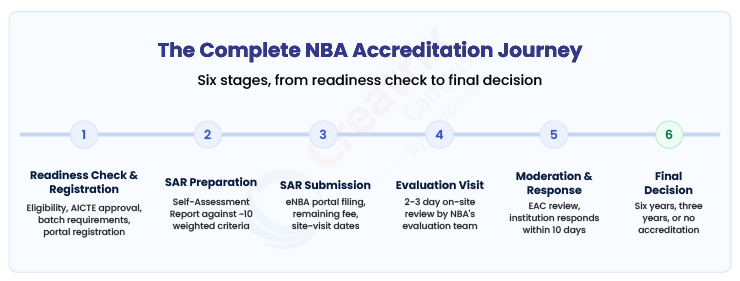
The path to accreditation follows six stages, and each one has its own demands.
Readiness Check and Registration
Before applying, an institution needs to confirm it fits an approved category, engineering, management, pharmacy, architecture, and holds AICTE approval. There are batch requirements too: most programs need at least two completed batches of graduates before applying, while management programs need three. Registration happens through NBA's portal, with an application built around pre-qualifiers and an initial payment of 10 percent of the accreditation fee.
Self-Assessment Report (SAR) Preparation
This is, by NBA's own description, the most important document in the entire process. It needs to be clear, concise, error-free, and backed by data for every criterion, roughly ten of them, broadly weighted across a total of 1000 points, with the exact weightage varying by discipline. Institutions that keep their program outcomes, assessment records, and faculty data connected year-round have a very different experience writing this report than institutions starting from scratch, because the report becomes a summary of what they already know rather than a discovery exercise.
SAR Submission
Once the SAR is finalized, the institution downloads the formatted report, submits it through the eNBA portal, pays the remaining 90 percent of the fee, and proposes three possible dates for the site visit.
Evaluation Team Visit
NBA sends a team, typically a chairperson and one or two evaluators, for two to three days on campus. The institution needs close to 22 program-specific documents and 17 institution-specific documents ready for review. The team's job is to verify what the SAR claims against what is actually happening on the ground, which is exactly why loosely organized evidence tends to show up as gaps during this stage, not before it.
Report Moderation and Institutional Response
The Evaluation and Accreditation Committee reviews the visiting team's report. If they raise questions or need clarification, the institution has ten days to respond before the committee finalizes its recommendation.
Final Accreditation Decision
The Academic Advisory Committee makes the final call: accreditation for six years, accreditation for three years, or no accreditation at all, per NBA General Manual, Version May 2019. Institutions that disagree with the outcome can appeal within 30 days of receiving the decision.
Benefits of NBA Accreditation for Engineering Colleges
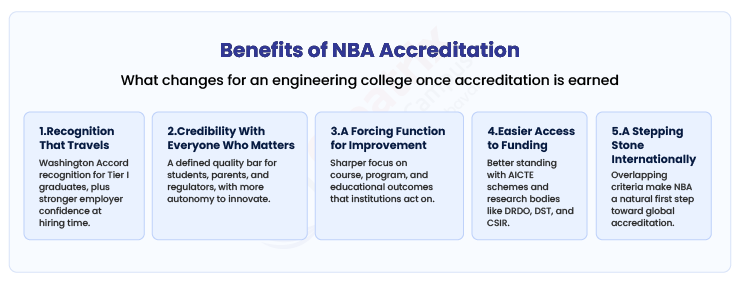
None of that effort makes sense unless it changes something real for the institution and its students. Once accreditation is earned, here is what it actually changes.
Recognition that travels. Graduates from Tier I accredited programs carry credentials recognized under the Washington Accord, which opens doors to international study and work that graduates from non-accredited programs simply do not have. Multinational employers and government bodies increasingly favor accredited institutions when evaluating candidates, and that hiring preference compounds over time, semester after semester, as more alumni enter the workforce carrying that credential.
Credibility with everyone who matters. Accreditation is a signal to prospective students, their parents, and regulators that an institution meets a defined bar, not just a self-declared one. It also gives institutions more autonomy to design innovative programs, because they have demonstrated they can maintain quality while doing it. For a dean fielding questions at every admissions counseling season, that is a concrete answer to a question that used to be a matter of reputation alone.
A forcing function for real improvement. Preparing for NBA pushes institutions to look closely at course outcomes, program outcomes, and program educational objectives, and to act on what they find. Institutions that take this seriously tend to see it reflected in stronger outcome-based education practices, not just a certificate on the wall. The exercise of mapping outcomes to evidence, done properly, tends to outlast the accreditation cycle that triggered it.
Easier access to funding. NBA-accredited institutions are generally viewed more favorably by funding bodies. That includes AICTE schemes like TAPTEC, research and development grants, and MODROBS, as well as research funding from bodies like DRDO, the Department of Science and Technology, and CSIR.
A stepping stone to international accreditation. NBA's criteria overlap significantly with the expectations of accreditation bodies elsewhere. For institutions with global ambitions, NBA accreditation is often the first serious step, not the last one.
If your last SAR cycle felt like a fire drill, it is worth seeing what a connected evidence trail looks like before your next one starts.
Where Creatrix Campus Fits
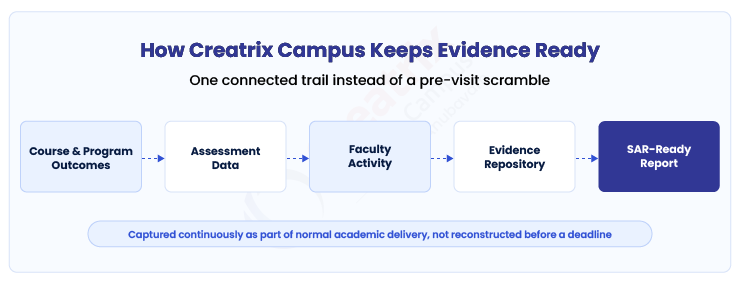
Most of the pain in accreditation prep is not about meeting the standard. It is about proving it, after the fact, from records that were never designed to be pulled together.
Creatrix Campus is built as an Academic Operating System, which means program outcomes, course outcomes, assessment data, faculty activity, and infrastructure records live in one connected system instead of a dozen disconnected ones. When outcome-based education data is captured as part of normal academic delivery, rather than reconstructed before a SAR deadline, accreditation stops being a scramble and starts being a formality you are already prepared for.
That is the real shift. Instead of a sprint that repeats every accreditation cycle, evidence accumulates as a byproduct of how the institution already teaches, assesses, and reports. Departments preparing their next SAR are working from a live evidence trail, not reconstructing one under deadline. IQAC heads spend their time reviewing evidence instead of hunting for it.
Learn more about how Creatrix Campus supports accreditation management
This plays out in a few common situations. A Tier I engineering college preparing its first SAR uses program outcome attainment already tracked through the semester to populate its criteria data, instead of assembling it after the fact. A multi-program institution renewing accreditation across five departments keeps faculty activity, publications, and workload data centralized, so no department is chasing the same documentation twice. A Tier II college affiliated to a university keeps its own curriculum evidence and assessment records organized independently, ready to hand over whenever the affiliating university's processes require it. And an institution juggling NBA alongside NAAC keeps one evidence base behind both, rather than maintaining two parallel documentation efforts that quietly drift out of sync with each other.
Creatrix Campus is not a reporting tool bolted onto existing systems. It is built around the idea that admissions, curriculum, assessment, faculty, and quality assurance are pieces of one connected academic lifecycle, not separate software problems to solve one at a time. For institutions managing NBA accreditation alongside NAAC, and increasingly conversations about ABET or Washington Accord peers, that connected foundation means the same evidence can serve more than one accreditation body without being rebuilt for each one. It is a modular adoption path too, so a quality team can start with accreditation and outcome data without waiting on the rest of the institution to migrate at the same time.
That lifecycle-first design is deliberate. Evidence gets captured once, at the point where the work already happens, a faculty member logging an assessment, a coordinator updating a course outcome, and it is available later wherever it is needed: a SAR, a NAAC self-study report, or an internal review. Nobody has to remember to also update a second system for accreditation purposes, because there is no second system to update.
Conclusion
NBA accreditation was never meant to be a once-in-six-years fire drill. The real decision institutions face is not whether to pursue it. It is whether they are willing to keep rebuilding the same evidence trail from scratch every cycle, or whether they let program outcomes, faculty data, and quality evidence live in one connected system instead. When that shift happens, accreditation stops being something you prepare for and becomes something you are always ready for. If you want to see how Creatrix Campus keeps that evidence trail current for engineering programs specifically, talk to us about accreditation-ready evidence management.
Quick recap
NBA accreditation is an outcome-based evaluation of one program, not the whole institution, awarded for six years, three years, or not accredited at all. Most of the difficulty comes from scattered evidence rather than weak quality, and the benefits, Washington Accord recognition for Tier I programs, funding access, employer confidence, compound once accreditation is earned and evidence stays connected year-round.
Frequently asked questions
What is NBA accreditation?
How long does NBA accreditation last?
What is the difference between Tier I and Tier II?
Does NBA accreditation help outside India?
How is NBA different from NAAC?
Is NBA accreditation mandatory for engineering colleges?
What happens if a program is not accredited?
What documents does an institution need ready for the NBA site visit?
How much does NBA accreditation cost?
Join the conversation
Want to contribute?
We welcome thought leaders to share ideas and write for our blog.
Become a guest author