
On this page
Every NAAC cycle reaches the same point.
The Self-Study Report begins, and suddenly IQAC needs answers from everywhere.
Academic departments send data. Student Services shares reports. Research teams provide evidence. Governance records are checked. Metrics are validated. Narratives are rewritten.
At first, it looks like a documentation problem.
It usually is not.
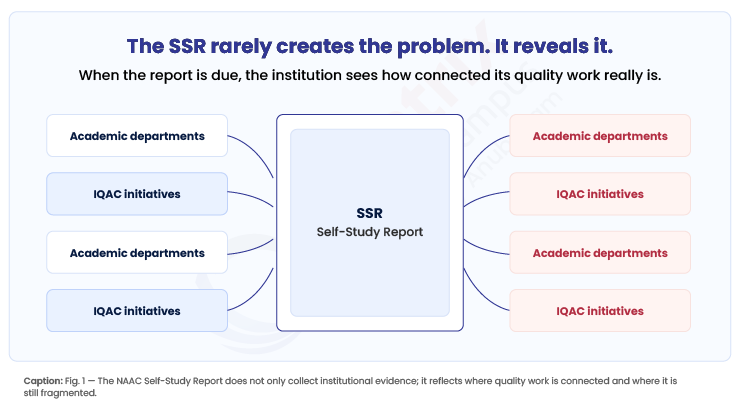
The SSR does not create institutional gaps. It exposes where quality work was never connected clearly enough in the first place.
That is why the NAAC Self-Study Report is more than a submission. It is one of the clearest tests of how mature an institution’s quality system really is.
Quick answer
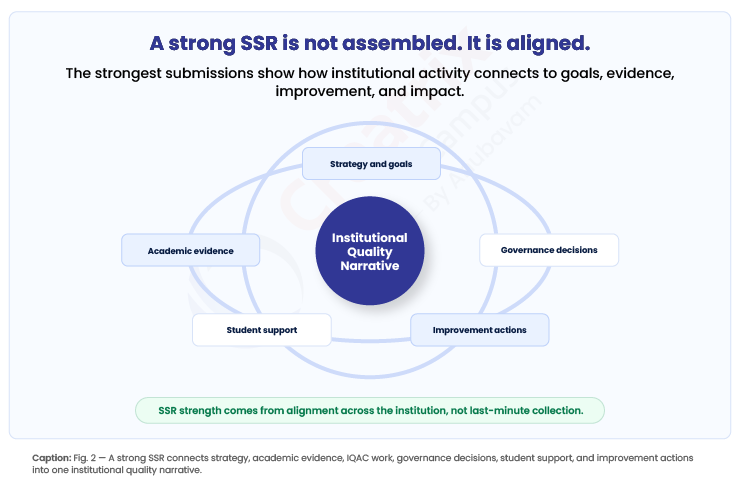
The NAAC Self-Study Report reveals institutional quality maturity because it requires evidence, IQAC activity, academic work, student support, governance decisions, and improvement actions to come together as one coherent story. When those elements remain disconnected, IQAC and accreditation teams spend the review cycle collecting, validating, and reconciling information. When they stay connected throughout the year, SSR preparation becomes a reflection of quality already being managed.
Article summary
| Problem | SSR preparation becomes a large evidence-reconstruction exercise across departments. |
| Who this is for | IQAC leaders, NAAC coordinators, Principals, Deans, Registrars, and institutional quality teams. |
| What changes | Evidence, governance, quality activity, and improvement remain connected throughout the year. |
| Why it matters | The SSR asks the institution to demonstrate one quality story, not a collection of departmental reports. |
| Outcome | Less evidence chasing, stronger institutional alignment, and more confident NAAC readiness. |
Key takeaways
- The SSR exposes coordination problems that often existed long before accreditation preparation.
- IQAC cannot create institutional readiness alone.
- Strong documentation is usually the result of stronger institutional alignment.
- Evidence becomes more valuable when it can be traced to decisions and improvement.
- Continuous readiness reduces the need for last-minute institutional reconstruction.
Why This Matters
For an IQAC leader, the hardest part of the SSR is often getting many parts of the institution to speak with one evidence base. Departments may all be active, yet data definitions differ, improvement actions sit in committee records, and institutional outcomes require manual consolidation. NAAC’s official manuals position the Self-Study Report within a broader assessment and accreditation process built around quality criteria and evidence. If IQAC has to recreate the institution’s quality story every cycle, the problem goes deeper than report writing.
Why the SSR Exposes Institutional Quality Gaps
The SSR brings different parts of institutional life together.
Teaching and learning.
Student support.
Research.
Governance.
Quality assurance.
Improvement.
Each area may function effectively on its own.
But the SSR asks something more difficult:
Can the institution show how these activities contribute to quality together?
That is where the gaps appear.
A Principal may know an improvement initiative was successful. A Dean may know what changed academically. IQAC may hold the report. The Registrar may have the student data.
The SSR still needs the connection between them.
Why SSR Preparation Becomes Difficult
The challenge is often not a lack of evidence.
It is where the evidence lives and how consistently it has been maintained.
| What IQAC needs | What often happens |
| Academic evidence | Maintained differently across departments |
| Quality initiatives | Tracked separately from their outcomes |
| Student data | Requires validation across multiple sources |
| Research evidence | Spread across units and individual records |
| Governance decisions | Stored in minutes without clear impact links |
| Improvement evidence | Reconstructed close to accreditation |
That creates a familiar cycle.
IQAC asks departments.
Departments search records.
Numbers are checked.
Formats differ.
Questions come back.
Leadership waits for a consolidated answer.
Accreditation readiness becomes much harder when this coordination starts only because the SSR deadline is approaching.
The institution may own the evidence, but IQAC still has to assemble the institution around it.
Documentation Is Not the Same as Institutional Alignment
A well-written SSR does not automatically mean the institution has a mature quality system. Documentation is the output, but alignment is what makes that output credible. An institution may report learning outcomes, but the stronger question is whether those outcomes actually influence academic decisions. It may report an IQAC initiative, but the stronger question is whether that initiative produced a measurable improvement. It may describe a governance decision, but the stronger question is whether leadership can show what evidence informed it.
This is why the SSR is difficult to manufacture at the end of the cycle. The strongest narrative already exists when an institution has been operating with visible connections between evidence, decision, action, and impact all along.
Why the SSR Reveals Quality Maturity
One of the clearest signs of quality maturity is how little institutional memory depends on individual people. Can IQAC retrieve evidence without repeatedly contacting departments? Can a Dean see the status of an improvement action, or leadership identify where quality indicators need attention? Can the Registrar validate institutional data without an accreditation-period scramble, and can continuous improvement actions be traced beyond the committee meeting where they were approved? Those questions reveal far more about readiness than the number of files in an accreditation folder.
A mature institution does not eliminate accreditation work. It reduces the amount of rediscovery required to complete it. That is why the SSR is best treated as an institutional self-awareness exercise, showing the institution not only what it has documented, but how well it can see itself.
Where Creatrix Campus Fits
Creatrix Campus is not another repository where IQAC uploads NAAC evidence. It connects the academic and quality work that produces that evidence throughout the year, so IQAC spends less time chasing evidence, NAAC coordinators get clearer traceability, Deans get visibility into programme-level improvement, and Registrars face less last-minute validation pressure. The value is not simply a cleaner SSR. It is an institution that can explain its quality without rebuilding the explanation every accreditation cycle.
Conclusion
The NAAC Self-Study Report is difficult when the institution has to assemble its quality story at the same time it is trying to write it. When evidence, IQAC work, academic decisions, governance, and improvement stay connected throughout the year, the SSR becomes less of a reconstruction exercise and more of an honest reflection of institutional quality.
If your SSR preparation started today, would IQAC retrieve the institution’s quality story or begin asking departments to rebuild it? Explore continuous NAAC readiness with Creatrix Campus.
Quick recap
The NAAC Self-Study Report reveals whether institutional quality is genuinely connected. If IQAC must chase evidence, reconcile departmental versions, and reconstruct the links between initiatives and outcomes, the SSR is exposing an operating problem, not merely a documentation problem. Stronger readiness begins when evidence and improvement remain visible before accreditation asks for them.
Frequently asked questions
Why does NAAC SSR preparation become difficult?
What does the NAAC Self-Study Report reveal about an institution?
Why does the SSR reveal quality maturity?
Can IQAC alone ensure NAAC readiness?
How can institutions make SSR preparation less manual?
How can Creatrix Campus support NAAC SSR readiness?
Join the conversation
Want to contribute?
We welcome thought leaders to share ideas and write for our blog.
Become a guest author