
On this page
A fee payment deadline notice goes out to every student through the portal. Most students read it, understand it, and act on it the same day. One international student, still building fluency in English, reads it twice, isn't fully sure what it's asking, and finally sends a screenshot to a friend down the hall to translate. By the time the meaning is clear, three of the seven days before the deadline are already gone.
Nothing about that student's situation was unusual. Institutions actively recruit international and multilingual students, often citing the exact benefits they bring to a campus. What's unusual is expecting every one of those students to navigate financial deadlines, enrollment steps, and policy notices exclusively in a language they may still be building fluency in, and calling that an equal experience.
Multilingual software in higher education exists to close that specific gap: delivering the same policy, the same deadline, the same instructions, in a language a student actually reads first, rather than treating translation as an afterthought layered on top of an English-only system.
Quick answer
Multilingual software benefits universities by delivering the same policies, deadlines, and instructions to every student in a language they actually read fluently, rather than publishing content only in English and treating translation as an informal, ad hoc workaround. The real benefit isn't just accessibility. It's that a deadline understood immediately by every student produces fewer missed payments, fewer confused support tickets, and a genuinely equal experience across a diverse student body.
Article summary
The case for genuine multilingual software rests on three things: why an English-only system creates real, quantifiable friction for students who read another language first, what NAFSA's global scale suggests about how structural this challenge is across higher education, and what to check for so localization actually reaches the policies and deadlines that matter, not just the marketing pages.
Key takeaways
- A fee deadline or policy notice published only in English can cost a multilingual student real time, sometimes days, before its meaning is fully clear.
- This friction usually shows up as small, disconnected symptoms, missed deadlines, confused emails, lower engagement, rather than a clear complaint pointing back to the language barrier itself.
- NAFSA describes itself as the leading organization for international education and exchange, serving more than 11,000 members worldwide, reflecting how structural language access is across global higher education.
- Localization that only covers a website's marketing pages, while leaving fee notices, enrollment forms, and portal alerts in English only, misses where the actual friction lives.
- The institutions that get real value from multilingual software evaluate for whether operational content, deadlines, financial notices, policy alerts, is genuinely localized, not just the public-facing site.
An Equal Deadline, Unequally Understood
The friction here rarely shows up as a formal complaint. It shows up as a slightly higher rate of missed deadlines, a few more confused emails to the registrar, a student who seems less engaged with campus communications, without anyone connecting those symptoms back to a single root cause: the content was never actually accessible to them in the first place.
NAFSA, the Association of International Educators, describes itself as the leading organization committed to international education and exchange, and reports serving more than 11,000 members worldwide. That an entire international professional association exists to support the work of serving students across language and cultural lines is a fair signal that this is a structural feature of global higher education, not an edge case affecting a handful of students at any one institution.
Where Localization Actually Needs to Reach
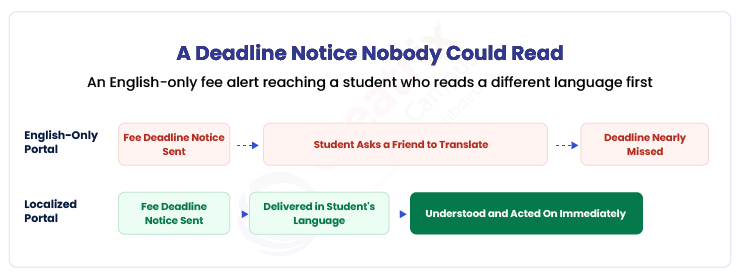
It's tempting to treat multilingual support as primarily a marketing or admissions concern: translate the public website so prospective international students can navigate it during recruitment. That's genuinely useful, but it addresses only the part of the experience that happens before enrollment. The friction that actually costs a student time and money tends to live later, in operational content: a fee deadline, a financial aid status update, a registration hold notice, a housing policy change.
These are exactly the messages where a delay in understanding has real consequences, a missed payment, a missed add/drop window, a housing deposit deadline. If localization stops at the recruitment website, the institution has solved the easier, more visible half of the problem while leaving the operationally important half untouched.
What to Check Before Trusting "Multilingual Support"
| Claim | What it might actually cover | What to ask instead |
| "Multilingual website" | Public marketing and admissions pages only | Ask whether fee notices, portal alerts, and policy documents are included, not just recruitment content |
| "Available in multiple languages" | A language toggle that covers navigation labels but not actual policy text | Ask to see a specific fee deadline notice rendered in a non-English language, not just the homepage |
| "Localized for international students" | Static translated PDFs that go stale when policy changes | Ask what happens to translated content when the underlying policy or deadline changes, whether it updates automatically or requires a manual re-translation |
The most reliable test is asking to see one specific operational document, a fee deadline, a housing policy, an enrollment hold notice, rendered in a language other than English, and confirming that it updates automatically when the underlying policy changes, rather than depending on someone remembering to re-translate it manually.
Where Creatrix Campus Fits
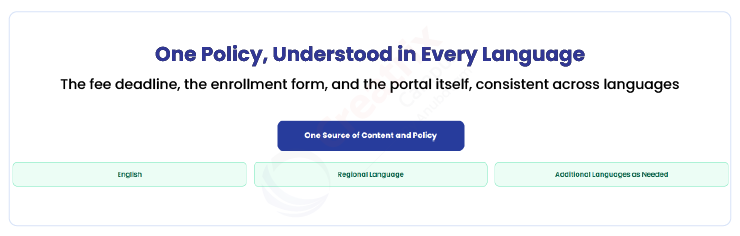
Creatrix Campus maintains one source of policy and content, and localizes it consistently across English and additional regional languages, so a fee deadline, a policy update, or a portal alert reaches every student in a language they understand, not only the ones fluent in English.
Because localization draws from the same underlying content source, an update to a policy or a deadline is reflected across every language version automatically, rather than requiring a separate manual translation each time something changes.
Conclusion
An institution can recruit a genuinely diverse, multilingual student body and still deliver an unequal experience, if the deadlines and policies that matter most, the ones with real financial and academic consequences, are only ever published in one language.
Institutions that build multilingual support into operational content, not just the recruitment website, give every student the same fair chance to understand a deadline the first time they read it. The rest keep relying on a friend down the hall to translate a notice that was never actually built for every student it was sent to.
If you want to see how Creatrix Campus keeps policies and deadlines consistent across languages, talk to us about multilingual software for higher education.
Quick recap
Multilingual software should localize the operational content that carries real consequences, fee deadlines, policy updates, portal alerts, not just a recruitment website's marketing pages. Institutions should evaluate for whether translated content updates automatically as policies change, and whether coverage genuinely reaches the messages a student needs to act on quickly.
Frequently asked questions
What are the benefits of multilingual software for universities?
Why isn't a translated marketing website enough for true multilingual support?
How can an institution tell if "multilingual support" actually covers what matters?
What happens when translated content isn't kept current with policy changes?
How does Creatrix Campus handle multilingual support?
Join the conversation
Want to contribute?
We welcome thought leaders to share ideas and write for our blog.
Become a guest author