

On this page
A student cannot register because of a prerequisite.
Another needs a credit overload approved.
A required course clashes with another requirement.
A graduation audit uncovers a missing credit.
An auditor asks why an exception was approved two semesters ago.
Different problems. Different departments.
Eventually, many of them arrive at the Registrar’s office.
That is the shift happening in modern registrar operations.
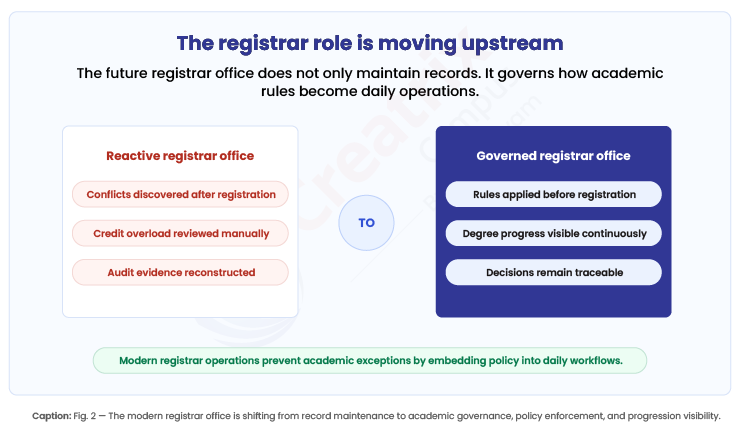
The Registrar is no longer simply recording academic decisions. Increasingly, the office is expected to make sure those decisions follow institutional rules in the first place.
Quick answer
Registrar offices are becoming academic governance hubs because registration, scheduling, degree progression, credit rules, curriculum requirements, exceptions, and compliance now intersect throughout the student lifecycle. For Registrars and Academic Affairs leaders, a modern registrar system should do more than maintain accurate records. It should help apply academic policy earlier, surface risk before it affects students, and preserve the decision trail behind academic operations.
Article summary
| Problem | Registrar teams inherit exceptions created by disconnected academic processes. |
| Who this is for | Registrars, Academic Affairs leaders, Deans, Student Records, Compliance, Curriculum, and Institutional Operations teams. |
| What changes | The Registrar moves from recording decisions to helping govern how academic rules are applied. |
| Why it matters | Late policy enforcement creates student delays, manual exceptions, compliance risk, and unnecessary Registrar workload. |
| Outcome | Earlier control, fewer preventable exceptions, and stronger academic governance. |
Key takeaways
- Registrar workload increasingly reflects problems created outside the Registrar’s office.
- Accurate records are not enough if academic rules are applied too late.
- Course clashes, credit exceptions, and graduation gaps often share the same governance problem.
- Modern registrar operations need traceable rules and decisions, not more manual checking.
- The Registrar is becoming a control point connecting academic policy with daily operations.
The Registrar Often Inherits Problems It Did Not Create
A Registrar rarely creates the prerequisite rule.
The curriculum team does.
The Registrar may not decide when a required course should be offered.
Scheduling and departments do.
The Registrar may not design the student’s academic plan.
Advisers and programme teams influence it.
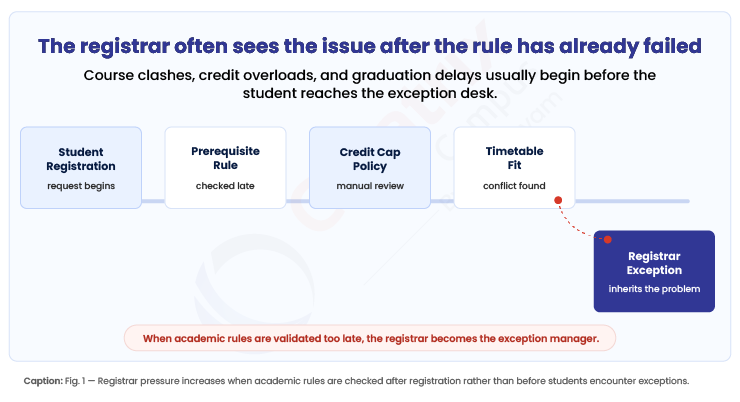
Yet when the prerequisite is missed, the required courses clash, or progression goes off track, the Registrar is expected to resolve the exception.
That creates a difficult operating model.
The office responsible for maintaining academic integrity becomes the place where upstream inconsistencies are corrected manually.
For Registrars, the real workload is therefore not transactions.
It is exception inheritance.
Course Clashes and Credit Caps Are Governance Signals
A clash may look like a scheduling issue.
A credit overload may look like a registration issue.
A missing graduation requirement may look like a degree-audit issue.
But underneath each one is a governance question:
Was the right academic rule evaluated at the right time?
| What the Registrar sees | What may have happened upstream |
| Course clash | Programme pathways and scheduling were evaluated separately |
| Credit overload | Policy was checked after registration |
| Missing prerequisite | Curriculum rule did not act at the point of enrollment |
| Graduation gap | Degree requirements became visible too late |
| Repeated exception | Policy depends on manual interpretation |
That is why student progression cannot be managed only through periodic checks.
Rules need to travel with the student’s academic decisions.
A policy that becomes visible only after the exception is not governing the process. It is explaining the failure afterward.
What the Modern Registrar Role Is Becoming
The Registrar’s office is moving closer to the centre of academic operations.
Not because every responsibility should move into one department.
Because someone must be able to see whether the institution’s academic rules are surviving the journey from policy to student action.
That means modern Registrar operations increasingly need visibility into:
- registration controls and prerequisite rules
- credit and progression requirements
- scheduling conflicts affecting programme pathways
- degree completion and graduation readiness
- exceptions and approvals
- curriculum changes affecting student records
- evidence supporting compliance decisions
The shift is significant.
A traditional records function asks:
“What happened?”
A governance-oriented Registrar also needs to ask:
“Should the institution have allowed this to happen?”
That is a much more strategic role.
And it explains why academic leaders should stop measuring Registrar effectiveness only by transaction speed.
Where Creatrix Campus Fits
Creatrix Campus connects the records, policies, approvals, and workflows that Registrars depend on, giving them visibility across academic processes without requiring them to control every function.
Scheduling, registration, curriculum rules, degree requirements, progression, approvals, compliance evidence, and relevant assessment evidence should not become separate institutional stories that the Registrar reconciles later.
For the Registrar, that means fewer preventable exceptions.
For Academic Affairs, stronger policy consistency.
For Deans and programme teams, clearer visibility into how academic decisions affect student progression.
For compliance teams, more traceable evidence.
The value is not simply a more efficient records office.
It is preventing the Registrar from becoming the university’s final manual integration layer.
Conclusion
The modern Registrar is becoming a frontline academic governance leader because increasingly complex institutions need someone to connect policy with what actually happens to students. When registration, scheduling, curriculum rules, progression, and compliance remain disconnected, the Registrar inherits the exceptions. When those processes stay governed, the office can focus less on repairing decisions and more on protecting academic integrity.
How much of your Registrar team’s workload comes from resolving decisions that should have been governed earlier? Explore connected registrar operations with Creatrix Campus.
Quick recap
Registrar offices are evolving because record accuracy alone cannot protect students from course conflicts, credit violations, progression gaps, or poorly documented exceptions. The modern role sits between academic policy and academic execution. The opportunity is to move the Registrar upstream, from recording what happened to helping the institution prevent what should never have happened.
Frequently asked questions
Why are Registrar offices becoming more important in higher education?
Why do Registrars spend so much time managing exceptions?
What is a modern registrar system?
How does the Registrar support academic governance?
How does Registrar work connect to accreditation readiness?
How can Creatrix Campus support modern Registrar operations?
Join the conversation
Want to contribute?
We welcome thought leaders to share ideas and write for our blog.
Become a guest author