

On this page
Walk into one lecture hall and you'll see a professor asking students to put their phones away, then noticing half the room checking them under the desk anyway. Walk into another, and you'll see the same model of phone in every hand, being used to answer a live poll the instructor just launched, with results appearing on the screen in real time.
Same device. Same generation of students. Completely different classroom. The difference isn't a policy about phones. It's whether the software in the room gives that phone something specific and useful to do.
This is worth naming clearly, because most conversations about classroom technology default to a binary: allow phones or ban them. That framing misses the actual variable, which is whether a phone is a distraction with nothing else to do, or a tool with a job.
Quick answer
Mobile technology benefits the higher education classroom when the software gives a student's own device a specific job, live polling, quiz responses, content access, attendance confirmation, rather than leaving it as either a banned temptation or an ignored distraction. The device itself isn't the variable; whether it's integrated into how a lesson runs is.
Article summary
The case for mobile technology in the classroom rests on three things: why banning and ignoring phones produce the same non-outcome, what a genuinely integrated classroom looks like when a device has real work to do, and what ISTE's standards suggest about evaluating technology by impact rather than novelty.
Key takeaways
- Banning phones and ignoring them tend to produce the same classroom outcome: a device doing nothing for learning, one way or another.
- What changes the outcome is whether the classroom software gives the device a specific job: a live poll, a quiz, a check-in, immediate access to materials.
- ISTE develops standards specifically meant to guide equitable, high-impact technology use in education, evidence that the field treats impact, not device presence, as the real measure.
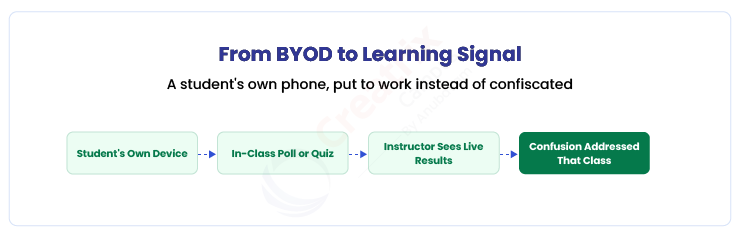
- Live polling turns a lecture from one-directional into something an instructor can adjust in real time, based on whether the room actually understood the last point.
- The institutions getting real value from mobile technology evaluate for what specific classroom moment it improves, not for whether students are simply "allowed" to have devices out.
Banned or Ignored, Same Result
Banning phones outright and simply ignoring their presence produce a surprisingly similar outcome. In both classrooms, the device isn't doing anything for learning. In the banned scenario, it's a temptation students hide and check anyway. In the ignored scenario, it's a distraction competing for attention with no countervailing pull toward the lesson.
Neither approach is really about phones. Both are about a classroom that hasn't decided what role, if any, mobile devices should play in how the material gets taught and how understanding gets checked.
What an Integrated Classroom Actually Looks Like
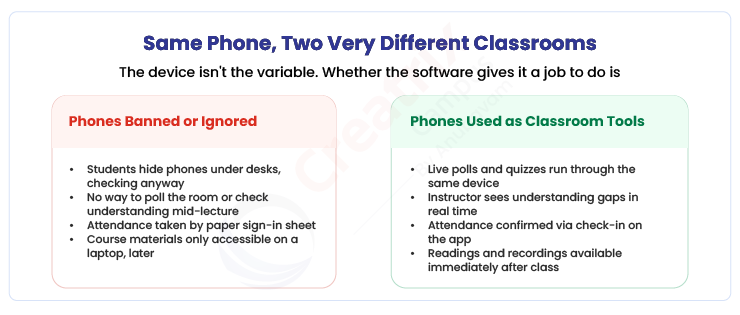
In the integrated version, a student's own device becomes the mechanism for a live poll mid-lecture, an instant quiz that checks understanding before moving to the next topic, or a check-in that confirms attendance without a paper sheet being passed around. None of that requires new hardware. It requires software that treats the device students already carry as part of the lesson plan, not as a problem to manage.
ISTE, the International Society for Technology in Education, develops the ISTE Standards specifically to guide educators, leaders, and institutions toward technology use that is described as "high-impact, sustainable, scalable and equitable," per ISTE's own site. That framing, impact and equity rather than novelty, is the right lens for mobile technology in the classroom. The question was never whether students have phones. It's whether the classroom gives that phone something worth doing.
What to Evaluate Beyond "Are Phones Allowed"
| Question to Evaluate | Why It Matters |
| Can an instructor launch a live poll or quiz and see results in the same session? | This is what turns a one-directional lecture into something the instructor can adjust in real time |
| Does attendance or check-in use the device students already carry? | Removes a manual process (paper sign-in) without requiring new hardware |
| Can students access materials and recordings immediately after class on their own device? | Extends the classroom beyond the room itself, particularly useful for review and accessibility |
| Does the tool work reliably on the range of devices students actually bring? | A polished feature that only works on certain phones will exclude students rather than include them |
These questions matter more than a simple phones-allowed policy, because they get at whether the technology is actually doing something for teaching and learning, or just present in the room without a purpose.
Where Creatrix Campus Fits
Creatrix Campus gives a student's own mobile device specific classroom jobs: live polling and quizzes an instructor can launch mid-lecture, attendance check-in without a paper sheet, and immediate access to course materials and recordings on the same app students already use for the rest of their academic life.
Because these mobile capabilities connect to the same underlying academic record, attendance and quiz participation captured on a phone update the institution's records directly, rather than requiring a separate manual step to transfer that data afterward.
Conclusion
A classroom's relationship with mobile phones was never really a policy question about whether to allow them. It's a design question about whether the software in the room gives a student's own device a specific job worth doing.
Banning and ignoring both land in the same place: a device doing nothing for learning. Institutions that integrate mobile technology deliberately, live polling, attendance, immediate access to materials, get a classroom where the phone in every hand is working for the lesson instead of against it.
If you want to see how Creatrix Campus turns student devices into working classroom tools, talk to us about mobile technology for higher education classrooms.
Quick recap
Banning or ignoring phones in the classroom both produce the same outcome: a device doing nothing for learning. What actually matters is whether the software gives a student's own device a specific job, live polling, attendance check-in, immediate material access, so it becomes a classroom tool rather than a distraction or a confiscated temptation.
Frequently asked questions
What are the benefits of mobile technology in the higher education classroom?
Is banning phones in class actually effective?
What should a live polling or quiz tool actually accomplish in class?
Does mobile classroom technology require new hardware?
How does Creatrix Campus use mobile technology in the classroom?
Join the conversation
Want to contribute?
We welcome thought leaders to share ideas and write for our blog.
Become a guest author