
On this page
The LMS remains one of the most important systems in modern teaching.
It organises courses, gives students access to learning materials, supports assignments and communication, and makes online and blended delivery possible.
The problem begins when universities expect it to answer questions beyond the course.
Is a student progressing toward programme outcomes? Does declining course activity require Advisor attention? Is assessment evidence informing curriculum improvement? Can QA see what learning evidence supports programme quality?
Those questions cross academic boundaries the LMS was not designed to govern.
The LMS does not need to become everything. The institution needs to connect what happens inside it with what happens next.
That is the learning operations challenge.
Quick answer
Higher education needs learning operations beyond the LMS because course activity is only one part of the academic lifecycle. Universities need to connect learning activity with assessment evidence, outcomes, student support, progression, curriculum decisions, and quality assurance so information generated inside a course can inform decisions beyond the course.
Article summary
| Problem | LMS data can remain trapped inside the teaching window while important academic decisions happen elsewhere. |
| Who this is for | Directors of Online Learning, CIOs, Provosts, Deans, QA leaders, Academic Technology teams, and Curriculum leaders. |
| What changes | The institution stops asking the LMS to do everything and connects it to wider academic operations. |
| Why it matters | Learning activity becomes more useful when it can inform outcomes, support, quality, and programme decisions. |
| Outcome | Better continuity between course delivery and the academic lifecycle surrounding it. |
Key takeaways
- The LMS remains essential for course delivery.
- LMS activity does not automatically explain learning quality.
- Course data becomes more valuable when connected to outcomes, assessment, advising, and QA.
- Universities need to preserve learning context beyond the course shell.
- The answer is not a bigger LMS. It is stronger continuity around it.
Why This Matters
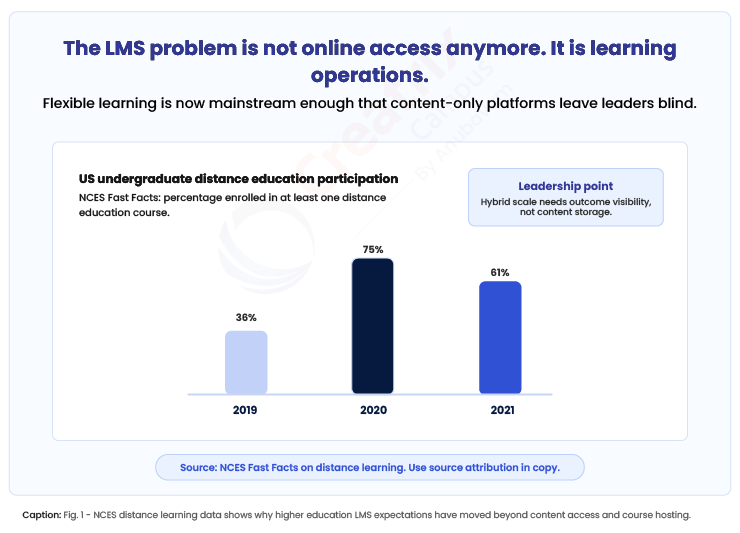
Online and blended learning are now embedded in mainstream higher education. The original NCES distance-learning reference documented the substantial rise in distance participation around the pandemic period, while newer NCES IPEDS trend data reports that 53.8% of postsecondary students were enrolled in distance education courses in fall 2024.
The LMS therefore matters enormously.
But increased LMS use also makes its boundary more important.
The LMS was designed around the teaching window, while institutional responsibilities such as progression, outcomes, faculty workload, records, and quality continue beyond it.
The strategic question is not how much more work the LMS can absorb. It is what needs to happen when learning information leaves the course.
The LMS Still Has an Important Job
A modern learning management system can give faculty and students valuable visibility into the course itself.
That should not be undervalued.
The problem is assuming that course visibility equals institutional visibility.
| The LMS can tell you | The institution may still need to know |
| Student logged in | Is the change in engagement meaningful? |
| Assignment submitted | Which learning outcome did it demonstrate? |
| Course grade recorded | What does performance mean at programme level? |
| Activity declined | Who should respond, if anyone? |
| Module completed | Has the intended capability been demonstrated? |
| Course ended | What evidence should continue into QA, advising, or programme review? |
This distinction becomes particularly important with flexible, blended, modular, and self-paced learning.
Students may move differently through learning.
The institution's responsibility for progression, outcomes, and academic quality does not disappear because the delivery model became more flexible.
Where Learning Context Gets Lost
Consider what happens when a student begins disengaging from an online course.
The LMS may see falling activity.
But an Advisor may need to know whether attendance changed elsewhere. Faculty may need assessment context. Student Support may already have contacted the learner. A programme leader may eventually need to understand whether the same problem is appearing across a cohort.
The original signal is useful.
What matters is whether its meaning survives as responsibility moves across the institution.
The same applies to assessment.
A mark inside the LMS becomes more valuable when assessment evidence remains connected to the outcome being assessed and can later inform programme review or quality improvement.
Learning data loses institutional value when every team has to reinterpret it from the beginning.
What Should Happen Beyond the LMS
The LMS should continue doing the job it does well.
The wider academic operating model should handle the relationships the course itself cannot own.
That means connecting learning activity with:
Student context → Assessment evidence → Outcomes → Support → Progression → Quality
If engagement falls, the institution should be able to determine whether anyone needs to act.
If an assessment exposes a recurring weakness, the finding should be able to reach the academic team responsible for the programme.
If outcome evidence is generated through learning, QA should not have to reconstruct that relationship months later.
This is also where student success advising becomes relevant. An engagement signal becomes useful to an Advisor only when enough surrounding context exists to decide whether outreach is appropriate.
The issue is not whether systems exchange data.
It is whether academic meaning survives the handoff.
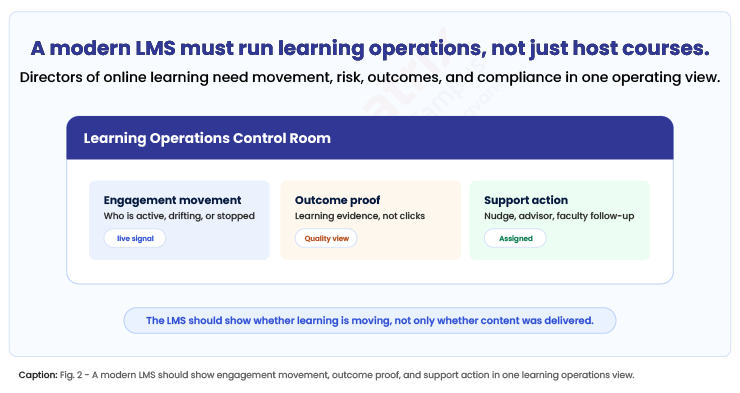
What Learning Operations Visibility Should Show
Academic leaders do not need every click produced by the LMS.
They need a smaller set of useful questions answered:
- Where is learner movement changing?
- What does assessment evidence say about outcomes?
- Which signals genuinely need human attention?
- Has anyone already responded?
- Are recurring patterns pointing to a course or programme issue?
- Can the evidence support curriculum and quality review?
This is learning operations visibility.
It takes information generated during teaching and makes it usable by the people responsible for what happens before, around, and after teaching.
Where Creatrix Campus Fits
This gives a much cleaner Creatrix story. Creatrix Campus is not an LMS replacement. The LMS handles classroom content delivery, while Creatrix Campus covers the wider academic lifecycle of design, governance, assessment, records, outcomes, and institutional operations, integrating with the LMS so those responsibilities don't stay disconnected.
That means the value is not "a better LMS." It is what becomes possible around the LMS. Assessment evidence can remain connected to outcomes. Learning signals can reach the appropriate student-support context. Academic findings can contribute to programme and quality decisions, and the course can remain an important part of the learning experience without becoming the institutional boundary around what the university knows.
The LMS manages the teaching window. Creatrix Campus helps the institution govern the academic lifecycle around it.
Conclusion
Universities should not ask the LMS to become the curriculum system, advising system, outcome system, quality system, and institutional operating layer all at once. Its value is clearer when its role is clear.
When a student's learning activity becomes relevant outside the course, does that context travel with the student or does another team have to rebuild it? Move from isolated LMS activity to connected learning operations.
Quick recap
The LMS remains essential, but course delivery is only one part of the academic lifecycle. Learning operations begins when activity, assessment evidence, outcomes, student context, support, and quality decisions remain connected beyond the course. The future is not an LMS that tries to become the whole university. It is a university that knows how to use what the LMS knows.
Frequently asked questions
Is the LMS still important in higher education?
Why is the LMS not enough on its own?
What are learning operations in higher education?
Why is LMS engagement data not enough?
Should universities replace their LMS?
How can Creatrix Campus work with the LMS?
Join the conversation
Want to contribute?
We welcome thought leaders to share ideas and write for our blog.
Become a guest author