
On this page
Somewhere on most campuses, there's a script that runs after midnight. It exports a file from the student information system, reformats it, and uploads it into the learning management system and the finance system, so that tomorrow morning, a course drop that happened yesterday afternoon finally shows up everywhere it needs to.
Nobody designed this on purpose. It grew, one integration project at a time, because the systems involved were never built to speak the same language automatically. IT staff call it, half-jokingly, swivel-chair integration: someone swivels between two screens, copying data from one system into another by hand, because no shared connection exists.
Interoperability is what replaces that nightly script with something that doesn't need a script at all: a change made once, in one system, reaching every other system that depends on it, within the same session, not the next business day.
Quick answer
Interoperability in higher education software means different systems, the SIS, LMS, finance platform, and portal, exchanging data automatically through shared standards, rather than through custom one-off connectors or nightly manual exports. Genuine interoperability means a change made in one system reaches every other system that depends on it within the same session, not after an overnight batch job.
Article summary
The case for interoperability rests on three things: why institutions end up running nightly manual syncs between systems that should already agree, what open standards like those maintained by 1EdTech actually solve that a custom connector doesn't, and what to check for before assuming a vendor's "integration" claim means real-time data exchange.
Key takeaways
- Swivel-chair integration, manually re-keying or exporting data between systems, is still how many campuses connect their SIS, LMS, and finance platforms.
- A course drop or fee payment made this afternoon often doesn't reach every dependent system until an overnight batch job runs.
- 1EdTech, the nonprofit behind widely adopted standards like LTI, OneRoster, and QTI, exists because unrelated education systems needed a common language to exchange data without a custom connector for every pair.
- "Integrated" software sold as one suite can still require manual reconciliation underneath if its modules weren't built on a shared standard or data model.
- The institutions that get real value from interoperability evaluate for how current the data actually is across systems, not for how many systems a vendor claims to "integrate with."
The Nightly Job Nobody Talks About
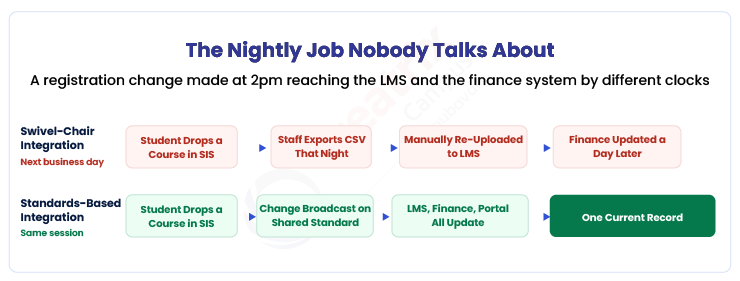
Ask an IT director how many nightly or weekly jobs move data between systems that were never designed to connect, and the honest answer is usually more than they'd like. Each one exists because someone, at some point, needed the registrar's system and the LMS to agree with each other, and building a proper connection wasn't in that year's budget or timeline.
The cost of this shows up in small, constant ways: a student who dropped a course still shows as enrolled in the LMS for a day, a finance record that doesn't reflect this morning's fee payment until tonight's batch job runs, a faculty member teaching a roster that's already out of date. None of these are dramatic failures. They're just friction, repeated daily, across every system that wasn't built to talk to the others.
What Standards Solve That a Custom Connector Doesn't
A custom connector between two specific systems can work, until one of them updates its API, or a third system needs to join the conversation, and someone has to build another one-off bridge. This is why a purely custom-integration approach tends to multiply: every new system added means another connector to build and maintain, and none of them share a common design.
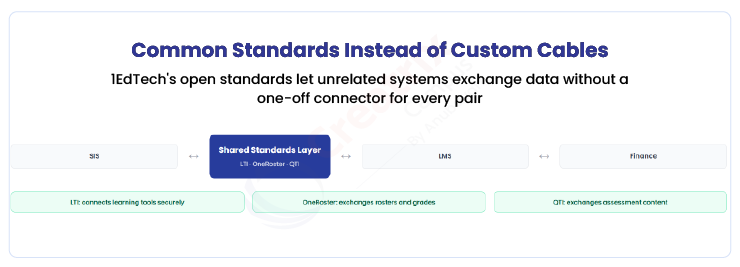
Open standards solve this differently. Instead of a direct point-to-point connection between exactly two systems, a standard defines a common format that any compliant system can read and write. 1EdTech, the nonprofit formerly known as IMS Global Learning Consortium, maintains several of the standards most widely used in this exact space: LTI for securely connecting learning tools and platforms, OneRoster for exchanging class rosters and grades, and QTI for exchanging assessment content, per 1EdTech's own site.
The practical difference is that a system built to these standards doesn't need a custom connector for every other system it might ever need to talk to. It needs to speak the standard once, and anything else that also speaks it can exchange data without a bespoke integration project.
What to Check Before Trusting an Integration Claim
The word "integrated" gets used loosely in vendor marketing. Software can be sold as an integrated suite while its underlying modules still require manual reconciliation, if those modules were acquired separately over time and never rebuilt on a shared data model or common standard.
| Approach | What it actually delivers | Where it breaks down |
| Custom point-to-point connector | Works for the exact two systems it was built to connect | Doesn't extend to a third system without another custom build; breaks when either system changes its API |
| "Integrated suite" without shared standards | One vendor relationship, one contract | Modules can still require manual reconciliation underneath if they weren't built on common data standards |
| Standards-based interoperability (LTI, OneRoster, QTI, or equivalent) | Any compliant system can exchange data without a bespoke project | Requires the institution to actually verify standards compliance, not just take a vendor's word for it |
The honest test is asking a vendor to demonstrate what happens the moment a change is made in one system: does it appear in the connected system within the same session, or does the answer involve words like "nightly," "batch," or "sync job"? That answer says more than any feature list about whether the interoperability is real.
Where Creatrix Campus Fits
Creatrix Campus connects the systems institutions already run through standards-based interoperability, rather than requiring a custom connector for every new system added over time.
A change made in one place, a course drop, a fee payment, an enrollment update, reaches every dependent system within the same session, not after an overnight job. That removes the swivel-chair work that otherwise falls on IT staff and the delay that otherwise falls on students and faculty waiting for records to catch up.
The same architecture that connects internal modules also extends to third-party tools institutions already use, so adding a new system doesn't mean starting another custom integration project from scratch.
Conclusion
Most institutions don't notice how many nightly jobs are quietly patching over systems that were never built to talk to each other, until someone asks why a student's record looks different depending on which office you ask.
Real interoperability isn't measured by how many systems a vendor claims to connect to. It's measured by how quickly a change made in one place reaches everywhere else it matters, and whether that requires a custom project every time a new system joins the mix. Institutions that evaluate for standards-based exchange get genuine interoperability. The rest keep running the nightly script.
If you want to see how Creatrix Campus connects your campus systems without another custom integration project, talk to us about higher education interoperability.
Quick recap
Interoperability in higher education means systems exchanging data through shared, open standards, not custom one-off connectors or nightly manual exports. A change made once should reach every dependent system in the same session. Institutions should evaluate vendors on how current the data actually stays across systems, not on how many integrations are claimed on a feature list.
Frequently asked questions
What does interoperability mean for higher education software?
Why do institutions still rely on nightly data syncs between systems?
How can an institution tell if a vendor's "integration" is genuine?
Can software be marketed as an "integrated suite" without genuine interoperability?
How does Creatrix Campus handle interoperability?
Join the conversation
Want to contribute?
We welcome thought leaders to share ideas and write for our blog.
Become a guest author