

On this page
AACSB accreditation asks business schools to do more than measure whether students are learning. Under the 2026 standards, Curriculum, Assurance of Learning, and Learner Progression are treated as one connected process, which means an AoL finding that never visibly changes the curriculum weakens the case for both.
Quick answer
AACSB Assurance of Learning is the process of evaluating whether students are achieving the competencies a programme intends and using those findings to improve it. It becomes genuinely useful only when a result changes an academic decision, a curriculum revision, an assessment redesign, or a shift in course sequencing, and that change is later reassessed against the original finding.
Article summary
AACSB's 2026 standards treat Curriculum, Assurance of Learning, and Learner Progression as interdependent, but many schools still let AoL results become accreditation records rather than academic signals. This article looks at what changes when a learning finding is expected to produce a visible curriculum response, and why the trail connecting evidence to decision to reassessment matters more than the measurement itself.
Key takeaways
- An attainment result only becomes useful once it changes an academic decision, not when it's simply recorded.
- AACSB's 2026 standards treat Curriculum, Assurance of Learning, and Learner Progression as one connected process, not separate conversations.
- "Closing the loop" means acting on a finding and then reassessing whether that change actually improved learning.
- The stronger continuous-improvement story connects the reason for a curriculum decision to its eventual impact, not just the fact that a committee approved it.
Why This Matters
Curriculum is expected to stay responsive to changes in business practice, technology, and society, while Assurance of Learning is expected to prove learners are developing the competencies a programme intends. Under AACSB's 2026 standards, those are treated as one connected process, not two separate conversations, so a finding that never visibly changes the curriculum weakens the case for both.
Assurance of Learning Should Tell You Something You Didn't Already Know
AoL becomes useful when a result changes an academic decision. If a competency falls below expectation, the real question is not whether the target was met, but what the result revealed about the programme. The assessment may be weak, the skill may be introduced too late, or the curriculum may assume a capability that was never deliberately developed.
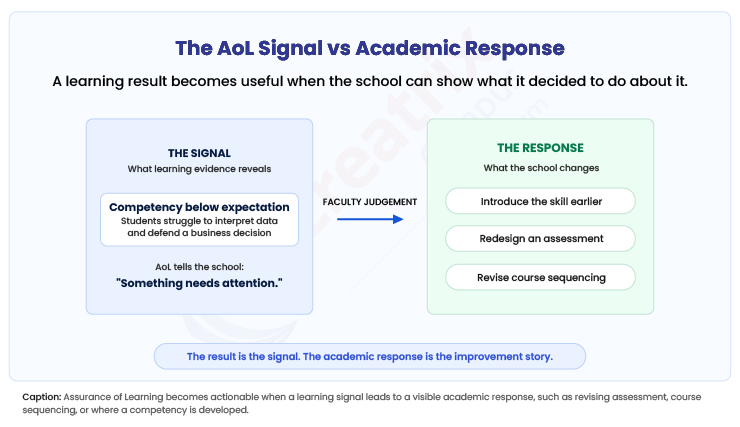
AACSB's guidance on closing the loop is ultimately about acting on that evidence and then checking whether the change improved learning. The goal is not another attainment table. It is a visible connection between what students demonstrated and what faculty decided to change.
| What AoL Produces | What Makes It Useful | Risk If Missing |
| An attainment result | A documented interpretation of what it means for the programme | The result sits as a record with no academic follow-through |
| A faculty discussion | A specific decision tied to the finding | The discussion happens but nothing traceable changes |
| A curriculum or assessment change | A link back to the evidence that prompted it | The change looks arbitrary or unmotivated during review |
| A reassessment cycle | A comparison against the original finding | The school cannot say whether the intervention worked |
The Curriculum Can Change Faster Than the Accreditation Story
Business education does not stand still between accreditation reviews. AI changes how work gets done, employers rethink expected graduate capabilities, and faculty introduce new assessments and learning experiences in response. The curriculum responds, but the evidence explaining why it changed can easily fall behind.
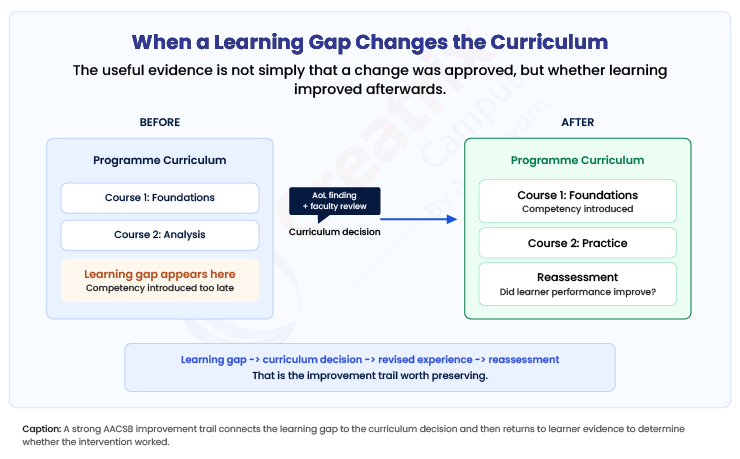
Imagine an AoL review identifies a weakness in students' ability to interpret data and defend a business decision. Faculty revise assessments across several courses and introduce the competency earlier in the programme. A year later, the school should be able to answer three questions: what evidence triggered the change, what exactly was changed, and did student learning improve afterward. That is a stronger continuous-improvement story than simply showing a curriculum committee approved a revision, because it connects the reason for the decision to its eventual impact.
For Deans and Programme Directors, this provides visibility into whether curriculum decisions are actually improving learner success. For AoL and accreditation teams, it removes the need to reconstruct the reasoning behind academic changes months or years later.
| Disconnected Improvement Cycle | Connected Improvement Cycle |
| Finding and curriculum change tracked separately | Finding, decision, and change remain linked |
| Reasoning reconstructed at review time | Reasoning stays attached to the record |
| Reassessment happens but isn't compared back | Reassessment is measured against the original finding |
| Committee approval is the visible record | The full evidence trail is the visible record |
The better question for a business school is not whether it has enough AoL evidence. It is whether it can show what that evidence changed.
Where Creatrix Campus Fits
Creatrix Campus helps keep learning competencies, assessment evidence, faculty decisions, and curriculum revisions connected as a programme evolves. Outcome-based education and assessment tools keep attainment data tied to the decisions it prompts rather than sitting as a standalone table. Curriculum management keeps revisions, approvals, and the evidence behind them in one place, and accreditation evidence management keeps that improvement trail visible as ongoing evidence rather than something assembled when review preparation begins. This does not guarantee AACSB accreditation, which remains AACSB's own determination.
Conclusion
AACSB Assurance of Learning becomes far more valuable when it stops being treated as an accreditation activity on its own. A result identifies a signal, faculty interpret it, the curriculum responds, and the next assessment shows whether that response worked. When those steps stay connected, a business school gains something more useful than accreditation evidence: a way to see whether its programmes are actually improving.
If your school's AoL findings tend to stay separate from the curriculum decisions they should be driving, talk to Creatrix Campus about connecting learning outcomes, assessment, and curriculum evidence across the academic lifecycle.
Quick recap
AACSB Assurance of Learning should create a visible path from learning evidence to faculty judgement to curriculum change to reassessment. The value is not proving that measurement happened, but showing how the school learned from the evidence and whether its response actually improved learner success.
Frequently asked questions
What is Assurance of Learning in AACSB accreditation?
What does “closing the loop” mean in AACSB Assurance of Learning?
How are curriculum and Assurance of Learning connected?
Who should be involved in AACSB Assurance of Learning?
How can business schools make AACSB readiness more continuous?
Join the conversation
Want to contribute?
We welcome thought leaders to share ideas and write for our blog.
Become a guest author