

On this page
Fee problems rarely begin at the payment counter.
They often begin when something academic changes.
A student accepts an offer. A scholarship is adjusted. Credits are added or dropped. A programme changes. Exam eligibility is checked. Graduation clearance begins.
Each of those academic decisions can change what the student owes, what they are allowed to do next, or whether they are financially cleared.
If the academic record changes before the financial record does, the student becomes the person forced to reconcile the difference.
That is the real problem.
The student experiences one university, but academic and financial rules may still be moving on different timelines.
Quick answer
Fee-academic misalignment happens when academic decisions such as admission, registration, course changes, exam eligibility, and graduation clearance do not update the student account quickly or consistently enough. The result is unexpected balances, manual corrections, clearance delays, student complaints, and avoidable friction between Finance, the Registrar, and Academic Operations.
Article summary
| Problem | Academic changes and financial records can fall out of sync. |
| Who this is for | Finance Heads, Registrars, Student Accounts, Exam offices, Admissions, and Academic Operations leaders. |
| What changes | Fee management moves from back-office billing toward lifecycle-aligned financial operations. |
| Why it matters | Students experience misalignment as blocked registration, confusing balances, or late clearance. |
| Outcome | Fewer surprises, less manual correction, stronger student trust, and better coordination between Finance and academic teams. |
Key takeaways
- Many fee problems begin with an academic change, not a payment failure.
- Registration is one of the biggest points where academic and fee records can drift apart.
- Exam and graduation clearance often expose problems that started much earlier.
- Finance and academic teams need to work from the same student context.
- Good fee alignment should reduce surprises for both the student and the institution.
Why This Matters
NACUBO’s Bursar Fundamentals covers student accounts work across areas including payments, refunds, collections, financial aid, customer service, and changing student-account practices. That breadth is a useful reminder that university fee operations are not simply about generating invoices.
Student accounts interact constantly with academic movement.
When that connection is weak, the institution may eventually correct the balance, but not before the student has spent time moving between offices, the Registrar has explained an academic record, Finance has recalculated an account, and another team has paused progression or clearance.
A financially correct answer delivered too late can still create a poor student experience.
Where Fee Misalignment Begins
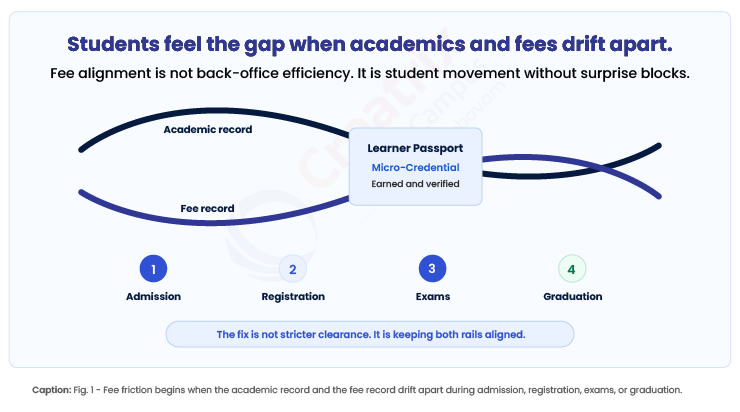
Fee misalignment begins when the academic record and the student account stop describing the same student reality.
An offer may be confirmed while deposit or scholarship rules remain unresolved. A programme transfer may be academically approved before the billing structure changes. Credits may be dropped while the account still reflects the original load.
The problem becomes clearer when the academic moment and its financial consequence are viewed together.
| Academic moment | Financial consequence | What the student may experience if they diverge |
| Admission or offer | Deposit, scholarship, initial charge | Confusing amount due |
| Course registration | Credit-based fee calculation | Incorrect or delayed billing |
| Add/drop or programme change | Recalculation or adjustment | Unexpected balance |
| Exam clearance | Financial eligibility check | Late hold or dispute |
| Graduation clearance | Final account status | Delayed completion or release |
A connected student information system matters because the student account should not become a separate institutional version of the truth.
The academic record says what the student is doing. The financial record should understand what that means.
Why Registration Is the Drift Point
Registration creates frequent financial movement.
Students add courses, drop modules, repeat classes, shift programmes, change study loads, receive scholarships, or request different payment arrangements. Each change can alter what the student owes.
If financial updates happen later, Finance begins working from an academic position that is already outdated.
That is when invoices are recalculated, payments have to be reallocated, balances become difficult to explain, and Registrar teams are drawn into student-account conversations.
A strong fee management system therefore needs to stay close to registration activity rather than depend heavily on later reconciliation.
The principle is simple:
If registration changes the academic obligation, the financial consequence should not remain unaware of that change.
Why Exams and Graduation Expose the Gap
Exam and graduation periods do not usually create fee misalignment.
They reveal it.
These are the moments when academic progression and financial clearance have to agree.
A student may have completed the required academic work but still appear financially uncleared. The Exam office needs a decision. The Registrar needs to confirm academic status. Finance has to enforce institutional rules. The student expects one clear answer.
If the records have been drifting for weeks or months, those teams are now reconciling them under pressure.
The result can be held hall tickets, revised clearance lists, delayed graduation approvals, last-minute payments, and difficult student conversations.
The clearance point gets blamed because that is where the problem becomes visible. The actual misalignment often started much earlier.
What Aligned Operations Should Feel Like
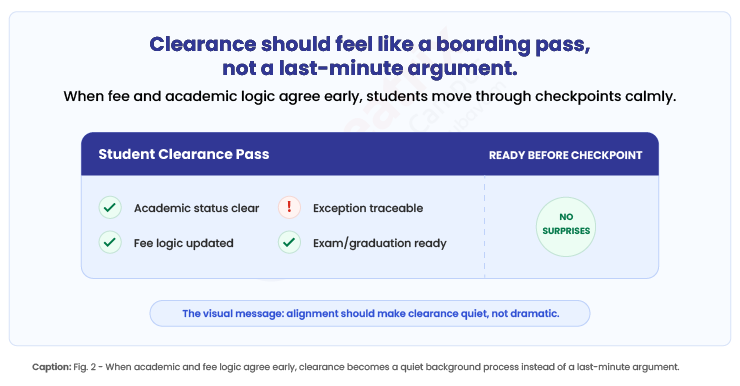
Good fee-academic alignment should be almost invisible to the student.
An offer creates the correct financial obligation. Registration adjusts the account. Course changes trigger the appropriate recalculation. Scholarship or exception decisions remain traceable. Exam clearance is known early enough to resolve issues. Graduation teams are not discovering financial problems while final lists are being prepared.
This is where student lifecycle management becomes relevant to Finance as well as Student Services.
The university should not need one office to explain what the student is academically allowed to do while another office separately works out what that means financially.
The student should receive one institutional answer.
Where Creatrix Campus Fits
Creatrix Campus becomes relevant at the point where academic movement and fee logic need to stay connected.
Creatrix Campus connects admissions, enrollment, registration, course changes, fee rules, scholarships, student accounts, exam eligibility, and graduation clearance within a connected student lifecycle.
For Finance and Student Accounts teams, that can reduce the amount of manual reconciliation needed after academic changes. For Registrars, it creates stronger continuity between student status and financial context. For Exam and Graduation teams, clearance becomes easier to understand earlier rather than becoming a last-minute investigation.
The wider value is not simply cleaner billing.
It is preventing the student from becoming the integration layer between Finance and Academic Operations.
Conclusion
Fee alignment is not about making financial rules stricter. It is about making sure academic and financial decisions remain coordinated as the student moves through the institution.
If a student changed courses today, how long would it take every relevant academic and financial process to reflect the same reality? Connect fee logic with the student lifecycle.
Quick recap
Fee misalignment appears when the academic record changes faster than the student account can follow. Registration, course changes, exams, and graduation then become pressure points where internal differences suddenly reach the student. The stronger model keeps academic movement and fee logic connected throughout the lifecycle so Finance, the Registrar, and the student are not working from different versions of the same situation.
Frequently asked questions
What is fee-academic alignment?
Why do university fee disputes happen?
Why is registration a common point of fee misalignment?
How does fee alignment affect exam eligibility?
How can universities reduce graduation clearance delays?
How can Creatrix Campus support fee-academic alignment?
Join the conversation
Want to contribute?
We welcome thought leaders to share ideas and write for our blog.
Become a guest author