

On this page
An institution can issue a beautifully designed digital badge, and an employer can still have no idea what the person holding it can actually do. That's not a design problem. It's a credibility problem, and it's the reason so many microcredential programmes struggle to gain traction outside the institution that issued them.
Quick answer
A microcredential becomes recognizable and credible to employers when it clearly shows what competency was developed, how that competency was assessed, what evidence supports the achievement, who issued it, and how it connects to a larger learning pathway. Without that structure behind it, a badge is a claim. With it, a badge becomes evidence an employer can actually act on.
Article summary
This article moves past the idea that launching more microcredentials is itself the goal. A badge is only as credible as the competency, assessment, and evidence behind it, and most institutions underinvest in exactly that structure. It looks at what separates a credential an employer trusts from one they quietly ignore, and where the real work of building employer recognition actually happens, well before a badge is ever issued.
Key takeaways
- A microcredential is not valuable because it's short or digital. It's valuable because of the evidence behind it.
- Employers need to understand what competency was developed, how it was assessed, and who stands behind the claim.
- Verification and issuer credibility matter as much as the skill itself.
- Stackability only helps if each credential connects clearly to a larger learning pathway.
- Building institutional structure behind credentials takes more effort than issuing them, and it's the part that actually earns recognition.
A Badge Is Not the Credential. The Evidence Behind It Is.
Here's the real problem with most microcredential programmes. The badge is the easy part. Anyone can design a graphic, attach a title, and issue it after a short course. What's hard, and what most institutions skip, is building the structure that makes the badge mean something once it leaves the institution's own systems.
Think about it from an employer's side. A résumé line or a badge image tells them almost nothing on its own. What they actually want to know is narrower and more specific: what can this person do, how confident should I be that they can do it, and who is vouching for that claim. A badge answers none of those questions by itself. The structure behind it has to.
That structure has five parts that all need to hold up. The competency has to be specific enough to mean something, not a vague label like "leadership." The assessment behind it has to actually test that competency, not just attendance. The evidence has to be something an employer could, in principle, review. The issuer has to be identifiable and credible. And the credential has to show how it fits into something larger, rather than existing as an isolated one-off.
The European Commission's Council Recommendation on micro-credentials makes a similar point at the policy level: without common standards for how micro-credentials are described, assessed, and issued, they cannot reach their full potential for cross-border recognition and portability. That's the institutional-scale version of the same problem a single employer faces looking at a single badge.
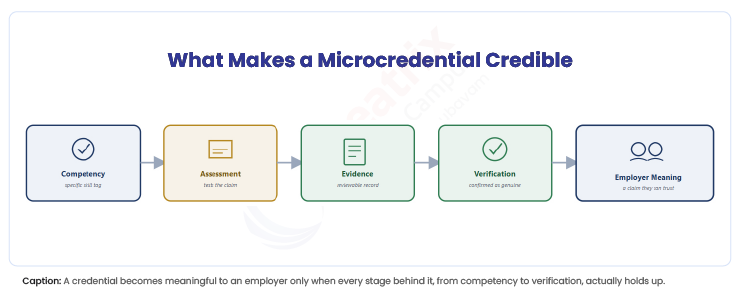
Employer Recognition Starts With Competency Clarity
Now imagine two institutions issue what looks like the same microcredential in data analysis. One defines the competency precisely, ties it to a specific assessment with a rubric, and issues it through a named academic unit. The other defines it loosely, grades it on completion, and issues it through a general continuing education account. An employer looking at both badges has no way to tell them apart unless the structure behind each one is visible.
This is where competency mapping earns its keep. A microcredential that's mapped to a clear learning outcome, the same way a course-level or programme-level outcome would be, gives an employer something concrete to evaluate rather than a title to take on faith. It also gives the institution a defensible basis for the credential if it's ever questioned during an audit or a partnership review.
| Microcredential Element | What the Institution Must Define | What an Employer Needs to Understand |
| Competency | The specific skill or capability being certified | What the learner can actually do |
| Learning outcome | How that competency is stated and measured | What standard of performance was expected |
| Assessment | The method used to test the competency | How rigorously the claim was tested |
| Evidence | The artifact or record supporting achievement | Whether the claim can be substantiated |
| Issuer | The academic unit or authority behind the credential | Who is accountable for the claim |
| Verification | How the credential can be confirmed as genuine | Whether the credential is real and current |
| Stackability | How the credential combines with others | Whether this represents a step toward something larger |
| Pathway connection | Where the credential sits in a broader programme | Whether this signals ongoing capability, not a one-off |
Notice that stackability sits near the bottom of that table, not the top. It's a genuinely useful feature once the other elements are in place, but it doesn't compensate for a missing assessment or an unclear competency. A stackable pathway built from vague credentials is still a pathway built from vague credentials.
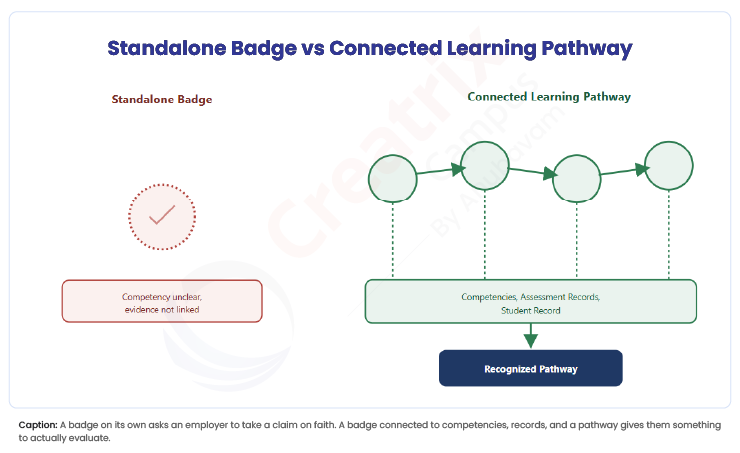
Where Creatrix Campus Fits
Creatrix Campus connects the underlying structure a credible microcredential depends on: competencies mapped to learning outcomes, assessment evidence tied to those outcomes, and a student record that carries both forward, within one governed system rather than across disconnected tools. Because that structure sits alongside the institution's broader outcome and competency framework and student success and records systems, a microcredential can be traced back to the same evidence an academic audit would already expect to see.
What Creatrix Campus does not do is guarantee employer recognition, job placement, or third party skills verification. Those outcomes depend on factors outside any single system, including how the credential is marketed, which employers already recognize the issuing institution, and broader industry adoption of the standard behind it. The platform's role is making the underlying evidence trustworthy and traceable, not making the external recognition promise on the institution's behalf.
Conclusion
A microcredential becomes more credible the moment an institution can show exactly what was learned, how it was assessed, and how the achievement can be verified, rather than simply that a badge was issued. That's a slower, less flashy standard than "launch more credentials faster," but it's the one that actually earns the trust the article's title promises. Before your next microcredential launch, it's worth asking whether you could hand an employer the evidence behind any single badge you've issued, not just the badge itself. If you want to see how competencies, assessment, and student records can stay connected behind every credential you issue, request a demo of Creatrix Campus.
Quick recap
A microcredential earns employer trust through the structure behind it: a clear competency, a real assessment, supporting evidence, a credible issuer, and a visible connection to a larger pathway. Stackability and design help, but they cannot substitute for that underlying evidence.
Frequently asked questions
What makes a microcredential recognizable and credible to employers?
Is a digital badge the same as a credible microcredential?
Do stackable microcredentials automatically improve employer recognition?
Can an institution guarantee that employers will recognize a microcredential?
Join the conversation
Want to contribute?
We welcome thought leaders to share ideas and write for our blog.
Become a guest author