

On this page
AI in university fee operations is easy to reduce to automation.
Send reminders earlier. Predict missed payments. Prioritise overdue accounts. Improve collections.
Those capabilities can be useful, but they address only the visible end of a much longer financial process.
A student’s balance may change because of registration, a scholarship adjustment, a programme transfer, an approved waiver, or an installment decision. A missed payment may signal genuine financial risk, or it may simply reflect an unresolved institutional change.
If AI cannot tell the difference, faster automation can create faster frustration.
A reminder can be perfectly automated and still be completely wrong for the student receiving it.
The real opportunity is therefore not making collections louder. It is helping Finance understand when to act, when to wait, what changed, and what needs human attention.
Quick answer
AI in university fee operations creates more value when it helps institutions understand timing and context, not simply automate collections. By connecting fee rules, billing events, academic changes, payment behaviour, exceptions, and communication, AI can help Finance identify emerging risk earlier, apply policies more consistently, and avoid contacting students when the underlying account still needs institutional review.
Article summary
| Problem | Fee operations become reactive when Finance sees payment behaviour without enough academic, policy, or exception context. |
| Who this is for | Finance Heads, Bursars, Registrars, CIOs, Student Accounts teams, and university operations leaders. |
| What changes | AI moves from collection automation toward contextual fee intelligence. |
| Why it matters | Automating the wrong action faster can increase student friction rather than reduce it. |
| Outcome | Earlier risk visibility, better-timed communication, clearer exceptions, and less manual chasing. |
Key takeaways
- AI in fee operations should do more than automate reminders.
- Payment risk needs to be interpreted alongside academic and policy context.
- Timing matters as much as the message being sent.
- Exceptions should influence automated actions rather than sit outside them.
- The goal is fewer avoidable interventions, not simply more efficient collections.
Why This Matters
Fee operations sit in a sensitive space between institutional revenue and student trust.
Finance has to protect cash flow and apply policy consistently. Students need balances and obligations they can understand. Registrars and Academic Operations need financial processes that do not unexpectedly interrupt registration, exams, or progression.
AI can help, but only if institutions define the problem correctly.
If the goal is simply “collect faster,” AI becomes another mechanism for increasing pressure. If the goal is to understand risk, context, timing, and exceptions earlier, it can help reduce the situations that require aggressive collection in the first place.
That is a much more useful test for AI in university finance:
Does it help Finance act earlier and more accurately, or merely automate what Finance already does?
Why Collections Are the Wrong Starting Point
Collections are usually the end of the story.
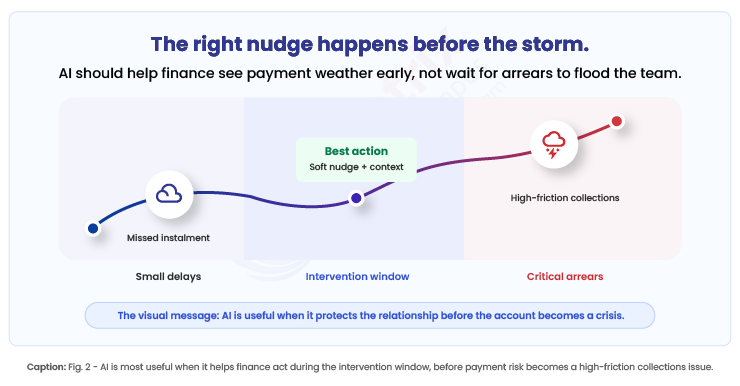
Before an account becomes seriously overdue, several smaller events may already have occurred. An installment was missed. A scholarship adjustment was delayed. A student changed programme. A partial payment arrived later than expected. A manually approved exception had not yet reached the account.
If AI starts only when the balance becomes overdue, it is reacting after much of the useful decision window has passed.
A stronger fee management system should therefore help institutions see how the account is changing before collection becomes the primary response.
The better question is not:
“Which students should we chase?”
It is:
“Which accounts are becoming risky, what is causing the change, and what should happen next?”
That difference moves AI from collection automation toward financial decision support.
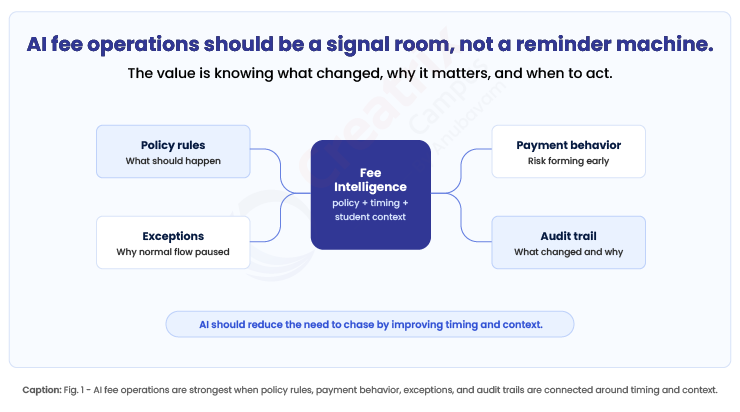
What AI Should Actually Connect
A financial transaction rarely explains itself.
AI becomes more useful when the institution can interpret payment activity alongside the context surrounding it.
| Signal | Context Finance may need |
| Missed installment | Is another payment expected, or has behaviour genuinely changed? |
| Changed balance | Did registration or programme status change? |
| Outstanding fee | Is a scholarship, waiver, or adjustment pending? |
| Repeated late payment | Is a longer-term payment risk emerging? |
| Reminder due | Should an open exception pause communication? |
| Manual adjustment | Who approved it and why? |
This is why AI cannot rely only on financial transactions.
The wider student context held within the student information system matters because a balance may be the result of an academic event rather than student behaviour.
Good fee intelligence does not simply detect that something changed. It helps explain why.
Why Timing Matters More Than More Reminders
Universities do not need an unlimited ability to send messages.
They need better judgement about when communication will actually help.
A student gradually slipping behind may benefit from an early, low-pressure nudge. Another may require a conversation about a payment plan. A third may have an unresolved scholarship adjustment and should not be receiving an automated overdue notice at all.
The message therefore matters less than the combination of timing, context, and next action.
AI can help Finance distinguish between accounts that need communication, cases that need human review, balances caused by institutional changes, and exceptions that should temporarily stop automated workflows.
This is where student lifecycle management becomes relevant to financial operations. The same outstanding balance can mean very different things depending on where the student is in registration, progression, exams, or completion.
The goal is not to remind everyone sooner.
It is to intervene at the point where intervention is most useful.
How AI Can Support Fairer Exceptions and Audit Trails
No university fee policy operates without exceptions.
Scholarship corrections, installment adjustments, programme changes, emergency waivers, refund reviews, late-payment appeals, and other individual circumstances are part of real student-account operations.
The governance challenge is making sure those exceptions do not disappear into informal decisions.
AI can support the process by helping surface unusual cases, route exception requests, flag missing information or approvals, and preserve context around why a financial decision changed.
But human ownership remains important.
An algorithm should not decide that a student deserves an exception simply because a pattern looks unusual. It can help identify the case and apply institutional logic more consistently, while authorised teams make the academic or financial judgement.
That creates a more defensible trail:
Policy → Exception → Review → Approval → Action → Evidence
If an automated reminder is paused, the institution knows why. If a waiver is approved, the approval remains visible. If a student is financially cleared, Finance can understand the basis for that decision.
That is how AI strengthens financial governance without turning fee operations into automated enforcement.
Where Creatrix Campus Fits
This is where Creatrix Campus becomes relevant.
Not simply as a way to automate collections, but as part of the connected student and financial processes that give those automations context.
Creatrix Campus connects fee rules, student accounts, billing events, payment behaviour, academic changes, exceptions, communication, and audit evidence within the student lifecycle.
For Finance and Student Accounts teams, that can mean earlier visibility into developing payment issues and less manual reconciliation. For Registrars, it creates stronger continuity between academic changes and account status. For university leadership, it provides a clearer view of financial risk before it reaches late-stage collection.
The larger value is not sending more reminders.
It is knowing when a reminder is the right action at all.
Conclusion
AI should make university fee operations more aware, not simply more automated. It should help Finance understand what is changing, why it is changing, when intervention is useful, and which cases need human judgement before the student account becomes a larger problem.
How many of your current collection actions could have been avoided if Finance had seen the right context two weeks earlier? Build smarter fee operations with Creatrix Campus.
Quick recap
AI in university fee operations should move institutions beyond automated collections toward better-timed financial decisions. Payment behaviour becomes more useful when it is connected to fee policy, academic changes, exceptions, student communication, and the wider lifecycle. The strongest outcome is not simply collecting faster. It is reducing how often Finance has to chase because the institution recognised the problem earlier.
Frequently asked questions
How can AI help university fee operations?
Is AI fee management only about collections?
Why do automated fee reminders sometimes create friction?
Why does timing matter in fee communication?
How can AI support fee exceptions?
How can Creatrix Campus support AI-enabled fee operations?
Join the conversation
Want to contribute?
We welcome thought leaders to share ideas and write for our blog.
Become a guest author