

On this page
By the time a prospective student emails an admissions office, they have usually already made up their mind about what kind of place the institution is. They've read reviews on Niche. They've skimmed a Reddit thread from current students. Maybe a parent in a Facebook group mentioned something about financial aid response times. None of that happened because the marketing team posted it.
That's the uncomfortable part of reputation in higher education right now. Niche alone reports more than 50 million users in the last year and over 100 million ratings and reviews across more than 200,000 school and neighborhood profiles. At that scale, an institution's reputation is being written continuously, by people who have never spoken to the communications office, based on things that happened to them personally on campus or in a portal.
Most reputation strategies still treat this as a monitoring and response problem: watch for bad reviews, respond quickly, manage the narrative. That's necessary, but it treats the symptom. The review is usually just an honest report of an operational experience that happened weeks or months earlier, and by the time it's public, the moment to have prevented it has already passed.
Quick answer
Higher education reputation management is the practice of shaping what students, families, and the public say about an institution, largely by improving the day-to-day operational experiences, portal access, advising responsiveness, fee processes, that generate reviews in the first place, rather than only monitoring and responding to reviews after they're posted. Niche, which reports over 50 million users and 100 million-plus reviews annually, is one clear signal of how much of this reputation forms outside an institution's own communications channels.
Article summary
The case for treating reputation as an operations problem, not just a communications one, rests on three things: where reviews and word of mouth actually originate, why a reactive monitor-and-respond strategy addresses symptoms rather than causes, and what to look for in systems that reduce the friction generating negative reviews in the first place.
Key takeaways
- Niche reports over 50 million users in the last year and more than 100 million ratings and reviews across 200,000-plus school profiles, evidence of how much reputation now forms outside an institution's own communications channels.
- Reviews are usually an honest report of an operational experience, a slow advising response, a confusing fee portal, not a communications failure on their own.
- Monitoring and responding to reviews after they're posted addresses the symptom. It does nothing to prevent the next one from being written.
- The institutions with the strongest organic reputation tend to have the fewest operational friction points, not the most active social media response team.
- A system that unifies the student portal, advising communication, and fee processes reduces the number of bad experiences available to review in the first place.
The Reviews Happen Before Anyone Calls Admissions
Ask any admissions director how much of their applicant pool did independent research before first contact, and the honest answer is nearly all of them. Niche's own scale, over 50 million users and 100 million-plus reviews, means a meaningful share of prospective students and their families are reading unfiltered accounts of student life before an institution's own messaging ever reaches them.
This creates a strange asymmetry. The admissions office controls the brochure, the campus tour script, and the official website copy. It has far less control over what a sophomore posts about a confusing fee payment process, or what a parent writes after struggling to reach financial aid for two weeks. Yet the second category is what a prospective family is more likely to trust, precisely because it wasn't written by the institution.
Where Reputation Actually Gets Written
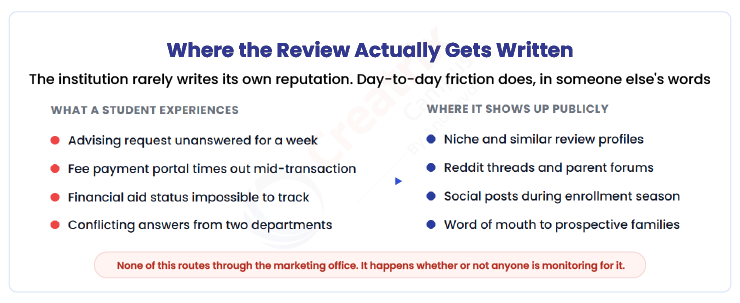
A student doesn't sit down to write a review because they feel like grading their university. They write one because something specific happened: an advising request went unanswered for a week, a fee payment failed twice before finally going through, financial aid status was impossible to track, or two departments gave them contradictory information about the same requirement.
None of that friction is a secret to the institution internally. Advising response times are usually trackable. Portal errors show up in support tickets. What's missing is the connection between those internal signals and the public reputation they eventually produce, because the two live in completely separate systems, one operational, one social.
The result is that reputation management, as most institutions practice it, only sees half the picture: the finished review, not the operational event that caused it. By the time anyone in communications sees the Niche post, the actual moment that generated it happened weeks earlier and has already been forgotten by everyone except the student who lived through it.
What Institutions Get Wrong About Managing It
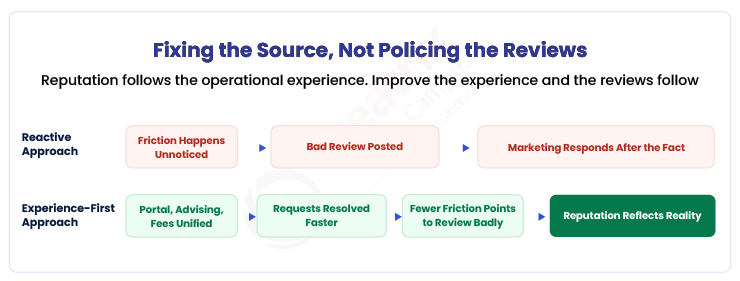
The default response to a bad review is to reply to it, publicly and politely, and hope the next one doesn't come. That's not wrong, exactly. It's just incomplete, because it treats each review as an isolated incident rather than as a data point about a system that's still producing the same friction for the next student.
| Approach | What it actually does | What it misses |
| Reactive monitoring and response | Watches for reviews and mentions, responds quickly and professionally when something negative appears | Does nothing to reduce how often the underlying friction, slow advising, portal errors, occurs for the next student |
| Marketing campaigns to "improve image" | Produces more positive content, testimonials, campus life features, to shift the balance of what's visible | Doesn't change the actual experience a struggling student has; the negative reviews keep coming alongside the new content |
| Experience-first, systems-level approach | Reduces the operational friction, unresponsive advising, confusing portals, unclear fee status, that generates negative reviews in the first place | Requires connecting operational systems to the reputation conversation, which most institutions don't currently do |
This is the piece that's easy to miss: an institution can win every individual review-response exchange and still watch its aggregate rating stay flat, because winning the exchange doesn't touch the operational cause. The advising office is still slow. The portal still times out. The next student experiences the same friction and writes a similar review.
What to Look For in a System That Actually Helps
If the goal is genuinely fewer negative reviews rather than just faster responses to the ones already posted, the evaluation question changes. It stops being "what social listening tool should we buy" and becomes "what in our own operational systems is currently producing a bad experience, and can we see it before a student has to write about it publicly."
| Capability | Why it matters | What to ask a vendor |
| Unified student portal for advising, fees, and records | Fewer separate logins and contradictory answers means fewer specific moments to review badly | Ask how many separate systems a student currently has to navigate to resolve one issue |
| Visibility into response times and unresolved requests | Slow advising or unclear financial aid status are two of the most common review triggers | Ask whether the system surfaces aging, unresolved student requests before they become public complaints |
| Consistent information across departments | Contradictory answers from two offices are a specific, avoidable source of frustration | Ask whether advising, registrar, and finance are working from the same current student record |
| Faster resolution, not just faster acknowledgment | A quick "we're looking into it" reply doesn't fix the underlying issue that will still frustrate the next student | Ask what actually changes operationally after a complaint, not just what gets said publicly in response to it |
Where Creatrix Campus Fits
Creatrix Campus unifies the student portal, advising communication, and fee processes that generate most of the day-to-day friction behind negative reviews, so fewer of those specific moments happen in the first place.
Advising requests, fee status, and academic records live in one connected system rather than several disconnected logins, which removes a common source of the contradictory answers and unresolved requests that end up described publicly. Staff can see aging, unresolved student requests before they turn into a public complaint, instead of learning about the friction for the first time on a review site.
The result isn't a reputation management dashboard layered on top of the same operational gaps. It's fewer operational gaps for a reputation dashboard to have to manage in the first place.
Conclusion
An institution's public reputation is mostly assembled by people who were never trying to make a statement. They were trying to get an advising question answered, a fee payment processed, or a financial aid status confirmed, and the review is just an honest account of how that went.
Managing that reputation well means treating it as downstream of operations, not just communications. Institutions that reduce the friction generating bad reviews end up with less to manage after the fact. Institutions that only monitor and respond keep fighting the same fire, review by review, without ever addressing what keeps starting it.
If you want to see how Creatrix Campus reduces the operational friction behind negative reviews, talk to us about higher education reputation management.
Quick recap
Higher education reputation is largely written by day-to-day operational friction, slow advising, portal errors, unclear fee status, long before it becomes a public review. Reactive monitoring and response addresses individual reviews but not the recurring cause. A unified system that reduces friction in advising, portals, and fee processes produces fewer negative moments to review in the first place, which is a more durable reputation strategy than managing the aftermath alone.
Frequently asked questions
What is higher education reputation management?
Why do reviews matter so much before a prospective student even contacts admissions?
What actually causes most negative reviews about a university?
Why isn't monitoring and responding to reviews enough on its own?
How does Creatrix Campus help with reputation management?
Join the conversation
Want to contribute?
We welcome thought leaders to share ideas and write for our blog.
Become a guest author