
On this page
Most universities didn't set out to run a dozen disconnected systems. It happened one department at a time. Finance bought a system that worked for finance. HR bought a system that worked for HR. The registrar's office kept using whatever handled student records reliably. Each decision made sense in isolation. The result, years later, is an institution where nobody can pull one clean picture of what's actually happening across the place.
Higher education ERP software exists to fix exactly that: one integrated system where finance, HR, student records, and reporting share the same underlying data, instead of exporting spreadsheets between departments to reconcile numbers that should already match.
A higher education ERP should deliver more than a bundle of modules. Why institutions end up with disconnected point solutions in the first place, and what to look for when evaluating a genuinely integrated system instead of a collection of modules sold under one brand name, is where the real decision lives.
Quick answer
Higher education ERP software is an integrated system connecting finance, HR, student records, and institutional reporting so they share one underlying data set, rather than requiring departments to manually reconcile numbers across separate tools. The genuine advantage isn't any single module. It's that data entered once, a new hire, a fee payment, a grade change, updates everywhere it needs to, instead of requiring the same information to be re-entered into three different systems.
Article summary
The practical case for higher education ERP software rests on three things: what integration should actually deliver beyond a shared login screen, why institutions accumulate disconnected point solutions department by department, and how to evaluate a system against genuine data integration rather than a marketing claim of being "all-in-one."
Key takeaways
- Disconnected systems create disagreement, not just inconvenience, when finance, HR, and the registrar each maintain their own version of the same number.
- Most institutions didn't choose to run separate systems all at once. It happened department by department, each decision reasonable on its own.
- EDUCAUSE, the nonprofit association focused on the strategic use of technology and data in higher education, reports more than 100,000 individual members across 2,100-plus member institutions, reflecting how widespread this exact integration challenge is across the sector.
- A genuine ERP updates data once and reflects it everywhere, rather than housing separate modules that still require manual reconciliation between them.
- The institutions that get real value from an ERP evaluate for actual data integration, not for how many modules are bundled under one product name.
What Is Higher Education ERP Software?
Higher education ERP, enterprise resource planning, software integrates the core administrative functions of a university, finance, human resources, student records, and institutional reporting, into one system built on a shared data model. The defining feature isn't any individual module. It's that a change made in one place, a new employee, a fee payment, an enrollment update, is reflected everywhere that data is used, without anyone re-entering it or exporting a file to reconcile it manually.
That distinction matters because plenty of software gets marketed as an ERP simply for bundling several modules under one brand, without those modules actually sharing data underneath. A finance module and an HR module sold together can still require manual data transfer between them if they weren't built on a genuinely integrated architecture.
Real integration also means institutional reporting draws from one consistent source. A president asking for enrollment, revenue, and staffing figures together should get numbers that already agree with each other, not three reports that need to be reconciled before anyone can present them.
Why Institutions End Up With Disconnected Point Solutions
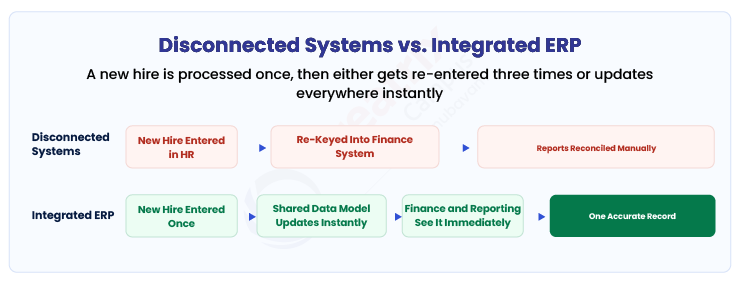
Here's how it usually happens: finance needed a system, so finance bought one that solved finance's problem. HR needed something separate later, so HR bought what worked for HR. The registrar's office had already been running student records on a system nobody wanted to migrate off. Each purchase was a reasonable decision made by the people closest to that specific problem, at a specific point in time.
Nobody sat down and decided the institution should run a dozen disconnected systems. It accumulated, one department procurement at a time, and by the time leadership notices the pattern, unwinding it means replacing systems that individual departments still depend on daily.
EDUCAUSE, the nonprofit association whose mission is to advance the strategic use of technology and data in higher education, reports more than 100,000 individual members across 2,100-plus member institutions, per EDUCAUSE's own site. An association with that much reach exists in part because integrating fragmented institutional systems is a genuinely widespread and ongoing challenge across the sector, not an isolated problem at any one university.
The honest cost of this fragmentation shows up in reconciliation work. Staff spend hours each month exporting data from one system, reformatting it, and importing it into another, or simply re-typing the same information a second time, just to keep departments working from numbers that agree.
What to Look For When Evaluating an ERP
Every vendor selling into this category can point to a list of modules, finance, HR, student records, reporting. That list alone does not tell you whether those modules actually share data or just share a login page.
| Approach | What implementation looks like | What it costs the institution later |
| Separate best-of-breed systems per department | Each department gets a tool suited to its own workflow | Ongoing manual reconciliation between systems; numbers drift out of sync between departments |
| Modules bundled under one brand, not truly integrated | One vendor, one contract, still separate underlying databases | Same reconciliation burden as separate systems, with the appearance of integration but not the substance |
| Genuinely integrated ERP on a shared data model | Finance, HR, student records, and reporting all draw from the same data | Requires more upfront evaluation of the platform's actual architecture, not just its module list |
If the goal is only to consolidate vendor contracts, bundled modules under one brand may be enough. If the goal is to actually eliminate manual reconciliation between departments, the evaluation needs a harder question: does a change in one module appear automatically in every report that depends on it, without anyone exporting or re-entering data.
| Capability | Why it matters | What to ask a vendor |
| Shared data model across modules | Without this, "integration" just means one login for still-separate databases | Ask what happens in the HR module the moment a change is made in finance, and whether that requires a manual sync |
| Institutional reporting from one source | Leadership needs enrollment, revenue, and staffing figures that already agree with each other | Ask to see a report that pulls from more than one module and whether the numbers reconcile automatically |
| Migration path from existing point solutions | Most institutions are not starting from a blank slate | Ask for a specific plan for migrating data out of the systems currently in use, department by department |
| Role-based access across functions | Different staff need different views into the same underlying data | Ask how a registrar's view differs from a finance officer's view of the same student record |
Where Creatrix Campus Fits
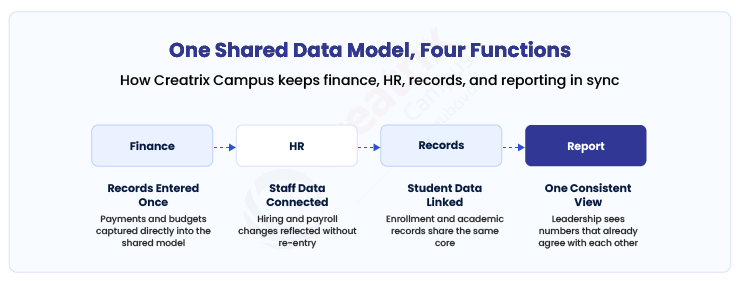
Creatrix Campus is built on a shared data model across finance, HR, student records, and institutional reporting, not a collection of modules that happen to share a login screen.
A change made in one place, a new hire processed in HR, a fee payment recorded in finance, an enrollment update from the registrar, is reflected everywhere that data is used, without manual reconciliation between departments. Institutional reporting draws from that same shared data, so leadership gets enrollment, revenue, and staffing figures that already agree with each other rather than three separate reports that need to be checked against one another first.
The practical effect is that departments keep their own workflows and views into the system, while the institution as a whole works from one consistent set of numbers, not a patchwork of point solutions that each solved a local problem at the expense of the bigger picture.
Conclusion
Most institutions accumulate disconnected systems gradually, one reasonable department decision at a time, and only notice the cost once reconciling numbers between finance, HR, and the registrar has become routine, unquestioned work.
The harder, more useful question when evaluating an ERP isn't how many modules are included. It's whether those modules actually share one data model, so that a change made once is reflected everywhere, without anyone exporting a file or re-typing the same information into a second system. Institutions that evaluate for that get real integration, not just a longer feature list under one brand name.
If you want to see how Creatrix Campus delivers genuine data integration across finance, HR, student records, and reporting, talk to us about higher education ERP software.
Quick recap
Higher education ERP software should connect finance, HR, student records, and institutional reporting on one shared data model, so that a change made once updates everywhere it's needed, instead of requiring manual reconciliation between separate systems. That requires genuine data integration and consistent institutional reporting, not just a bundle of modules sold under one brand name.
Frequently asked questions
What is higher education ERP software?
How is a genuine ERP different from bundled software modules?
Why do institutions end up running disconnected point solutions?
What should institutions look for when evaluating an ERP beyond its module list?
How does Creatrix Campus handle ERP integration?
Join the conversation
Want to contribute?
We welcome thought leaders to share ideas and write for our blog.
Become a guest author