
On this page
Most Malaysian universities are not waiting to become digital.
They already are.
Student records sit in one system. Learning happens in another. Assessment data may live somewhere else. Quality teams maintain evidence. Faculty information follows its own process. Leadership receives dashboards and reports.
Yet when an important institutional question appears, people still have to reconcile the university manually.
Is this programme ready for review?
Which outcome is underperforming?
Does faculty capacity match planned delivery?
Was an improvement action actually completed?
Which student risks need attention now?
The answers may exist, but not always together.
A university can be highly digitised and still be operationally discontinuous.
That is why the next conversation in Malaysian higher education should not be about how many systems have been implemented. It should be about whether academic work, evidence, and decisions remain connected as they move across the institution.
Quick answer
Digital continuity in Malaysian higher education means ensuring that curriculum, assessment, quality assurance, faculty capacity, student progression, institutional evidence, and leadership decisions remain connected throughout normal academic operations. The goal is not another digital-transformation project. It is an institution where important information does not lose its context every time responsibility moves from one office to another.
Article summary
| Problem | Universities may have many digital systems while academic work and evidence still require manual reconciliation between them. |
| Who this is for | Vice Chancellors, Deputy Vice Chancellors, QA Directors, Registrars, CIOs, Deans, Strategic Planning teams, and Institutional Effectiveness leaders. |
| What changes | Digital transformation moves from system adoption toward institutional continuity. |
| Why it matters | Quality, programme delivery, student progression, faculty capacity, and leadership decisions depend on information remaining trustworthy across departments. |
| Outcome | Less reconstruction, earlier visibility into risk, more continuous readiness, and stronger institutional decision confidence. |
Key takeaways
- More digital systems do not automatically create a more connected university.
- Malaysia’s QA, rating, research, and institutional reporting pressures depend on evidence created across many functions.
- Evidence becomes more valuable when it is generated and connected during normal academic work.
- Leadership dashboards are only as reliable as the operational relationships beneath them.
- The next stage of digital transformation is not more digitisation. It is continuity across institutional lifecycles.
Why This Matters
Malaysian university leaders are being asked to strengthen quality, graduate outcomes, internationalisation, research performance, academic capacity, student progression, and institutional readiness at the same time. That makes one leadership question increasingly important: “Can we see what is happening across the institution without first asking every department to reconstruct it for us?”
Why Digital Transformation Still Feels Fragmented
Higher education digitisation happened for sensible reasons.
Student Records needed a system. Teaching needed an LMS. Finance needed its own platform. Quality teams introduced tools and repositories. Assessment processes developed separately. Faculty workload often acquired another workflow. Leadership eventually added analytics.
Each decision solved a legitimate problem.
But the university does not experience those problems independently.
A curriculum decision changes what faculty must deliver. Delivery affects assessment. Assessment creates outcome evidence. Outcome gaps require improvement. Faculty capacity influences whether those improvements are practical. Student performance affects support decisions. QA eventually needs evidence showing how all of this was governed.
The systems may exchange data without preserving that institutional story. Integration can improve data movement without necessarily unifying how the institution works.
Digital continuity begins when information does not merely travel between systems, but retains the meaning needed for the next decision.
The Scale Problem Malaysian Universities Cannot Ignore
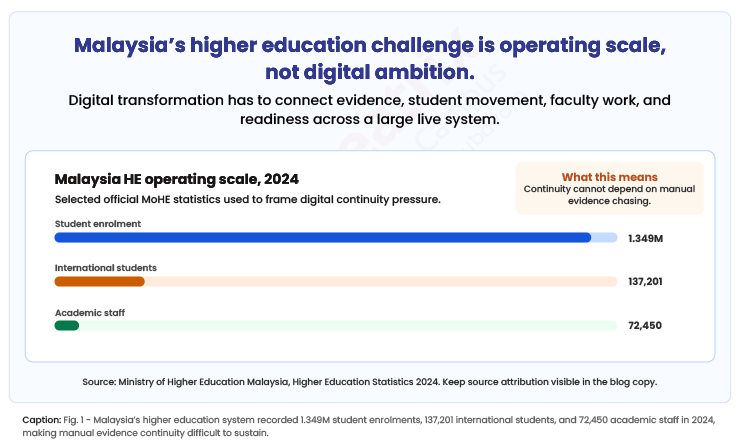
Malaysia's Ministry of Higher Education 2024 statistics report 1,349,090 student enrolments across higher education, including 137,201 international students and 72,450 academic staff, according to the source draft.
At that scale, manual reconciliation stops being a small administrative inconvenience.
A missing assessment relationship can complicate programme review. An outdated faculty-capacity view can weaken planning. A student-risk signal that remains inside one system may reach support too late. A quality finding recorded without a connected action creates more work when review begins.
The institution may still function.
But increasingly, it functions because people are compensating for the gaps between systems.
That is the hidden cost.
The question is not whether staff can keep reconciling the university manually. It is why a digital university should still depend on them doing so.
Why Readiness Must Become Continuous
The Malaysian context makes this especially timely.
Internal regulatory research identifies IQAF 2025 as effective in 2026, alongside ongoing MQA COPPA requirements, while SETARA and MyRA create separate rating and research-assessment demands. These are different frameworks with different purposes, but all depend on institutional information being complete, reliable, and available when required.
That changes what “readiness” should mean.
QA teams should not have to wait for review pressure before discovering that programme evidence is incomplete. Programme teams should not need to recreate outcome relationships at the end of the cycle. Faculty evidence should not become visible only when workload or quality questions arise. Improvement actions should not disappear into meeting minutes after approval.
This is where accreditation readiness becomes more useful as an operating principle.
Evidence created during normal academic work is usually more useful than evidence reconstructed because somebody requested it later.
And the benefit extends beyond accreditation.
The same trusted institutional information can support programme review, resource planning, leadership decisions, student support, internal quality work, and other reporting needs.
Continuous readiness is not about being permanently prepared for an audit. It is about not needing an audit to discover what is happening in the institution.
What Digital Continuity Should Actually Connect
Digital continuity becomes practical when universities stop treating institutional priorities as separate data projects.
| Institutional area | What continuity should preserve |
| Curriculum and outcomes | The connection between programme intent, CLOs, PLOs, assessment, and academic change |
| Assessment and improvement | What students demonstrated, where gaps appeared, what was decided, and what changed next |
| Faculty and academic planning | Teaching capacity, workload context, programme requirements, and delivery decisions |
| Student progression and support | Academic signals, relevant context, ownership of intervention, and follow-up |
| Quality and leadership | Evidence behind decisions, improvement history, readiness, and current institutional risk |
This is why outcome-based education cannot remain one reporting process while faculty workload remains another unrelated planning process.
They are connected by the academic reality of the programme.
If a curriculum changes, delivery changes.
If delivery changes, faculty requirements may change.
If assessment reveals a weakness, the programme may need action.
If that action changes curriculum or staffing, QA eventually needs to understand why.
Digital continuity means the institution does not lose that chain every time the work crosses a departmental boundary.
Where Creatrix Campus Fits
This is where Creatrix Campus becomes relevant. The Malaysian buyer does not need to begin with a new category name. Regional communication works best when it starts with familiar language such as campus management, university ERP, MQA OBE, and CLO-PLO concerns, before elevating the discussion into the Academic Operating System model.
The deeper Creatrix proposition is not another application added beside the existing stack. It is a connected operating model across institutional lifecycles, spanning admissions, governance, operations, assessment and outcomes, student administration, faculty administration, quality and accreditation, finance, and platform data, with consistent ownership, visibility, and traceability running across all of them.
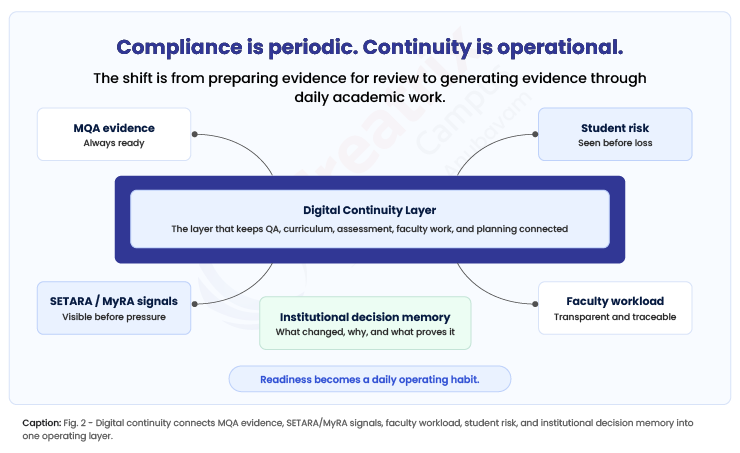
For Malaysian universities, that can change the nature of digital transformation. QA evidence can originate from the academic work that produced it. Outcome information can remain connected to assessment and improvement. Faculty capacity can sit closer to programme planning. Student signals can move toward responsible teams, and leadership can receive information with more of the decision context preserved.
This is when the Academic Operating System idea becomes useful, not as another transformation slogan, but as the operating layer that helps the university function as one institution even when many specialised systems remain in place.
Conclusion
Malaysia's next digital challenge is not simply adopting more technology. It is making sure that academic decisions, quality evidence, faculty capacity, student progress, and institutional priorities do not become fragmented every time they cross a system or departmental boundary.
If your Vice Chancellor asked today, “Where are our biggest readiness risks, and what evidence proves it?”, how many teams would need to reconcile the answer first? Map digital continuity gaps with Creatrix Campus.
Quick recap
Digital continuity is what comes after digitisation. Malaysian universities may already have strong systems for records, learning, assessment, quality, faculty, and reporting, but leadership value appears when those systems support one connected institutional picture. The real measure of transformation is not how many processes are digital. It is how rarely the university has to reconstruct itself before it can act.
Frequently asked questions
What is digital continuity in higher education?
How is digital continuity different from digital transformation?
Why is digital continuity particularly relevant to Malaysian universities?
How can digital continuity support MQA readiness?
Are SETARA and MyRA the same as MQA accreditation?
What should universities connect first?
How can Creatrix Campus support digital continuity?
Join the conversation
Want to contribute?
We welcome thought leaders to share ideas and write for our blog.
Become a guest author