

On this page
Ask a bursar's office how long month-end close takes, and the honest answer usually involves a sigh. Fee payments come in through one system. The general ledger lives in another. Scholarships and waivers get tracked in a spreadsheet someone built years ago because the accounting software never quite handled them the way financial aid needed. Closing the books means pulling data from all of it by hand and hoping the numbers land close enough to reconcile.
Higher education accounting software exists to remove that hoping. Done well, it connects fee collection, the general ledger, budgeting, and reporting into one system, so reconciliation is a formality instead of a multi-day scramble every month.
Higher education accounting software should deliver more than a way to record transactions. Why manual reconciliation still eats so much of the bursar's office's time, and what to look for when evaluating a platform meant to close the books faster, is where the real gap shows up.
Quick answer
Higher education accounting software connects fee collection, the general ledger, budgeting, and financial reporting in one system, so reconciliation happens automatically instead of requiring someone to manually match numbers across separate tools. The genuinely useful version of this software keeps an audit trail current as transactions happen, rather than requiring a reconstruction effort every time an auditor asks a question.
Article summary
Two related questions define higher education finance operations: what cloud accounting software should actually deliver for an institution, and how accounting software choices affect broader financial efficiency, budgeting, and audit readiness across the bursar's and finance office.
Key takeaways
- Manual reconciliation between fee collection and the general ledger costs the bursar's office real time every month, not just at year-end close.
- NACUBO, the National Association of College and University Business Officers, runs ongoing programming specifically on institutional budgeting, tax considerations, and student receivables, reflecting how much specialized attention higher education finance actually requires.
- An audit trail that's reconstructed after the fact is riskier than one that's current by default, since errors surface only when someone goes looking for them.
- Budget planning is only as reliable as the financial data feeding it, and reconciled, current numbers make that planning meaningfully easier.
- The institutions that get real value from accounting software evaluate it for reconciliation speed and audit-readiness, not just for whether it can record a transaction.
What Is Higher Education Accounting Software?
Higher education accounting software connects the financial functions specific to running an institution: fee collection and student billing, the general ledger, budget planning, financial reporting, and audit trail maintenance. The category exists separately from generic small-business accounting software because higher education finance has specific complications, term-based billing cycles, scholarships and waivers that reduce net revenue in ways that need clean tracking, multiple funding sources, that a generic accounting package wasn't built to handle cleanly.
The core value isn't recording a transaction. Any accounting software can do that. It's whether a fee payment recorded at the point of collection flows automatically into the general ledger and into reporting, without someone re-entering or reconciling it by hand later. That single distinction determines whether month-end close takes hours or days.
Audit trail maintenance matters just as much as day-to-day recording. An institution should be able to answer an auditor's question about any transaction quickly, tracing it back to its source, rather than reconstructing the history after the fact.
Why Manual Reconciliation Still Costs So Much Time
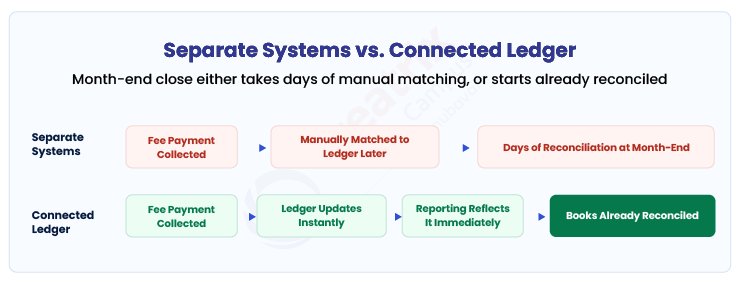
Here's the test that reveals whether an institution's accounting setup is actually working: at month-end close, does the bursar's office pull one report that already reconciles, or does someone spend days manually matching fee collection records against the general ledger?
In most institutions still running fee collection and general ledger accounting as separate systems, the honest answer is days. Every fee payment has to be checked against what the ledger shows. Every scholarship or waiver needs its own manual adjustment. By the time reconciliation is done, the numbers are already a few weeks stale relative to when the transactions actually happened.
NACUBO, the National Association of College and University Business Officers, runs ongoing programming specifically focused on institutional planning, budgeting, tax considerations, and managing and collecting student receivables, per NACUBO's own site. An organization built around exactly these recurring finance challenges exists because getting higher education accounting right, term-based billing, receivables, budget planning, is a genuinely specialized, ongoing undertaking, not something a generic accounting package solves by default.
The honest cost of manual reconciliation isn't only time. It's risk. Errors that would have been caught immediately in a connected system instead surface weeks later, sometimes not until an external audit asks a pointed question about a specific transaction.
What to Look For When Evaluating Accounting Software
Every vendor selling into this category can point to a general ledger module and a reporting dashboard. That's table stakes. It doesn't tell you whether fee collection actually flows into that ledger automatically or requires someone to import a file every week.
| Approach | What implementation looks like | What it costs the institution later |
| Fee collection and general ledger as separate systems | Payments recorded in one tool, manually entered or imported into accounting software | Month-end close takes days of manual reconciliation; errors surface late |
| Accounting software with periodic batch imports | Data flows between systems, but only on a scheduled batch, not in real time | Numbers are stale between imports; reconciliation still requires manual verification |
| Connected system where fee collection feeds the ledger directly | Every transaction updates the ledger and reporting immediately | Requires more upfront setup to connect fee collection and accounting, but stays current afterward |
If the goal is only to record transactions somewhere, a basic accounting package handles that. If the goal is to actually shrink month-end close and keep an audit trail current, the evaluation needs a harder question: does a fee payment update the general ledger the moment it's collected, or does someone have to import or reconcile it manually first.
| Capability | Why it matters | What to ask a vendor |
| Real-time link between fee collection and the ledger | Without this, reconciliation is a recurring manual task, not a solved problem | Ask what happens in the general ledger the moment a fee payment is recorded |
| Scholarship and waiver handling | Net revenue tracking breaks down if these aren't handled cleanly | Ask how the system tracks a scholarship or waiver against gross fee amounts |
| Current, traceable audit trail | Auditors need to trace a transaction to its source quickly, not after a reconstruction effort | Ask how far back the system can trace a specific transaction and how long that takes |
| Budget planning tied to actual financial data | Budgets built on stale numbers are less reliable | Ask whether budget planning tools pull from the same current data as the ledger |
Where Creatrix Campus Fits
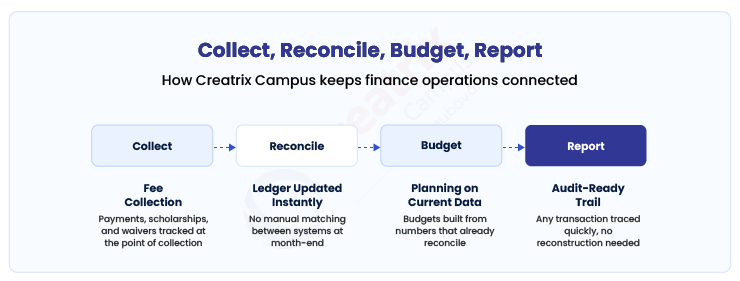
Creatrix Campus connects fee collection, the general ledger, budget planning, and financial reporting in one system, not a set of separate tools that require manual reconciliation between them.
A fee payment updates the general ledger the moment it's collected, so month-end close starts from numbers that already reconcile instead of a multi-day matching exercise. Scholarships and waivers are tracked against gross fee amounts cleanly, so net revenue reporting stays accurate. The audit trail stays current by default, so tracing a specific transaction back to its source is fast rather than a reconstruction project.
The practical effect is that the bursar's and finance office spend less time chasing numbers into agreement and more time on the budget planning and financial analysis that actually needs their attention.
Conclusion
Most institutions still treat manual reconciliation between fee collection and the general ledger as a normal part of month-end close, something the bursar's office simply budgets time for every cycle.
The harder, more useful question when evaluating accounting software isn't whether it can record a transaction. It's whether fee collection, the ledger, budgeting, and reporting actually connect to each other, so reconciliation becomes a formality and an audit trail stays current without a reconstruction effort. Institutions that evaluate for that get real financial efficiency, not just a longer feature list.
If you want to see how Creatrix Campus connects fee collection, the general ledger, budgeting, and reporting in one system, talk to us about higher education accounting software.
Quick recap
Higher education accounting software should connect fee collection, the general ledger, budget planning, and financial reporting in one system, so reconciliation happens automatically and an audit trail stays current, instead of requiring the bursar's office to manually match numbers across separate tools every month. That requires real-time linkage between fee collection and the ledger, clean scholarship and waiver handling, and budget planning tied to actual financial data, not just a system that records transactions.
Frequently asked questions
What is higher education accounting software?
Why does manual reconciliation still cost the bursar's office so much time?
What's the real cost of manual reconciliation beyond time?
What should institutions look for when evaluating accounting software beyond a general ledger module?
What is NACUBO, and why is it relevant to higher education accounting?
How does Creatrix Campus handle higher education accounting?
Join the conversation
Want to contribute?
We welcome thought leaders to share ideas and write for our blog.
Become a guest author