

On this page
An admissions team increases website traffic by 25%, inquiries by 30%, and applications by 20%, exactly as planned. Enrollment still comes in under target. That gap is not a failure of effort. It's a sign the goals measured activity instead of the outcome they were supposed to influence.
Quick answer
Setting SMART goals for enrollment strategy works best when each goal shows a clear line from a specific admissions activity to the enrollment outcome it's meant to affect, rather than measuring the activity alone. A goal to increase inquiries by 30% is specific and measurable, but it only becomes useful for enrollment planning when it's tied to how many of those inquiries need to convert into applicants, admits, and enrolled students.
Article summary
This article keeps what's genuinely useful from standard SMART goal guidance, the framework itself and the admissions funnel it typically maps to, but reframes the central problem. Most institutions already know how to set specific, measurable, time bound goals for website traffic, inquiries, and applications. Far fewer connect those goals to what happens at the bottom of the funnel, where actual enrollment is decided. The article looks at why that connection matters more than the goal-setting mechanics themselves.
Key takeaways
- Hitting activity targets, traffic, inquiries, applications, does not guarantee hitting the enrollment target behind them.
- A SMART goal becomes genuinely useful when it shows the link between an admissions activity and the enrollment outcome it's meant to influence.
- The enrollment funnel, prospects through enrolls, is still the right structure for goal setting. The gap is usually in connecting stages, not naming them.
- Goals need periodic review, since conditions like shifting yield rates or applicant behavior can make a previously reasonable target unrealistic.
- Attaching a goal to an activity without tracing it to yield or intake targets tends to reward busy work over enrollment results.
Activity Targets Are Not the Same as Enrollment Outcomes
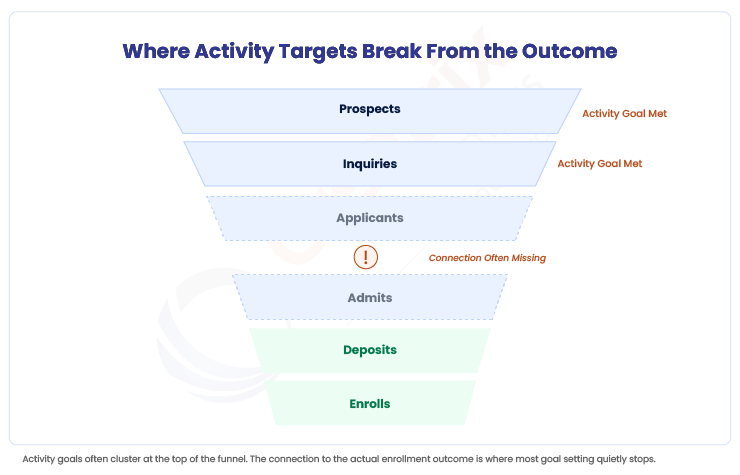
Here's the tension worth sitting with. A university can grow its website traffic, generate more inquiries, and pull in more applications, all measured accurately, and still miss its qualified applicant targets, its offer acceptance rate, its yield, or its programme level intake. Each activity metric can move in the right direction while the number that actually matters, enrolled students, moves in the wrong one.
This isn't a new problem, and the admissions funnel already describes where it happens. Prospects move to inquiries, inquiries to applicants, applicants to admits, admits to deposits, and deposits to enrolls, with the funnel usually mapped onto three broader stages: awareness, when prospective students first become aware of the institution, consideration, when they compare options, and decision, when they commit. Enrollment accounts for a relatively small share of everyone who entered the funnel at the top.
That narrowing is exactly why activity goals at the top of the funnel can look successful while the number that matters most, enrollment, still falls short. According to the National Center for Education Statistics, undergraduate enrollment nationally was still 15 percent lower in fall 2021 than in fall 2010, even after individual institutions ran active recruitment campaigns throughout that period. Activity alone did not reverse that trend. The institutions managing it well are the ones tracking how each stage of the funnel actually converts into the next, not just how much activity enters at the top.
A SMART Goal Should Show the Line From Action to Outcome
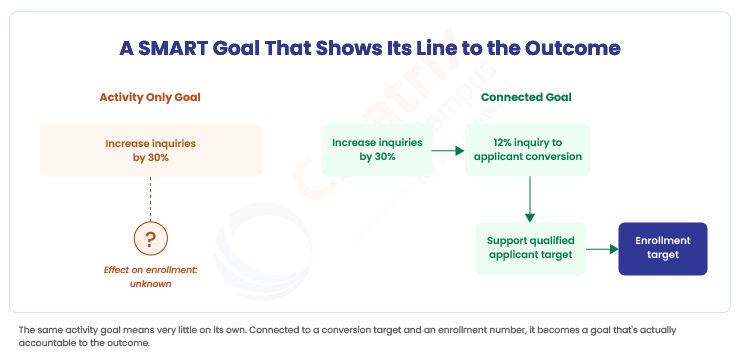
Now apply that to the goal itself. A goal like "we will increase inquiries by 30% in the next three months using email campaigns" is specific, measurable, and time bound. It's also, on its own, silent about enrollment. The stronger version of the same goal ties the activity to what it needs to produce further down the funnel: "we will increase inquiries by 30% in the next three months, targeting a 12% inquiry to applicant conversion rate, to support our qualified applicant target for the programme."
That reframing doesn't change the SMART criteria. It changes what the goal is actually specific and measurable about. Instead of treating specific, measurable, attainable, relevant, and time bound as separate boxes to fill in for each activity, the more useful discipline is asking one question for any goal at any funnel stage: if we hit this target exactly as written, does it move us closer to our enrollment number, or does it just prove the activity happened.
| Funnel Stage | Activity Goal Teams Often Set | Enrollment Outcome It Should Connect To |
| Prospects and Inquiries | Increase website traffic or inquiry volume by a set percentage | Enough qualified inquiries to feed the applicant target |
| Applicants | Increase application volume, often by channel | A defined inquiry to applicant conversion rate |
| Admits | Improve admit rate or review turnaround time | Enough admits to support the deposit and yield target |
| Deposits | Increase deposit volume within a set window | A defined admit to deposit yield rate |
| Enrolls | Meet the programme level intake number | Confirmed enrollment against the institution's actual target |
Read the right column, not the middle one, when you're deciding whether a goal is doing its job. A goal that only lives in the middle column is measuring effort. A goal that connects to the right column is measuring progress toward the number the institution actually needs.
This is also where periodic review earns its place, not as a generic best practice, but because yield rates and conversion behavior shift. A 12% inquiry to applicant conversion goal set two years ago may no longer be realistic if application volume patterns have changed, and a goal that isn't revisited against current funnel data will keep measuring activity against a target that's quietly gone stale.
Where Creatrix Campus Fits
Creatrix Campus connects admissions activity data to the funnel stages it's meant to influence, tracking leads, applications, and admissions status within the Admissions CRM rather than reconciling separate marketing and admissions reports. Because inquiry, applicant, and admit data live in the same governed system as enrollment and student success and retention records, a conversion goal set at one funnel stage can be tracked through to the enrollment outcome it was meant to support, not just reported on in isolation.
Creatrix Campus does not set enrollment targets or decide which goals are realistic for a given institution. Those decisions belong to enrollment management leadership, informed by the connected funnel data the platform makes visible.
Conclusion
A SMART goal earns its place in an enrollment strategy when it does more than describe an activity precisely. It should show the line from that activity to the enrollment outcome the institution actually needs. An admissions team that hits every traffic and inquiry target it set, while still missing the enrollment number, hasn't failed at goal setting. It set goals that were specific about the wrong thing. Before your next planning cycle, it's worth checking whether each of your team's current goals can answer a direct question: if we hit this exactly as written, what enrollment number does that actually get us closer to. If you want to see how admissions activity and enrollment outcomes can stay connected instead of tracked separately, request a demo of Creatrix Campus.
Quick recap
Activity goals for traffic, inquiries, and applications can all be met while enrollment still falls short, because they measure effort rather than the outcome behind them. A SMART goal becomes genuinely useful for enrollment planning only when it's connected through the funnel, from activity to conversion rate to the actual enrollment number it's meant to support.
Frequently asked questions
Why can an admissions team hit its goals and still miss enrollment targets?
What is the enrollment funnel, and why does it still matter for goal setting?
How often should enrollment SMART goals be reviewed?
Is it wrong to set goals for website traffic or inquiry volume?
Join the conversation
Want to contribute?
We welcome thought leaders to share ideas and write for our blog.
Become a guest author