

On this page
An NCAAA review may still be months away.
But the readiness problem may already have started.
A programme review identifies a concern, but the action plan sits somewhere else. A KPI shows a decline, but nobody sees the pattern early enough to intervene. Student outcomes are measured. Faculty evidence exists. Improvement actions are discussed.
Everything is happening.
The Quality Director still has to connect it later.
That is where NCAAA readiness begins to break down: not when evidence is missing, but when leadership cannot see the quality story while there is still time to change it.
Quick answer
NCAAA accreditation readiness becomes difficult when quality indicators, programme reviews, student outcomes, faculty evidence, and improvement actions are maintained through separate processes. For Quality leaders, Accreditation Directors, Deans, and Institutional Effectiveness teams, continuous readiness means connecting that evidence throughout the academic year so risks, actions, and results become visible before the self-study or review creates the urgency.
Article summary
| Problem | Quality work exists, but its connections become visible only during accreditation preparation. |
| Who this is for | Quality Leaders, Accreditation Directors, Deans, Programme Chairs, Institutional Effectiveness, and Academic Affairs teams. |
| What changes | KPIs, reviews, outcomes, evidence, and improvement actions remain visible throughout the year. |
| Why it matters | Late visibility leaves less time to correct programme-quality issues before review. |
| Outcome | Less evidence chasing, earlier intervention, and stronger continuous NCAAA readiness. |
Key takeaways
- NCAAA pressure usually begins long before the self-study.
- A KPI becomes useful when leaders can see what caused it and what happened next.
- Quality teams should not have to reconstruct programme improvement from separate files.
- Programme reviews need visible links to actions, ownership, and impact.
- Continuous readiness means making quality evidence useful before accreditation asks for it.
Why This Matters
For a Quality Director, the hardest part is often not collecting evidence. It is proving that the evidence led somewhere. A Programme Chair may have reviewed outcomes, a Dean may have approved an action, and faculty may have responded, yet Institutional Effectiveness teams still need to show how those activities connect to programme quality and improvement. ETEC/NCAAA positions performance indicators as tools for assessing and developing quality. If an indicator can be reported but its improvement story cannot be traced, the institution has data without enough line of sight.
Where NCAAA Readiness Breaks First
Readiness rarely collapses because one major report is missing.
It weakens through smaller disconnects during normal academic work.
| What Quality leaders need | Where the connection often breaks |
| Programme review findings | Actions are tracked elsewhere |
| Quality indicators | Numbers are reported without visible follow-through |
| Student outcomes | Findings are separated from curriculum decisions |
| Faculty evidence | Contribution is spread across departments |
| Improvement actions | Activity is documented without clear impact |
| Institutional planning | Programme evidence reaches leadership too late |
Every break creates work later.
The Quality office requests evidence. Programme Chairs ask departments. Faculty search for records. Leadership waits for a consolidated picture.
Nobody necessarily failed to do the quality work.
The institution simply made the Quality team assemble the meaning afterward.
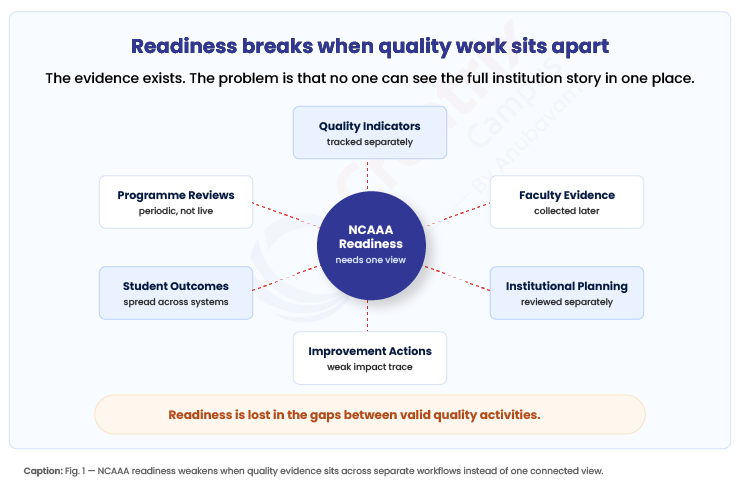
This is why connected programme and curriculum review matters beyond documentation. The value comes from keeping findings and the decisions that follow them closer together.
Why Quality Indicators Need a Line of Sight
A KPI can tell a Dean that performance changed.
It cannot explain the change by itself.
That creates the next set of questions:
Why did this indicator move?
Which programme or process contributed?
Who owns the response?
What action was taken?
Did the action improve the next result?
For Institutional Effectiveness leaders, that line of sight is critical.
A quality indicator should not become a number that appears in a report once a year. It should help leadership decide where attention is needed while intervention is still possible.
That moves the conversation from:
“What is our KPI?”
to:
“What is this KPI asking us to do?”
The second question is where quality management begins.
The Better Question Is Not “Are We Ready?”
As the accreditation review gets closer, leadership inevitably asks:
“Are we ready?”
For a Quality team, that can be an expensive question.
Answering it may require programme updates, evidence requests, action-plan reviews, KPI reconciliation, and several rounds of verification.
A stronger operating rhythm asks something different every semester:
“What is our evidence telling us now?”
That changes readiness from a deadline into a management practice.
Programme teams review. Owners act. Quality leaders monitor. Evidence remains connected to what triggered the action and what followed.
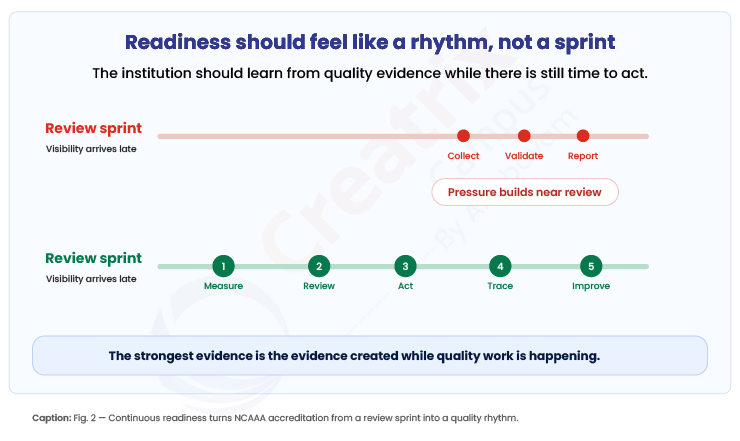
The institution still prepares for accreditation.
It simply spends less time rediscovering its own quality work.
Where Creatrix Campus Fits
This is where Creatrix Campus becomes relevant.
Not as another reporting layer for the Quality office.
As a way to keep the academic work behind accreditation connected while it is happening.
Accreditation Management can support continuous readiness by connecting programme-quality evidence and improvement workflows rather than leaving teams to reconstruct them only when the review approaches.
For the Quality Director, that means earlier visibility into gaps.
For the Programme Chair, clearer ownership of improvement actions.
For the Dean, a better view of whether interventions are changing programme performance.
For Institutional Effectiveness teams, stronger connection between indicators, evidence, decisions, and follow-through.
The real shift is from preparing evidence for NCAAA to running quality processes that naturally create NCAAA-ready evidence.
Conclusion
NCAAA readiness rarely fails suddenly. It weakens when programme reviews, KPIs, student outcomes, faculty evidence, and improvement actions stop connecting to the decisions they should inform. Keeping those connections visible gives Quality leaders something more valuable than easier review preparation: time to act before the review exposes the issue.
If leadership asked today which programme-quality risks need attention, could your Quality team answer without beginning another evidence-collection exercise? See how Creatrix Campus can support continuous accreditation readiness.
Quick recap
NCAAA readiness is not simply having the required evidence somewhere in the institution. It is being able to see how a quality indicator led to review, action, ownership, and measurable improvement while the academic year is still running. For Quality leaders, Deans, Programme Chairs, and Institutional Effectiveness teams, that means less reconstruction before review and more opportunity to improve before readiness becomes urgent.
Frequently asked questions
Why does NCAAA accreditation readiness break down?
Why are quality indicators important for NCAAA readiness?
What is the difference between NCAAA preparation and continuous readiness?
Why should programme reviews connect with improvement actions?
How can Creatrix Campus support NCAAA readiness?
Join the conversation
Want to contribute?
We welcome thought leaders to share ideas and write for our blog.
Become a guest author