

On this page
Universities often treat timetable problems as operational noise: a course clash, a late room change, an overloaded faculty member, or a lab that needs another slot.
Each can be corrected.
The more important question is why the problem appeared in the first place.
A timetable contains decisions about faculty workload, student access, room capacity, programme requirements, curriculum sequencing, and academic exceptions. When those decisions repeatedly create instability, the institution is dealing with more than poor scheduling.
It is discovering where academic complexity is no longer being governed consistently.
That is why timetable instability deserves attention from Provosts, Registrars, Deans, and Academic Operations leaders, not only scheduling teams.
Quick answer
Broken timetables become governance problems when institutions cannot consistently explain how faculty workload, student pathways, programme requirements, rooms, and timetable changes were balanced. The goal of AI-assisted scheduling is therefore not simply faster timetable creation. It is helping institutions apply scheduling rules consistently, understand trade-offs earlier, and keep important decisions traceable.
Article summary
| Problem | Timetable instability often reveals inconsistent or poorly visible academic decision-making. |
| Who this is for | Provosts, Registrars, Deans, HoDs, Academic Operations leaders, Scheduling teams, Faculty Workload planners, and CIOs. |
| What changes | Scheduling moves from calendar production to governed academic decision-making. |
| Why it matters | Scheduling decisions affect workload fairness, student progression, resource allocation, and programme delivery. |
| Outcome | More stable schedules, clearer decision logic, and stronger institutional control over academic delivery. |
Key takeaways
- Repeated timetable conflicts can expose governance gaps, not just scheduling errors.
- A complete timetable is not necessarily a well-governed timetable.
- Faculty workload and student progression need to be considered before publication.
- AI-assisted scheduling should make constraints and trade-offs clearer, not replace academic judgement.
- Strong scheduling governance makes institutional decisions easier to explain and defend.
Why This Matters
The 2026 EDUCAUSE Horizon Report discusses forces including AI, enrollment pressures, policy shifts, and institutional strategy reshaping higher education. Scheduling is one of the places where that complexity becomes operational.
A timetable determines whether students can access required learning, whether faculty allocations remain reasonable, whether rooms and labs support delivery, and whether programmes can operate as planned. When these decisions repeatedly require emergency correction, leadership should ask a more useful question than “Why did the timetable break?”
What part of our academic decision model allowed this problem to survive until publication?
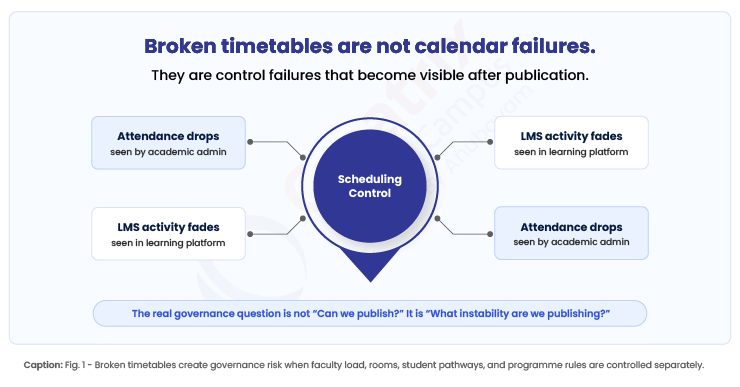
When Timetable Problems Become Governance Problems
Scheduling becomes a governance issue when the institution cannot clearly explain why an allocation was made.
Why was one faculty member given more demanding teaching sessions?
Why did two required courses overlap?
Why was a laboratory moved after publication?
Why did one programme change affect several others?
Why was a room selected when the delivery requirement did not fit?
These are accountability questions.
A spreadsheet may show the final slot. It may not preserve the logic behind the decision.
That matters particularly for faculty workload. A timetable can appear balanced by contact hours while masking differences in laboratory teaching, large cohorts, shared programmes, consecutive sessions, or other demands.
Governance begins when the institution can explain not only what was scheduled, but why.
Where Scheduling Governance Usually Breaks
The weakness usually appears where different constraints collide.
| Constraint meets... | Governance question |
| Faculty workload + student demand | Is the allocation academically reasonable and fair? |
| Core course sequencing + limited slots | Can students follow the intended pathway? |
| Laboratory requirement + room capacity | Can the planned delivery actually happen? |
| Curriculum change + existing timetable | What will the change disrupt downstream? |
| Programme priorities + shared resources | Which rule determines the trade-off? |
Each requirement may make sense on its own.
The problem comes from managing them separately.
Solving a room problem can create a faculty conflict. Moving a faculty member can disrupt a required course. Moving that course can affect student progression.
This is why scheduling governance is not about eliminating every conflict.
It is about ensuring that conflicts are resolved through visible institutional rules rather than whoever negotiates hardest or notices the problem first.
What AI Should Actually Do in Scheduling
AI-assisted scheduling should not be presented as a magic timetable button.
Academic scheduling involves institutional judgement, priorities, exceptions, and policies. Those decisions belong to people.
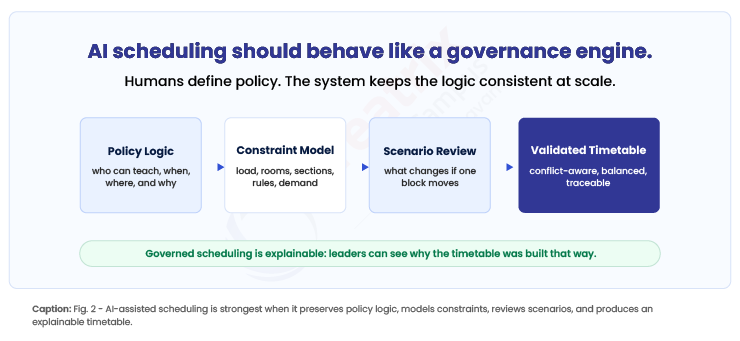
The useful role for AI and intelligent scheduling is to help teams evaluate more interacting conditions at once, such as faculty availability, workload rules, rooms, course sequences, student demand, programme requirements, delivery modes, and proposed timetable changes.
That creates a healthier division of responsibility:
Academic leaders define the rules and priorities.
The scheduling system helps apply and test them consistently.
The value is not removing human judgement. It is giving people better visibility into the consequences of their judgement before thousands of students and faculty inherit the result.
Why Governance-Driven Scheduling Protects Academic Stability
A governed timetable should leave the institution able to explain its decisions.
If a faculty allocation is challenged, the underlying workload context should be visible. If a course is moved, teams should be able to understand what else the change affects. If a room is selected, relevant capacity and delivery requirements should be clear.
This also matters for accreditation readiness, where programme delivery, faculty capacity, student access, and academic governance may all contribute to the wider evidence picture.
The principle is simple:
Academic judgement should remain human. Its application should not be invisible.
That is what makes scheduling decisions more stable, explainable, and defensible.
Where Creatrix Campus Fits
Creatrix Campus becomes relevant when institutions need scheduling decisions to connect with the academic context behind them.
Creatrix Campus connects class scheduling, faculty workload, rooms and laboratories, student pathways, programme requirements, academic rules, and timetable change impact within a connected operating model.
For scheduling teams, that can mean more context before a timetable is published. For Deans and HoDs, it means greater visibility into workload and programme-delivery implications. For Registrars and Academic Affairs leaders, it creates a clearer view of how scheduling choices affect progression and academic operations.
For senior leadership, the value is larger.
A timetable stops being a calendar nobody can fully explain and becomes an academic decision process the institution can govern.
Conclusion
Universities will always have scheduling constraints. The governance problem begins when the rules used to resolve those constraints are inconsistent, invisible, or discovered only after the timetable fails.
If your Provost asked why the current timetable looks the way it does, could the institution explain the important trade-offs without reconstructing them from spreadsheets and email conversations? Explore governed class scheduling with Creatrix Campus.
Quick recap
Broken timetables are often symptoms of a deeper issue: the institution cannot see or consistently apply the logic connecting workload, student pathways, programme rules, facilities, and timetable changes. Governance-driven scheduling does not remove academic judgement. It makes the rules, trade-offs, and consequences behind that judgement clearer before instability reaches students and faculty.
Frequently asked questions
Why can timetable problems become governance problems?
What is scheduling governance?
What is AI-assisted class scheduling?
Does AI scheduling replace academic judgement?
How does scheduling governance support accreditation readiness?
How can Creatrix Campus support scheduling governance?
Join the conversation
Want to contribute?
We welcome thought leaders to share ideas and write for our blog.
Become a guest author