
On this page
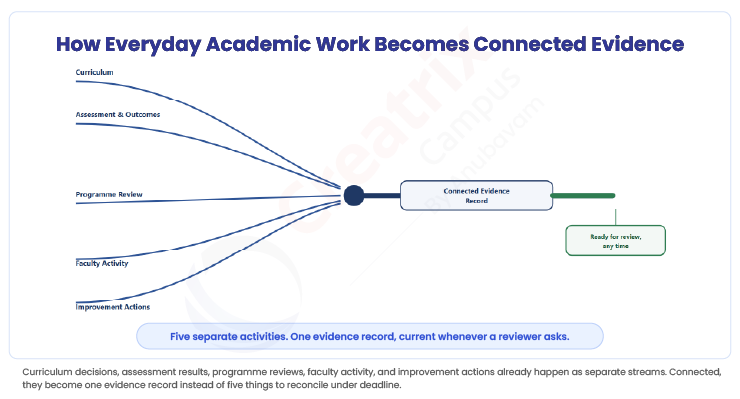
Accreditation systems differ by country, discipline, scope, and review model, so there is no single global process. But the operational problem is often the same: when review time approaches, institutions scramble to pull together curriculum records, assessment results, programme reviews, faculty evidence, and improvement actions from disconnected places. The standard is rarely the mystery. Proving that everyday academic work meets it consistently and traceably usually is.
Quick answer
The higher education accreditation process varies by accrediting body, but most share a recognizable pattern: an institution or programme conducts a self-evaluation against defined standards, compiles supporting evidence, undergoes external or peer review, receives findings, and is expected to act on them through continuing improvement and ongoing quality assurance. What determines how smoothly an institution moves through that pattern isn't how well it understands the standard, it's whether the evidence behind it already exists in a connected, traceable form or has to be reconstructed under deadline pressure.
Article summary
Problem: Institutions understand what accreditors expect but still struggle every cycle to prove it, because the evidence behind academic quality lives scattered across disconnected systems and offices.
For: Quality Assurance Heads, Accreditation Leaders, Institutional Effectiveness Leaders, Provosts, Vice Chancellors, Deans, and Programme Leaders.
Shift: From accreditation readiness as a self-study exercise that starts when a review is announced, to readiness as a byproduct of how academic work is normally run and evidenced.
Outcome: An institution whose curriculum, assessment, outcomes, and improvement evidence stay connected and current, so proving quality doesn't mean rebuilding the story from scratch.
Key takeaways
- Accreditation bodies vary widely; there is no single universal process, and treating them as identical misrepresents how they work.
- Most systems still share a recognizable pattern: self-evaluation, evidence, external review, findings, and continuing improvement.
- The recurring institutional problem isn't misunderstanding the standard. It's proving compliance with it consistently and traceably.
- When curriculum, assessment, outcomes, and improvement evidence live in separate systems, every review becomes a reconstruction exercise.
- Connected evidence, produced as a byproduct of normal academic operations, makes readiness continuous instead of periodic.
Why This Matters
A Provost fielding two different accreditation cycles in the same year, one institutional, one programmatic, quickly discovers that the standards are unrelated but the internal scramble is identical: the same curriculum committee minutes get tracked down twice, the same assessment data gets reformatted twice, the same improvement actions get explained twice, because nothing about how that evidence is stored assumes it might need to serve more than one reviewer. That repetition isn't a scheduling coincidence. It's what happens when evidence is organized around each review instead of around the institution's actual academic operations.
Conclusion
The higher education accreditation process isn't one thing, and any article claiming otherwise is oversimplifying a landscape that genuinely varies by country, discipline, and accreditor. What does hold steady, across nearly every system, is the shape of the exercise: self-evaluation, evidence, external review, and continuing improvement. Institutions that struggle with this rarely misunderstand what's being asked of them. They struggle because the evidence behind it was never connected enough to produce on demand.
Closing that gap isn't about working harder in the months before a review. It's about whether curriculum, assessment, programme review, and improvement activity already live in a way that keeps the evidence current, all year, for whichever accreditor asks next.
See how Creatrix Campus connects academic evidence across the institution. Creatrix Campus doesn't guarantee accreditation, compliance, or approval by any accrediting body; institutions remain responsible for meeting the specific requirements of their accreditors.
Quick recap
Accreditation bodies differ by country, discipline, and scope, and there's no single universal process every institution follows. What recurs across most systems is a shared pattern: self-evaluation, evidence, external or peer review, findings, and continuing improvement. The operational problem institutions repeatedly hit isn't misunderstanding that pattern; it's that curriculum, assessment, programme review, and improvement evidence usually live in disconnected places, turning every review into a reconstruction project. Connecting that evidence as part of normal academic operations, rather than compiling it fresh for each accreditor, is what turns periodic scrambling into continuous readiness.
Frequently asked questions
Is there one global accreditation process every institution follows?
What steps are common across most accreditation systems?
Why do institutions struggle with accreditation even when they understand the standards?
Does meeting one accreditor's requirements help with another?
Join the conversation
Want to contribute?
We welcome thought leaders to share ideas and write for our blog.
Become a guest author