
On this page
A Ministry report is due in three days. The Registrar opens the registration system and the finance office's export side by side, and the enrolment numbers do not match. Someone starts a spreadsheet. Someone else emails two departments. By the time the figures agree, most of the three days are gone.
Nothing about that situation is unusual. UAE institutions are now asked to prove outcomes, not just describe processes. The Ministry's Outcome-Based Evaluation Framework (OBEF) scores them on 24 KPIs across six pillars, at institution and programme level, and most institutional data reaches the Ministry as 43 standardised HEDB datasets. What is unusual is running that on systems built to record what happened rather than to show it.
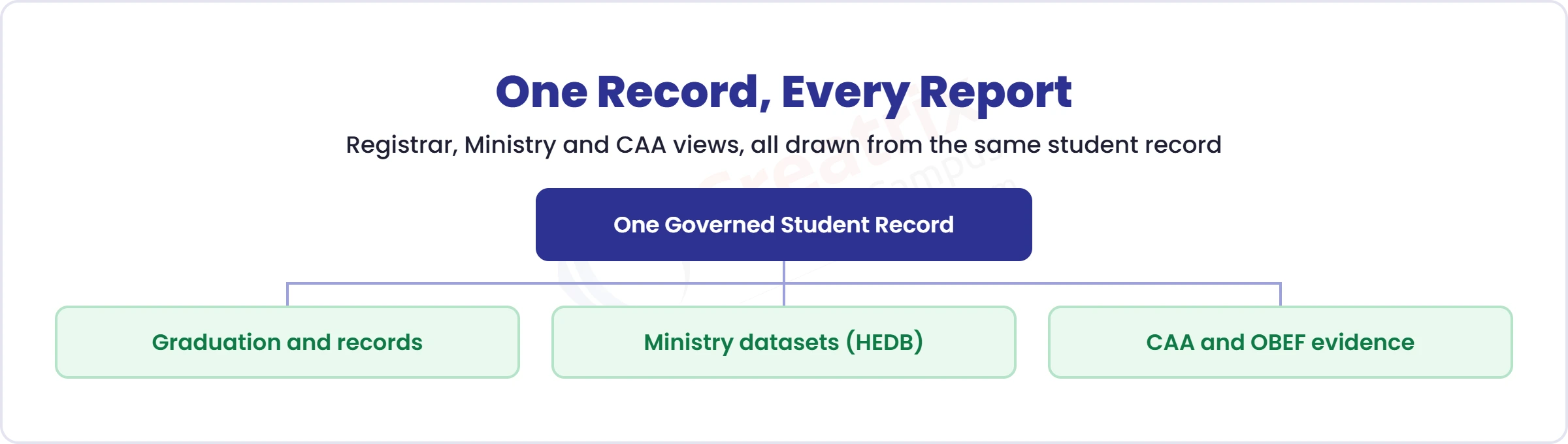
A modern student information system in the UAE exists to close that gap: one record that serves the Registrar, finance, CAA and the Ministry, in Arabic and English, instead of several records reconciled by hand.
Quick answer
A UAE-ready student information system keeps one governed record of the student journey, produces Ministry-shaped data from it, supports Arabic and English with right-to-left layout, and keeps CAA and OBEF evidence current as a by-product of daily work. The real benefit is not faster reports. It is that the Registrar's office stops being the bottleneck when the institution's credibility is on the line.
Article summary
The case for a modern SIS in the UAE rests on three things: why legacy systems cannot keep up with CAA and Ministry demands, how OBEF data reaches the Ministry and why one source of truth matters, and what to check so a UAE-ready system covers Arabic, evidence and rules, not just records.
Key takeaways
- A legacy SIS stores data but struggles with live accreditation demands, rapid programme growth and Ministry-shaped reporting.
- OBEF scores 24 KPIs at institution and programme level, and most institutional data arrives as 43 HEDB datasets.
- The same student data retyped into different formats drifts apart, which is where mismatched reports start.
- Evidence is easiest to defend when it is generated as decisions are made, not rebuilt before a review.
- Modernising does not require replacing your SIS on day one. Connect first, then expand in stages.
The friction rarely arrives as a formal failure. It arrives as a Ministry report that does not match the finance office, or a CAA auditor asking for evidence that spans five departments, each keeping records in its own format. These are the predictable result of running student records on systems built for a slower, less connected era.
Legacy tools can store data. They struggle with live accreditation demands, where evidence must be pulled in hours rather than weeks, with bilingual documentation that changes from cycle to cycle, and with programme growth that strains fixed workflows.
Two things make this sharper in 2026. The Federal Decree-Law on Higher Education, issued on 31 December 2025, requires every institution to hold federal licensure and every programme to achieve its own accreditation. And cloud is now the default expectation: 34 percent of UAE businesses already use public cloud and 66 percent are transitioning soon.
How OBEF Data Reaches the Ministry
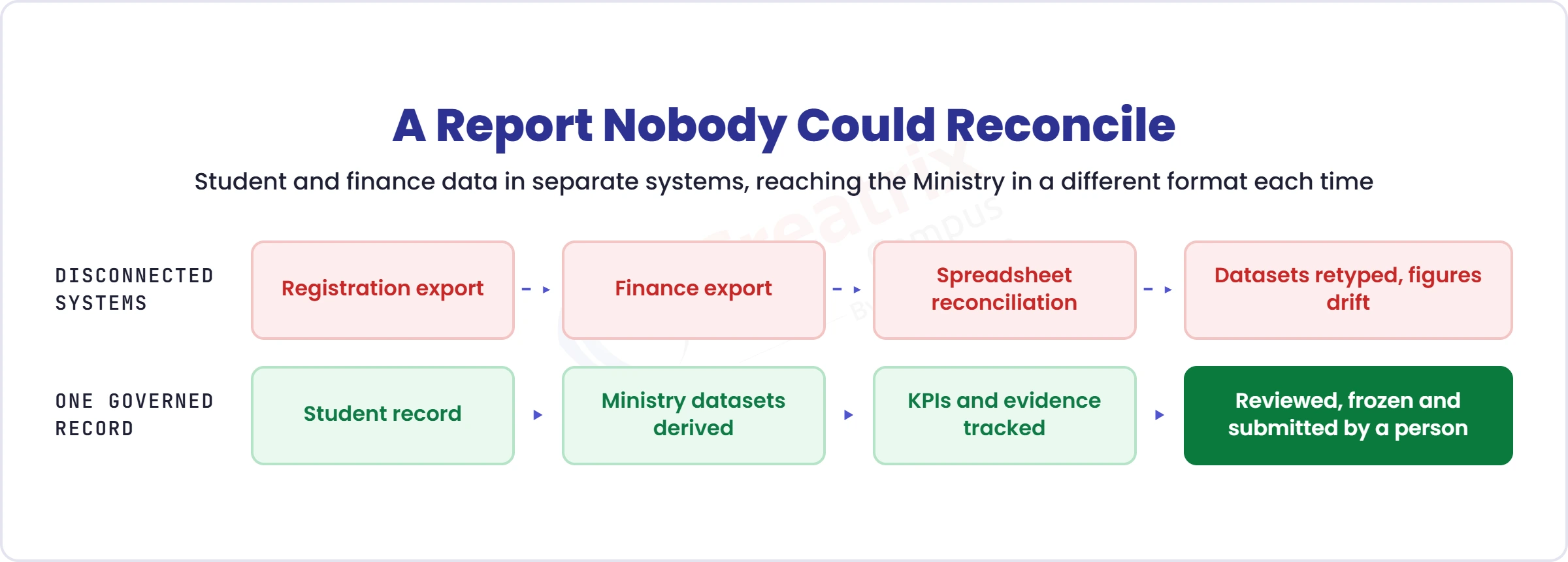
Understanding the data routes explains most of the workload. Most institution-collected KPIs are fed by 43 standardised datasets submitted through the HEDB portal, each defined field by field in the HEDB Data Dictionary 2026. National surveys are run by the Ministry, so the institution's only lever is response rate. Some KPIs, such as citation impact and global rankings, are produced by the Ministry itself. Everything else travels as evidence: assessment packages, certificates and policies reviewed during the CAA evaluation. The largest package is assessment evidence for every course offering.
The direction of travel matters too. The OBEF University Guide says submission will shift from portal and manual packages to a master API in the long term, and the Master-API Specification of 18 February 2026 describes a continuous, standardised feed rather than a periodic upload.
What to Check in a UAE-Ready SIS
| Claim | What it might actually cover | What to ask instead |
| "Arabic support" | Translated interface labels, with English and Arabic records kept in separate files | Ask to see one record viewed in both languages, with right-to-left layout on real forms and reports |
| "CAA-ready" | Report templates formatted by hand for each audit | Ask to see a Ministry dataset or CAA report generated from live data, and what happens when the data changes |
| "Modular" | Separate products sold together, each with its own data | Ask whether modules share one record and one set of rules, and whether you can start with one lifecycle |
The most reliable test is to ask to see one real scenario, a graduation list, a Ministry dataset or an evidence request, traced end to end, and to confirm that nobody retypes anything along the way.
Where Creatrix Campus Fits
Creatrix Campus keeps one governed record across the student journey, so degree audit, financial holds and graduation clearance feed the same decision. Creatrix Qualitas derives the 43 Ministry-shaped datasets from that record, locks them by default so a submission cannot drift from reality, computes OBEF KPIs, and tracks evidence per KPI. AI assists with tagging, and people decide: freezing results and submitting to the Ministry are always human acts.
Arabic is supported with right-to-left layout. Creatrix holds ISO/IEC 27001:2022 and ISO 27701:2019, with data residency in the UAE. Where an institution already runs a SIS, Creatrix Connect brings its data into the same record, so it does not have to be replaced on day one.
Conclusion
An institution can run a capable SIS and still rebuild the truth by hand every reporting cycle, if student, finance and accreditation data only ever meet in a spreadsheet. Institutions that connect them, in Arabic and English, give the Registrar's office time back for planning, policy and the student experience. The rest keep reconciling reports that were never built to agree.
If you want to see how Creatrix Campus produces Ministry-shaped data and CAA evidence from one record
Quick recap
A UAE-ready student information system should produce Ministry and CAA evidence from one governed record, in Arabic and English, rather than reconstruct it before each cycle. Test this with one real scenario, not a feature list.
Frequently asked questions
What is a student information system in the UAE?
What is OBEF?
Why is integrating our systems not enough?
Do we need to replace our SIS to be CAA-ready?
How does Creatrix Campus handle Arabic and Ministry data?
Join the conversation
Want to contribute?
We welcome thought leaders to share ideas and write for our blog.
Become a guest author