
On this page
AI-powered grading is attractive for understandable reasons.
Faculty workload is heavy. Students expect timely feedback. Large classes make detailed marking difficult. Assessment leaders want greater consistency, while academic leaders want faster visibility into where students are struggling.
AI appears to offer relief.
But grading is different from many other university processes because a grade carries academic authority. It can affect progression, scholarships, academic standing, appeals, and eventually the evidence an institution uses to say that learning occurred.
That changes the question.
It is no longer simply:
“Can AI help us grade faster?”
It becomes:
“If AI influences an academic judgement, who remains accountable for that judgement, and can the institution still explain how it was made?”
That is why governance has to come before scale.
Quick answer
AI-powered grading needs governance because assessment decisions affect fairness, academic standards, student trust, learning evidence, and institutional accountability. AI can assist with activities such as feedback drafting, pattern identification, or structured grading support, but institutions need clear boundaries around rubric design, human review, final judgement, moderation, appeals, data use, and evidence retention before those practices are scaled.
Article summary
| Problem | AI grading is often approached as a faculty-efficiency opportunity before institutions define the academic boundaries around its use. |
| Who this is for | Provosts, Deans, Assessment leaders, Faculty leaders, QA teams, CIOs, Academic Technology leaders, and governance committees. |
| What changes | AI grading moves from automation-first adoption to governed academic assistance. |
| Why it matters | Faster grading loses value if the resulting judgement becomes harder to validate, challenge, or explain. |
| Outcome | Institutions can explore AI-assisted assessment while protecting academic authority, student trust, and assessment integrity. |
Key takeaways
- Grading is an academic judgement, not simply a repetitive task.
- AI should reduce work around judgement without making the judgement less explainable.
- Rubrics, thresholds, moderation, appeals, and final academic authority need clear ownership.
- AI-generated feedback requires review because speed does not guarantee usefulness or accuracy.
- Institutions need governance before expanding AI-supported grading across programmes or assessment types.
Why This Matters
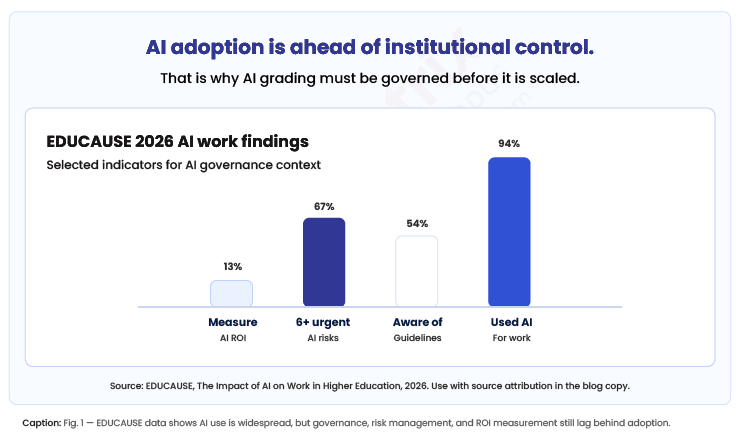
Assessment is one of the most trust-sensitive academic processes in a university. EDUCAUSE’s 2026 research shows on AI and work in higher education, which found widespread AI use alongside much lower awareness of institutional policies governing that use. For grading, that gap matters because experimentation can move quickly from individual productivity into decisions that affect students. An institution should know where academic authority sits before an AI-assisted judgement reaches the gradebook.
Why AI Grading Cannot Be Treated as Simple Automation
Some assessment tasks are naturally suited to automation.
An objective quiz with predefined answers can be scored according to established rules. That is very different from evaluating an essay, clinical judgement, design project, presentation, capstone, or other performance requiring interpretation.
In those assessments, the marker is not simply checking whether an answer matches.
They are interpreting evidence against academic criteria.
That distinction can disappear when AI grading is discussed primarily as a productivity tool.
A student essay is not merely text to classify. A rubric is not simply a checklist for a model to complete. Feedback is not useful simply because it was generated quickly.
AI may help process information, surface patterns, or support an evaluator.
But a grade cannot become less explainable simply because it became faster to produce.
Where AI Can Actually Help Faculty
The strongest opportunities may sit around academic judgement rather than replacing it.
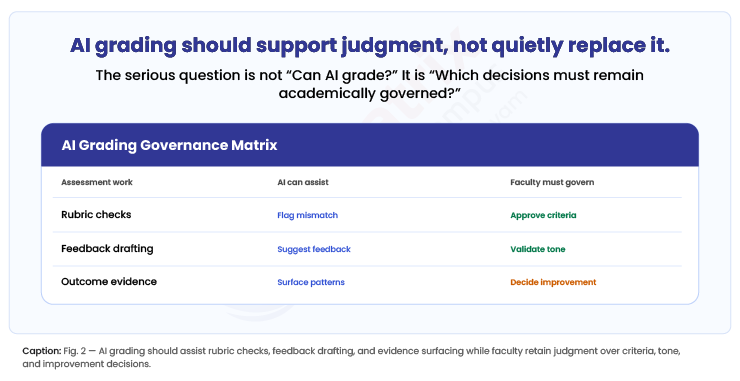
Depending on the assessment type and the institution's policies, AI can potentially help faculty draft feedback, identify recurring misconceptions, highlight possible rubric mismatches, compare patterns across a large cohort, or draw attention to scoring inconsistencies that deserve review.
Consider a faculty member grading 150 submissions.
The valuable AI question may not be:
“Can you grade these 150 students for me?”
It may be:
“Can you help me see where students are making the same mistake, where my rubric may be producing inconsistent interpretations, or where I should look more closely?”
That preserves an important distinction.
AI deals with scale.
Faculty retain responsibility for meaning.
This is where assessment evidence matters. AI-assisted work should strengthen the institution's ability to understand student performance without making the basis of the judgement harder to follow.
Efficiency should remove repetitive effort around academic judgement, not remove academic judgement from the process.
What Must Remain Academically Governed
The critical governance question is not whether AI touches grading.
It is how far its authority extends.
| AI may assist with | Academic authority still needs to govern |
| Drafting possible feedback | What good feedback should contain |
| Highlighting rubric patterns | Rubric design and interpretation |
| Surfacing unusual scoring patterns | Whether a score actually needs adjustment |
| Identifying common learner difficulties | What those difficulties mean academically |
| Supporting repetitive evaluation tasks | Final judgement where human review is required |
| Summarising performance patterns | Decisions made because of those patterns |
Institutions also need clear ownership of criteria weighting, grading thresholds, moderation, re-evaluation, appeals, acceptable evidence, and the appropriate use of student information.
This becomes especially important when students challenge a result.
The institution should be able to answer:
Who made the academic decision?
What criteria were used?
Where did AI contribute?
Was its contribution reviewed?
Can the decision be reconsidered through the institution's normal academic process?
AI can participate in an assessment workflow. It should not make institutional accountability disappear inside the workflow.
What AI Grading Governance Should Include
Good governance does not begin with a 40-page AI policy nobody remembers.
It begins with practical decisions about how assessment will actually work.
Before scaling AI-supported grading, institutions should define:
- which assessment types permit AI assistance,
- which uses require faculty review,
- whether AI may suggest or influence marks,
- how rubrics and grading criteria are validated,
- what quality checks apply to generated feedback,
- how inconsistent or biased outputs are identified and reviewed,
- when and how students are informed about AI involvement,
- how student information may be processed,
- how re-evaluation and appeals work,
- what records need to remain available for later review.
This governance also needs to connect with outcome-based education.
If grading contributes to outcome-attainment evidence, the institution needs confidence not only in the resulting score but in how that score was produced.
The same is true for accreditation readiness. Assessment evidence becomes difficult to defend when the institution cannot explain the judgement behind it.
The institution does not need to prove that AI never participated. It needs to prove that academic responsibility never became ambiguous.
Where Creatrix Campus Fits
This is where the distinction around Creatrix Campus matters.
Creatrix Campus supports AI-assisted assessment while keeping academic judgement and final grading with faculty. More relevant here are the assessment capabilities that strengthen consistency, feedback, and evidence.
Creatrix Campus supports assessment processes including rubric-based assessment, outcome-linked assessment, grading workflows, evaluator and grade-approver roles, faculty feedback, marks moderation, re-evaluation, grade revisions with audit trails, and assessment activity tracking.
Those capabilities matter even more if an institution begins introducing AI into parts of the assessment process.
For Assessment leaders, defined rubrics and workflows create boundaries around evaluation. For faculty, feedback and grading remain attached to the academic process. For Deans and QA teams, moderation and re-evaluation provide mechanisms for review. Outcome mapping helps assessment evidence remain connected to what students were expected to learn.
The value is not “AI grades for you.”
It is having enough academic governance around grading that AI assistance does not weaken the institution's ability to review, moderate, explain, and defend the result.
Conclusion
AI can reduce parts of the grading burden, but higher education should not exchange workload efficiency for weaker academic accountability. Institutions need to decide where AI may assist, where faculty judgement must remain decisive, and how every consequential assessment decision can still be reviewed and explained.
If a student challenged an AI-assisted grade tomorrow, could your institution clearly show what AI contributed, what the faculty member decided, and how that decision can be reviewed? Build governed assessment intelligence.
Quick recap
AI-powered grading becomes safer and more useful when universities govern academic authority before scaling automation. AI may help faculty work through volume, surface patterns, and prepare feedback, but rubrics, final judgement, moderation, appeals, data use, and outcome interpretation still need clear institutional ownership. The question is not how much grading AI can do. It is how much responsibility the university is prepared to delegate without losing the ability to explain the result.
Frequently asked questions
What is AI-powered grading?
Can AI replace faculty grading?
What are the main risks of AI-assisted grading?
How can AI improve assessment feedback?
How does AI grading connect to learning outcomes?
How can Creatrix Campus support governed AI-assisted assessment?
Join the conversation
Want to contribute?
We welcome thought leaders to share ideas and write for our blog.
Become a guest author