

On this page
Admissions backlogs are usually blamed on volume.
More applications arrive. Review teams become stretched. Faculty have limited time. Leaders ask how decisions can move faster.
But look at what reviewers are often doing.
They open a file and discover an unresolved document. They check whether a qualification meets programme requirements. They wait for another office to confirm something. They receive cases that could have been handled administratively before academic judgement was needed.
The institution calls it a review backlog.
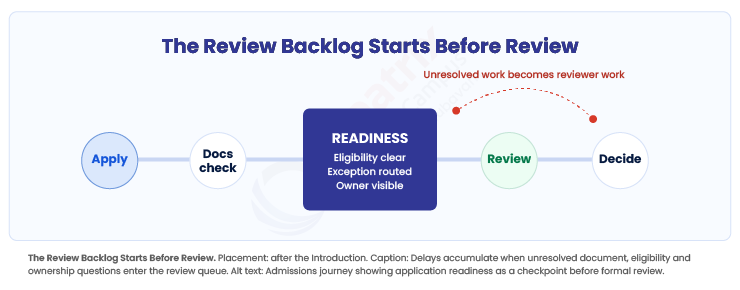
Much of it is actually a readiness backlog.
The problem is not always how slowly reviewers decide. It is how much unresolved work reaches them before they can decide.
Quick answer
Admissions application review delays often begin before formal evaluation. A stronger process resolves document requirements, routine eligibility checks, ownership, exceptions, and reviewer routing before applications reach the people responsible for academic judgement. Faster review comes from reducing false starts, not asking reviewers to make important decisions faster.
Article summary
| Problem | Reviewers inherit applications with unresolved documents, eligibility questions, ownership, or exceptions. |
| Who this is for | Enrollment leaders, Admissions Directors, Registrars, Faculty Reviewers, International Admissions teams, and CIOs. |
| What changes | Admissions separates application preparation from academic judgement. |
| Why it matters | Review capacity is wasted when professional judgement is interrupted by administrative investigation. |
| Outcome | Fewer false starts, clearer ownership, faster decisions, and stronger auditability. |
Key takeaways
- Admissions backlogs often begin upstream of the review committee.
- A complete application is not necessarily decision-ready.
- Routine rules should remove avoidable interpretation, not replace human judgement.
- Exceptions need visible ownership rather than private email chains.
- Reviewers should spend more time judging applications and less time preparing them to be judged.
Why Review Speed Is the Wrong First Question
Imagine a faculty reviewer opening ten applications.
Four are fully ready for academic judgement.
Two have unresolved document questions.
One needs an international qualification checked.
Two require an exception decision from another authority.
One has been assigned to the wrong reviewer.
On paper, there are ten applications waiting for review.
Operationally, there are only four.
That distinction changes how leaders should think about the backlog.
A queue is not useful simply because it shows how many files are waiting. It should show what each file is waiting for.
Otherwise, Admissions Directors see volume but not the cause of delay.
Complete Is Not the Same as Decision-Ready
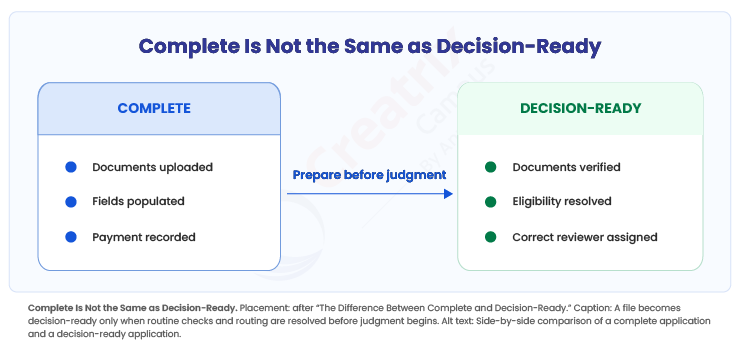
An applicant can upload every requested document and still not be ready for a decision.
Completeness asks:
Is everything present?
Readiness asks:
Has the routine work been resolved so the right person can exercise judgement?
| Application status | What may still need to happen |
| Documents uploaded | Required documents still need verification |
| Entry qualification provided | Eligibility still needs to be established |
| Portfolio submitted | Appropriate reviewer still needs assignment |
| Routine criteria satisfied | Exception may still require approval |
| Application marked complete | Decision authority may still lack required context |
This is where admissions time quietly disappears.
A document gets checked twice because the first verification was not visible. A policy is interpreted differently by two people. An exception is approved through email but does not remain attached clearly to the application.
Individually, these look like small delays.
Together, they turn admissions professionals into investigators of their own process.
What Should Be Resolved Before Review
The goal is not to automate the admission decision.
It is to remove avoidable work surrounding that decision.
Before a file reaches an academic or senior reviewer, the process should make clear:
- whether required documents are present and verified,
- whether routine eligibility requirements have been resolved,
- whether an exception exists,
- who owns that exception,
- which reviewer or panel is responsible,
- what stage the application is in,
- and what happened at previous stages.
Creatrix Campus supports this operating model with configurable application and document requirements, a central verification workspace, verification checklists, role-based workflows, programme-specific policies, automated status updates, panel assignments, and a complete application activity history.
That gives automation the right job.
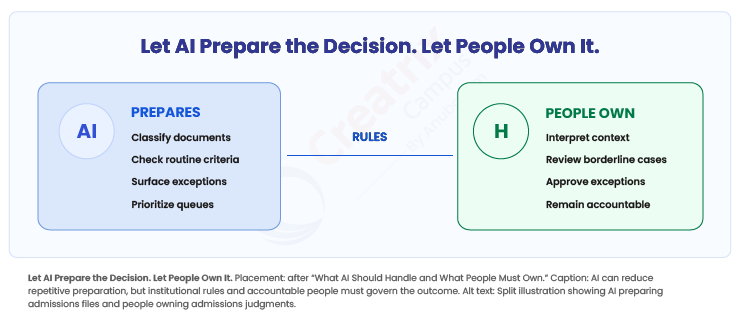
Automate what can be governed by agreed rules. Preserve human judgement where context matters.
This is also a better way to think about AI.
AI or automation may assist institutions with repetitive preparation where an approved capability exists. But the important admissions decisions, exceptions, and contextual judgements still need accountable institutional ownership.
The test is not whether technology made the process faster.
It is:
Can the university still explain what happened, which rule applied, what required judgement, and who was responsible?
Where Creatrix Campus Fits
Creatrix Campus approaches Admissions as a lifecycle:
Prospect → Application → Decision → Offer → Enrollment.
That matters because application review is not an isolated task.
Creatrix Admissions capabilities include application tracking, configurable admission workflows, role-based permissions, document submission and verification, programme-specific document requirements, verification history, panel assignment, offer management, and applicant-to-student profile transition.
Through student admission management, the application can therefore carry its status, documents, workflow context, and history as it moves toward decision and enrollment.
The value is not simply processing applications faster.
It is reducing the number of times reviewers have to stop, search, clarify, or reconstruct what should already have been settled.
And that protects something more important than speed:
the quality of the judgement itself.
Conclusion
Admissions teams should not have to choose between faster decisions and careful decisions. The trade-off appears when reviewers inherit administrative preparation, unresolved exceptions, and fragmented context along with the application itself.
If you opened your review queue today, how many applications are genuinely waiting for a decision, and how many are actually waiting to become decision-ready? Explore how Creatrix Campus can reduce avoidable admissions review delays.
Quick recap
Admissions backlogs often start before formal review. The stronger model distinguishes application completeness from decision readiness, resolves routine requirements earlier, routes exceptions clearly, and gives reviewers the context they need before judgement begins. The fastest review process is not the one where people decide faster. It is the one with fewer false starts.
Frequently asked questions
Why are university admissions application reviews delayed?
What does application readiness mean?
Is a complete application always ready for review?
Should universities automate admissions decisions?
How can universities reduce admissions backlogs?
How does Creatrix Campus support admissions review?
Join the conversation
Want to contribute?
We welcome thought leaders to share ideas and write for our blog.
Become a guest author